
Introduction to Vocabulary for IELTS Speaking
Many IELTS candidates believe that better speaking scores come from learning more vocabulary.
They spend weeks memorising long word lists, idioms, and so-called “Band 8 phrases”, only to freeze in the test or sound unnatural when they try to use them. Others avoid anything beyond basic vocabulary because they are afraid of making mistakes.
The reality is that IELTS speaking vocabulary is not about sounding impressive. It is about sounding clear, natural, and appropriate while communicating ideas smoothly.
This lesson explains what examiners actually listen for when assessing vocabulary in IELTS Speaking, why memorised language often lowers scores, and how to build vocabulary that works naturally in real speaking situations.
Practise English every weekday with me
Get short Mon–Fri English practice in LINE with LEW Daily, plus regular feedback to help you improve.
Explore LEW DailyNT$399/month • Cancel anytime

How vocabulary is assessed in IELTS Speaking
Vocabulary is assessed under the criterion Lexical Resource. Examiners are not counting advanced words or ticking off idioms.
Instead, they listen for how effectively you use words to express ideas, avoid unnecessary repetition, and respond flexibly to different questions. Vocabulary is judged in context, not in isolation.
A candidate using mostly common words can score well if those words are accurate, well chosen, and used naturally. A candidate using “advanced” vocabulary poorly often scores lower.
Why memorised vocabulary fails in speaking
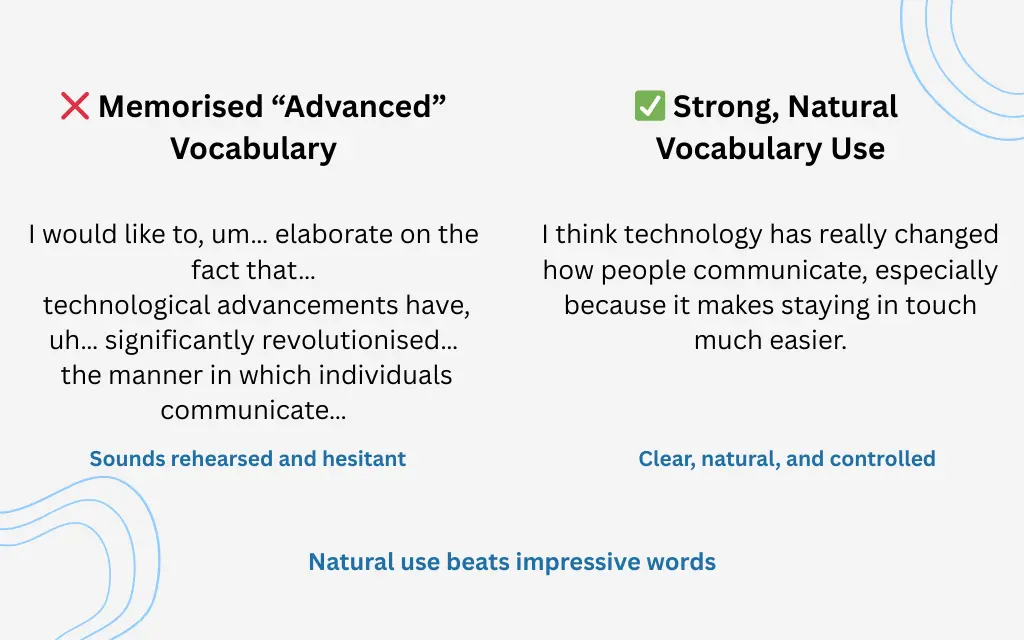
Memorised vocabulary causes problems because it interrupts natural speech.
When candidates rely on prepared phrases, they often pause unnaturally to recall them, insert words that do not fit the question, or repeat the same expressions across different answers. This makes speech sound rehearsed rather than conversational.
Examiners notice this immediately. IELTS Speaking rewards communication, not performance.
Spoken vocabulary is different from written vocabulary
Many candidates apply writing strategies to speaking, which creates confusion.
Spoken English uses shorter sentences, more personal language, and natural repetition. Vocabulary that works well in essays can sound stiff or unnatural when spoken aloud.
Examiners are listening for spoken English, not spoken essays.
What examiners mean by “range” in speaking
Range in speaking does not mean rare or difficult words.
It means being able to adjust vocabulary as ideas change, paraphrase naturally when needed, and choose words that suit personal, factual, or abstract topics.
A speaker with good range sounds flexible and responsive, not rehearsed.
What strong IELTS speaking vocabulary sounds like
Strong speaking vocabulary is usually built from familiar words used well.
It sounds natural, topic-appropriate, and controlled. Ideas are paraphrased smoothly rather than replaced with memorised synonyms.
This is why many Band 7+ speakers use relatively simple vocabulary but use it accurately and confidently.
Vocabulary problems that reduce speaking scores
Vocabulary lowers scores when problems become patterns rather than occasional slips.
Common issues include repeating the same word again and again, using words with the wrong meaning, forcing idioms unnaturally, or relying on memorised phrases that do not answer the question.
These issues interfere with clarity and natural flow, which affects multiple assessment criteria.
Why repetition is not always a problem
Candidates often worry about repeating words, but repetition is normal in natural speech.
Examiners do not penalise occasional repetition. It only becomes a problem when it signals limited control, prevents idea development, or appears across multiple answers without variation.
Natural repetition sounds different from restricted vocabulary.
Vocabulary across the three speaking parts
Vocabulary expectations increase gradually across the test.
In Part 1, everyday vocabulary is expected and sufficient.
In Part 2, descriptive language supports storytelling and detail.
In Part 3, more abstract vocabulary helps explain opinions and trends.
Progression matters more than sophistication.
Topic vocabulary vs memorised vocabulary
Topic-specific vocabulary can be helpful when it arises naturally from the question.
For example, when discussing work, education, or technology, relevant vocabulary often appears without effort. Problems occur when candidates force memorised topic lists into unrelated questions.
Vocabulary should respond to the question, not override it.
How paraphrasing works in speaking
Paraphrasing in speaking is simpler than in writing.
It usually involves explaining ideas differently, changing verbs, or adjusting sentence structure rather than searching for complex synonyms.
Natural paraphrasing sounds conversational, not planned.
Collocations matter more than rare words
Examiners listen closely to how words combine.
Natural collocations make speech sound fluent and controlled, even when vocabulary is simple. Using common words accurately together is far more effective than using rare words incorrectly.
Accuracy within familiar word combinations matters more than advanced vocabulary.
Idioms: when they help and when they hurt
Idioms are not required in IELTS Speaking.
They only help when they are fully understood, used naturally, and appropriate for the topic. Forced idioms often damage fluency and clarity.
Examiners do not reward idioms simply for being idioms.
Why simpler vocabulary often scores higher
Clear vocabulary supports fluency, idea development, and confidence.
When candidates stop worrying about sounding advanced, they usually speak more smoothly and accurately. This improves multiple assessment criteria at once.
Improving vocabulary for speaking naturally
Vocabulary improves fastest when it is used, not memorised.
Speaking aloud on familiar topics, practising full answers rather than single words, and noticing how ideas are expressed in real speech are far more effective than learning lists.
Vocabulary grows through use and confidence.
Listening like an examiner
When reviewing your speaking, try listening from the examiner’s perspective.
Does the vocabulary fit the question? Do the words support the idea? Does the speech sound natural and clear?
This shifts focus from vocabulary quantity to vocabulary quality.
Confidence and vocabulary choice
Confidence strongly influences vocabulary use.
When candidates feel relaxed, vocabulary flows naturally. When nervous, they rely on memorised phrases or avoid speaking freely.
Trusting familiar vocabulary builds confidence faster than constantly learning new words.
Conclusion
IELTS speaking vocabulary is not about memorising advanced words or sounding impressive.
It is about choosing words that fit the situation, support your ideas, and sound natural when spoken aloud. When vocabulary serves communication rather than performance, examiners reward clarity, control, and confidence.
Related IELTS Speaking Lessons
Glossary
Vocabulary (noun) — the words a person uses when speaking
Lexical resource (noun) — how effectively vocabulary is used
Collocation (noun) — words that commonly appear together
Paraphrasing (noun) — expressing the same idea using different words
Idioms (noun) — fixed expressions with non-literal meanings
Comprehension & Practice Questions
True or False: Examiners reward memorised vocabulary lists in speaking.
Multiple choice: What matters most in speaking vocabulary?
A) Rare words
B) Natural use
C) Idioms
Short answer: Why does forced vocabulary lower scores?
True or False: Some repetition is natural in spoken English.
Short answer: What should vocabulary support in speaking answers?
Answers
False
B
It disrupts fluency and clarity
True
Communication and meaning
Join 1,300+ English learners
Get free English lessons, IELTS tips and useful vocabulary by email.
No spam. Just practical English you can use.