
How to Reach Band 7 in IELTS Listening: A Clear and Achievable Strategy
Reaching Band 7 in IELTS Listening does not require perfection or native-level fluency. It requires control. Candidates who achieve this score understand the structure of the test, manage their attention carefully, and avoid the small technical errors that cost marks unnecessarily.
Many students believe that band 7 IELTS listening demands complete comprehension of every word. In reality, Band 7 is achieved through consistency rather than perfection. You need to understand enough information accurately and maintain focus throughout all four sections.
This lesson explains what Band 7 truly represents, how to improve your IELTS listening score step by step, and which listening band strategy produces reliable results.
Practise English every weekday with me
Get short Mon–Fri English practice in LINE with LEW Daily, plus regular feedback to help you improve.
Explore LEW DailyNT$399/month • Cancel anytime

What Does Band 7 in IELTS Listening Mean?
Before developing a strategy, you must understand the score requirement.
In most IELTS tests, Band 7 in Listening requires approximately 30 correct answers out of 40. This means you are allowed to make several mistakes and still achieve your target.
Band 7 listeners are not flawless. They are consistent. They manage timing effectively, recover quickly after small errors, and protect secure marks in easier sections.
Band 7 reflects stability under exam conditions.
The Difference Between Band 6.5 and Band 7
Many candidates remain at Band 6.5 for long periods. The difference between 6.5 and 7 is rarely vocabulary. It is usually precision and control.
Band 6.5 candidates often:
- Miss plural endings
- React too quickly to distractors
- Panic after one missed answer
- Lose focus in Sections 3 or 4
Band 7 candidates tend to:
- Wait for final confirmation
- Check spelling and word limits carefully
- Move on quickly after a missed detail
- Stay mentally present in longer sections
The gap is strategic rather than linguistic. Improving your IELTS listening score at this level means refining habits, not expanding vocabulary lists.
Building a Band 7 Listening Strategy
An effective listening band strategy focuses on three core skills: accuracy, attention, and recovery.
1. Accuracy: Reducing Technical Errors
At this level, many lost marks come from small but avoidable mistakes:
- Spelling errors
- Missing plural endings
- Incorrect word limits
- Misheard numbers
For example:
Recording:
“The total cost is thirty-five pounds.”
If you write “30 pounds”, the error is not comprehension — it is detail control.
To reach band 7 IELTS listening, careless errors must be reduced first. Precision protects marks.
2. Attention: Following Meaning to the End
Band 7 listeners understand that the first idea mentioned is not always correct.
For example:
“We initially planned to expand the building, but in the end we decided to renovate it instead.”
A weaker candidate may write “expand” immediately. A stronger candidate waits for the final confirmed decision.
Attention means listening until the idea is complete. It also means remaining focused during Section 4, where information is delivered continuously and often at a faster pace.
You do not need to understand every word. You need to understand the information that answers the questions.
3. Recovery: Protecting the Next Answer
Recovery is one of the most underestimated skills in IELTS Listening.
If you miss one answer, you must move forward immediately. Answers appear in order. If Question 12 has passed, Question 13 is coming next.
Band 7 candidates accept small losses and protect future marks. They do not allow one missed detail to damage three additional answers.
This mindset reflects maturity and control under pressure.
Securing Marks in Sections 1 and 2
Sections 1 and 2 often include form completion, numbers, names, and straightforward information. These sections provide valuable opportunities to secure marks early in the test.
If you lose points here due to spelling or plural errors, you create unnecessary pressure in later sections.
Targeted practice should therefore include:
- Distinguishing similar numbers (fifteen vs fifty)
- Writing names accurately
- Respecting word limits
Consistency in the early sections builds confidence for the more demanding parts of the test.
Managing Sections 3 and 4
Sections 3 and 4 present greater challenges.
Section 3 includes multiple speakers and changing opinions. Expect clarification and correction.
Section 4 is typically a lecture delivered by one speaker. The information flows continuously, and answers may appear in quick succession.
Band 7 listeners anticipate these patterns. They expect changes of opinion in Section 3 and structured topic progression in Section 4. Understanding these patterns helps you follow the audio with greater confidence.
Practising Effectively
To improve IELTS listening score, practice must be deliberate.
Instead of completing many tests without review:
- Complete one full listening test.
- Analyse every incorrect answer.
- Identify the type of error:
- Detail accuracy
- Distractor
- Spelling
- Timing
- Detail accuracy
- Write down recurring patterns.
For example, if you repeatedly lose marks due to plural endings, that becomes your immediate focus.
Band 7 performance develops through targeted correction rather than repetition alone.
A Calm Exam-Day Approach
On exam day, remember that you do not need a perfect test. Approximately 30 correct answers are sufficient.
Focus on process:
- Use preparation time carefully.
- Follow the audio logically.
- Let go of missed answers quickly.
- Use checking time systematically.
Anxiety often causes careless mistakes. Confidence reduces them.
A Realistic Four-Week Plan
If you are currently scoring Band 6 or 6.5, reaching Band 7 is realistic with focused practice.
Week 1: Eliminate spelling, plural, and number errors.
Week 2: Practise recognising distractors and confirmation language.
Week 3: Complete full tests under timed conditions.
Week 4: Simulate exam conditions and refine weak areas.
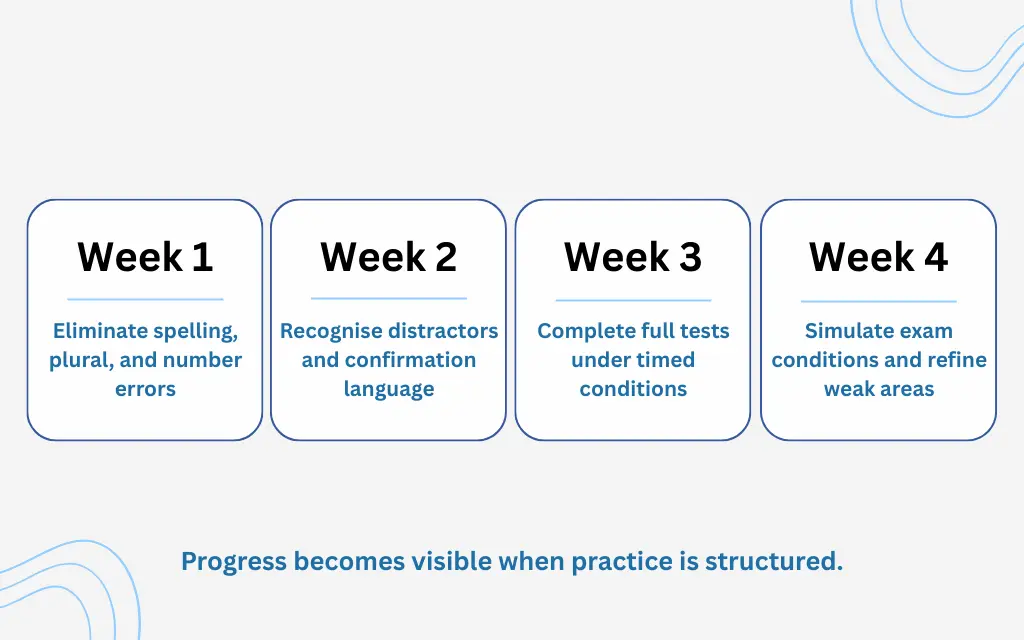
Progress becomes visible when practice is structured.
Conclusion
Band 7 IELTS listening is not about advanced vocabulary or exceptional speed. It is about disciplined listening and consistent control.
When you learn to:
- Reduce careless technical errors
- Wait for final meaning
- Recover quickly after mistakes
- Practise strategically
- Stay calm under pressure
you move from inconsistency to stability.
To continue building your listening band strategy, explore the related lessons linked below. Band 7 is not achieved by luck. It is achieved by control.
Related IELTS Listening Lessons
Glossary
Band Score (n.)
A score from 0 to 9 representing performance in IELTS.
Consistency (n.)
Maintaining a stable level of performance without large fluctuations.
Recovery (n.)
The ability to continue effectively after a mistake.
Precision (n.)
Careful accuracy in small details.
Strategy (n.)
A planned method for achieving a goal.
Practice Section
Questions
- (True/False) You need 40 out of 40 to achieve Band 7 in IELTS Listening.
- (MCQ) Band 7 candidates usually avoid losing marks due to:
A. Vocabulary weakness
B. Careless errors
C. Lack of grammar
D. Accent differences - (Short Answer) Why is recovery important during the Listening test?
- (MCQ) Section 1 is often considered:
A. The most difficult section
B. A secure opportunity for accurate marks
C. Impossible to prepare for
D. Random - (True/False) Band 7 requires perfection.
Answers
- False
- B
- Because moving on quickly prevents losing multiple marks after one mistake.
- B
- False
Join 1,300+ English learners
Get free English lessons, IELTS tips and useful vocabulary by email.
No spam. Just practical English you can use.