
Introduction to Selecting Data in IELTS Task 1
One of the biggest misunderstandings in IELTS Task 1 is the belief that a good answer must describe everything. Candidates look at a chart, graph, or table and feel pressure to mention every number, every category, and every small change.
This instinct is exactly what holds scores back.
In reality, IELTS Task 1 is not a test of how much data you can describe. It is a test of data selection. Examiners care deeply about what you choose to include, what you group together, and what you leave out.
Understanding IELTS Task 1 data selection changes how you approach the task. Instead of translating numbers into sentences, you start making decisions, the same decisions examiners are trained to value.
This lesson will explain how to select data effectively in Task 1, what examiners expect you to prioritise, and why ignoring some information is not only acceptable, but necessary for higher bands.
Practise English every weekday with me
Get short Mon–Fri English practice in LINE with LEW Daily, plus regular feedback to help you improve.
Explore LEW DailyNT$399/month • Cancel anytime

Why Data Selection Matters More Than Description
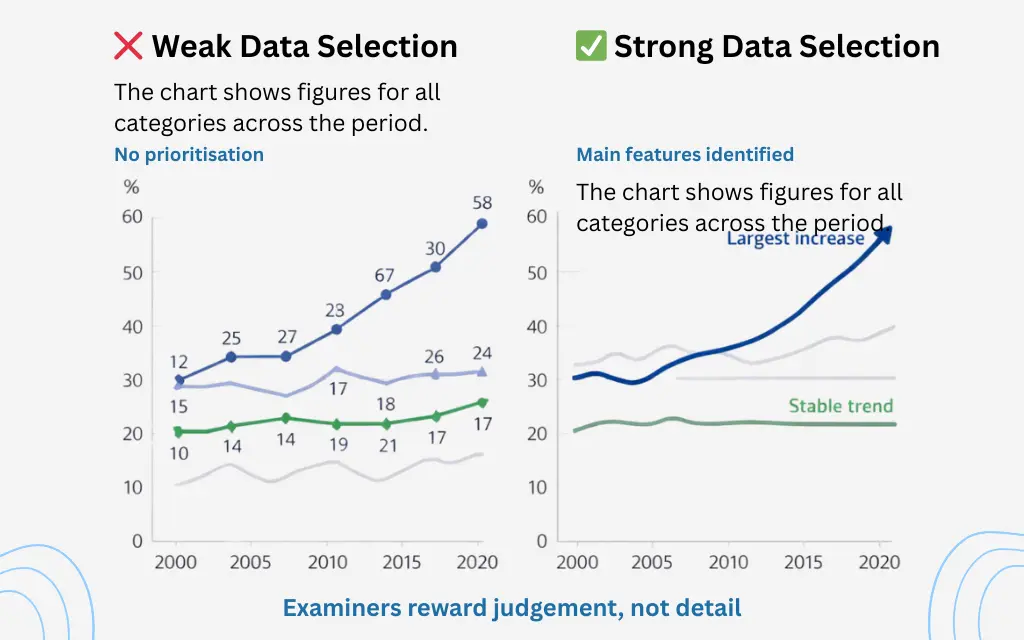
Examiners read Task 1 responses with one core question in mind: Has the candidate identified and prioritised the main features?
This means they are not impressed by long lists of figures or chronological descriptions that treat all data as equally important. They are looking for judgement.
When data selection is weak, writing often becomes:
- Overloaded with numbers
- Difficult to follow
- Lacking in comparison
When data selection is strong, writing feels purposeful and controlled, even if it is shorter.
What Examiners Mean by “Key Features”
The phrase key features appears repeatedly in IELTS band descriptors, but it is often misunderstood.
Key features are not simply the highest and lowest numbers. They are the most meaningful patterns in the data.
These may include:
- Overall trends (increase, decrease, stability)
- Major contrasts between categories
- Notable changes over time
- Clear differences between groups
What matters is significance, not visibility.
Why Describing Everything Lowers Your Score
Many candidates believe that missing data equals missing marks. Examiners see the opposite.
Describing everything often signals:
- Lack of overview
- Poor prioritisation
- Weak Task Achievement
Examiners do not penalise you for ignoring minor details. They penalise you for failing to distinguish between important and unimportant information.
This is why data selection sits at the heart of Task Achievement.
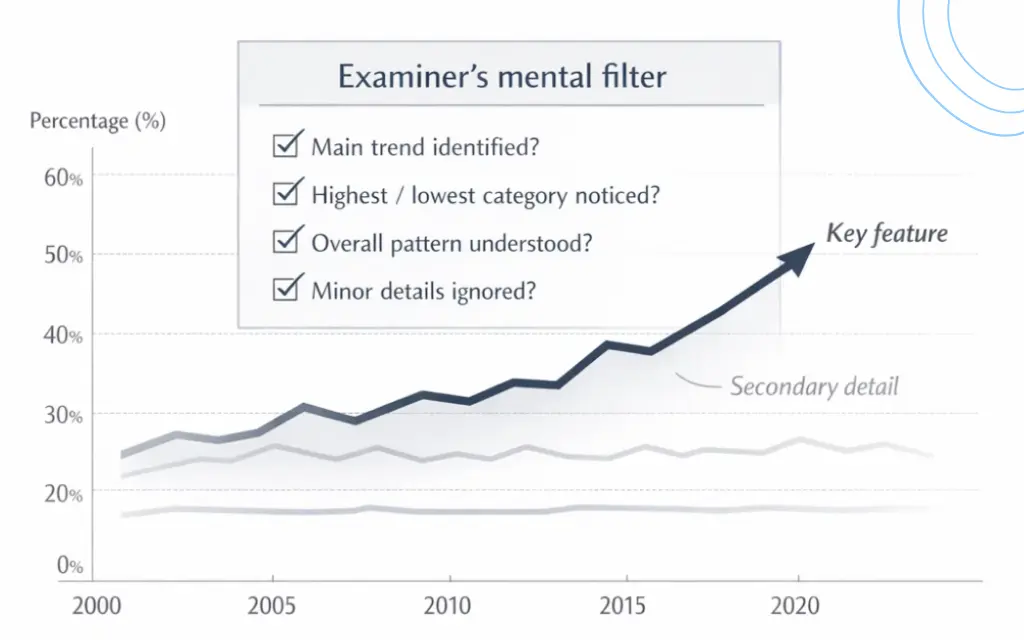
The Examiner’s Mental Filter
When examiners look at a Task 1 response, they mentally filter the data themselves.
They already know what the main features are. They want to see whether you have identified the same ones.
If your response focuses on secondary details while missing major patterns, examiners immediately notice the mismatch.
Selecting Data Starts Before Writing
Good data selection happens before you write your first sentence.
When you first look at the visual, pause and ask:
- What is changing overall?
- Which categories behave similarly?
- Which differences are most striking?
This thinking stage is more important than sentence construction.
Candidates who rush into writing often end up describing rather than selecting.
Grouping Data Instead of Listing It
One of the clearest signs of strong data selection is grouping.
Rather than describing each category separately, higher-band responses group similar trends together. This allows for comparison and reduces repetition.
For example, instead of treating four categories as four separate stories, a strong response might group two increasing trends and contrast them with two declining ones.
This grouping shows examiner-valued judgement. For a worked example of selecting and grouping figures from rows and columns, read our IELTS Task 1 table sample answer.
What Data Can Safely Be Ignored
A common fear is ignoring something “important”.
In Task 1, it is usually safe to ignore:
- Small fluctuations that do not affect the overall trend
- Minor differences between very similar figures
- Redundant data that does not add insight
Ignoring these allows you to focus on what matters most.
Examiners do not expect exhaustive coverage. They expect intelligent selection.
The Role of the Overview in Data Selection
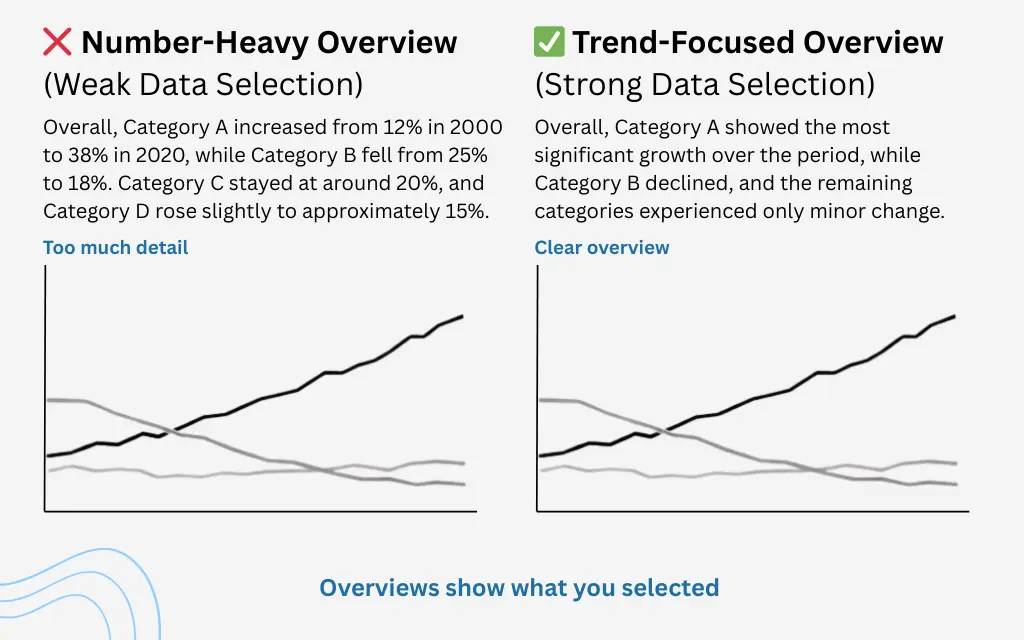
The overview is where data selection becomes most visible.
A strong overview:
- Summarises the main trends
- Avoids specific numbers
- Reflects the examiner’s own understanding of the data
If your overview includes too much detail, it usually means data selection has not happened properly yet.
Data Selection and Paragraph Structure
Paragraphing in Task 1 should reflect your data selection choices.
Each paragraph should focus on:
- One main trend
- One comparison set
- One clear relationship
If a paragraph tries to include unrelated data points, it often becomes confusing and weakens coherence.
Strong data selection leads naturally to clearer paragraphs.
Selecting Data in Different Task 1 Visuals
Although the visuals vary, the principle of data selection remains the same.
In time-based visuals, selection often focuses on direction and scale of change. In category-based visuals, selection often focuses on contrast and ranking.
The mistake many candidates make is changing strategy completely depending on the visual. Examiners are looking for consistent judgement across all types.
Why Numbers Matter Less Than Relationships
Another common misconception is that examiners value numerical accuracy above all else.
Accuracy matters, but relationships matter more.
Examiners care about:
- How categories compare
- Whether trends are identified correctly
- Whether proportions are understood
You can include very few numbers and still score well if relationships are clear.
Common Data Selection Mistakes
Weak data selection often shows up as:
- One sentence per category, regardless of importance
- Chronological narration without comparison
- Excessive use of figures with little analysis
These patterns signal description rather than interpretation.
How Data Selection Affects Band Scores
At lower bands, candidates tend to describe data mechanically. At higher bands, candidates interpret data selectively.
This difference alone can raise a response from Band 6 to Band 7, even if grammar and vocabulary remain similar.
Examiners reward insight more than effort.
Practising Data Selection Effectively
To practise data selection, try this exercise:
- Look at a Task 1 visual
- Write only the overview
- Ask whether it captures the most important features
If the overview feels clear and balanced, your data selection is likely strong.
Why Examiners Care So Much About This Skill
Data selection mirrors real-world academic skills. In academic writing, professionals do not report every detail — they select what matters.
IELTS Task 1 reflects this expectation. This is why examiners care deeply about data selection and why it appears implicitly in band descriptors.
Conclusion
Understanding IELTS Task 1 data selection is one of the fastest ways to improve your score.
Examiners are not looking for more language or more numbers. They are looking for better judgement. When you learn what to include and what to ignore, your writing becomes clearer, more focused, and more examiner-friendly.
To build on this skill, explore the related Learn English Weekly Task 1 guides linked below, especially those focusing on overviews and examiner marking.
Related IELTS Task 1 Lessons
Glossary
Data selection (noun) — Choosing which information to include
Key features (noun) — The most important patterns or trends
Overview (noun) — A summary of main trends without detail
Task Achievement (noun) — How well the task requirements are met
Grouping (noun) — Combining similar data for comparison
Comprehension / Practice Questions
- True or False: IELTS Task 1 requires describing all data points.
- What do examiners value more?
A) Quantity of data
B) Quality of selection - Why is grouping data effective?
- Short answer: Name one type of data that can often be ignored.
- True or False: Numbers are more important than relationships.
Answers
- False
- B
- It highlights comparisons and reduces overload
- Minor fluctuations / redundant details
- False
Join 1,300+ English learners
Get free English lessons, IELTS tips and useful vocabulary by email.
No spam. Just practical English you can use.