
Introduction to How to Fully Answer the Question in IELTS Task 2
IELTS candidates leave the exam room believing they have written a solid Task 2 essay, only to receive a score that feels unfairly low. When this happens, examiners’ comments are often frustratingly vague: “task not fully addressed” or “position unclear”.
In most cases, the issue is not grammar or vocabulary. It is the failure to answer the question in IELTS Task 2 fully and precisely.
This is one of the most examiner-critical skills in the writing test. You can write fluent English and still lose significant marks if you misunderstand the task or respond only partially. This lesson will explain what “answering the question” really means in IELTS Task 2, how examiners judge it under task response, and how to avoid the most common traps that keep scores stuck at Band 6 or 6.5.
Practise English every weekday with me
Get short Mon–Fri English practice in LINE with LEW Daily, plus regular feedback to help you improve.
Explore LEW DailyNT$399/month • Cancel anytime

What “Answering the Question” Really Means in IELTS
Answering the question is not about writing on the general topic. It is about responding to the exact instructions in the task.
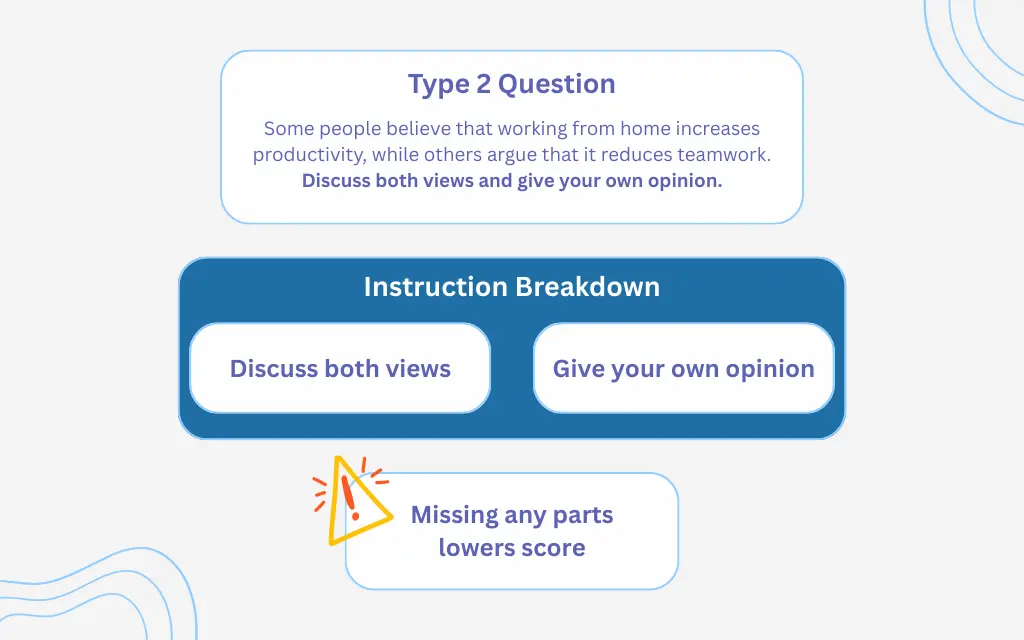
Every Task 2 question contains one or more requirements. Examiners expect you to identify all of them and address them clearly in your essay. If even one part is ignored or misunderstood, your task response score drops.
This is why some essays feel relevant but still score poorly. They discuss the topic, but they do not complete the task.
Why Task Response Is So Heavily Penalised
Task response is one of the four equally weighted marking criteria. However, it has a unique power: weak task response can cap the entire score, even if other areas are strong.
Examiners cannot reward language skill fully if the task itself is not completed. An essay that misunderstands the question may never rise above Band 6, regardless of how accurate or fluent it sounds.
This is why examiner reports often emphasise “answering the question” more than any other skill.
How Examiners Decide Whether You Answered the Question
Examiners do not search for keywords. They look for clear evidence that you understood the task.
They ask themselves:
- Did the writer address all parts of the question?
- Is the position clear where required?
- Is the response relevant throughout the essay?
If the answer to any of these is uncertain, the task response score drops.
Importantly, examiners decide this early. If the introduction or first body paragraph shows misunderstanding, that impression is hard to reverse.
Common Ways Candidates Fail to Answer the Question
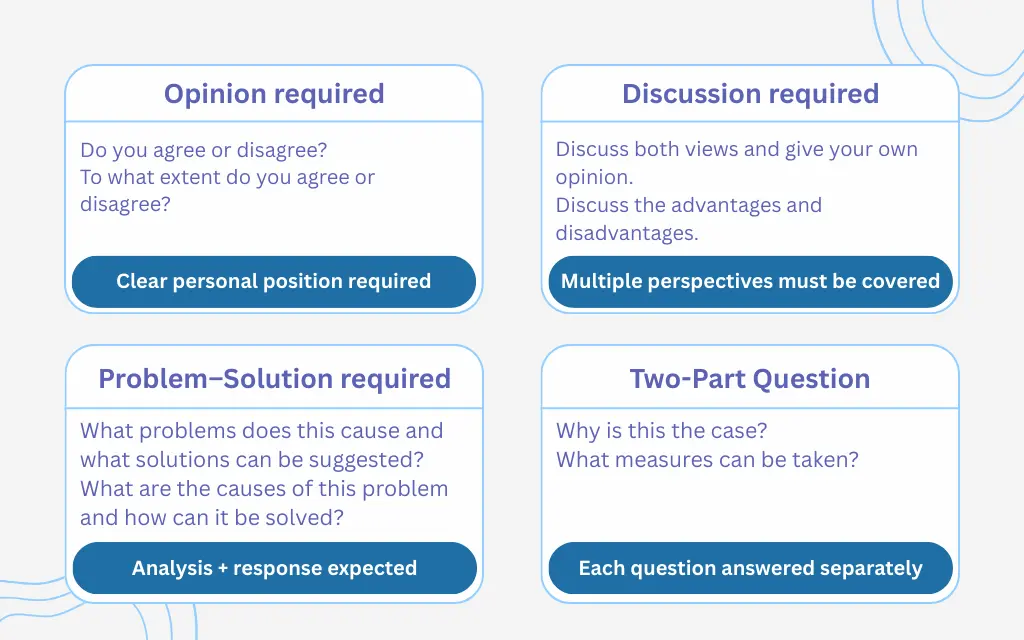
One frequent problem is misinterpreting the question type. Candidates may treat an opinion question like a discussion, or a problem-solution task like an advantages-disadvantages essay.
Another common issue is partial response. For example, a question may ask you to discuss both sides and give your opinion, but the essay only discusses the sides without a clear conclusion.
A third issue is drifting away from the task. Essays sometimes begin well but gradually shift focus, especially in longer body paragraphs.
Understanding Task Instructions Properly
Every Task 2 question uses specific instruction words. These words tell you what kind of response is required.
For example, words like discuss, agree or disagree, or to what extent are not interchangeable. Each signals a different structure and level of commitment.
Misreading these instructions is one of the most common causes of misinterpreting questions in IELTS.
The Role of the Introduction in Answering the Question
The introduction is where examiners look first for task response.
A strong introduction clearly paraphrases the question and signals how the essay will respond. In opinion-based questions, this includes a clear position. In multi-part questions, it shows awareness of all required elements.
Weak introductions often stay vague to “play safe”. Unfortunately, this has the opposite effect. Vagueness creates doubt in the examiner’s mind.
Answering All Parts of Multi-Part Questions
Some Task 2 questions contain more than one instruction. These are particularly dangerous.
Examiners expect you to address every part with sufficient development. Writing more about one part does not compensate for ignoring another.
For example, if a question asks why something happens and what can be done about it, both explanation and solution must appear clearly in the essay.
A helpful visual here would show a checklist beside a multi-part question, with each part ticked as it is addressed.
Staying on Task Throughout the Essay
Answering the question is not a one-time action. It must be maintained throughout the essay.
Some candidates answer the question clearly in the introduction, but then write body paragraphs that focus on loosely related ideas. Examiners notice this immediately.
Every paragraph should serve the task. If a paragraph does not clearly support one part of the question, it weakens task response.
This is why planning is so closely linked to answering the question properly.
Task Response vs Idea Development
Candidates sometimes confuse task response with idea development.
Task response is about relevance. Idea development is about depth. You need both, but relevance comes first.
An essay with well-developed ideas that answer the wrong question will score lower than an essay with simpler ideas that answer the question directly.
Examiners reward precision before sophistication.
How Band Descriptors Reflect Task Response
Band descriptors describe task response using phrases like “addresses the task fully” or “partially addresses the task”.
At higher bands, the response is not only complete but also consistent. The essay does not contradict itself or drift off topic.
This is why linking your understanding of task response to band descriptors is so valuable. It shows exactly what examiners are looking for.
A Simple Examiner-Style Self-Check
Before finishing your essay, a quick check can reveal task response problems.
Ask yourself:
- Have I answered everything the question asks?
- Is my position clear where required?
- Does each paragraph clearly support the task?
If any answer is uncertain, the essay needs adjustment. This kind of checking mirrors how examiners think.
Conclusion
Learning how to answer the question in IELTS Task 2 is one of the fastest ways to improve writing scores.
By focusing on task instructions, maintaining relevance, and understanding how examiners judge task response, you can avoid one of the most costly and common mistakes in the writing test.
To strengthen this skill further, explore related guides on Learn English Weekly, especially those explaining band descriptors and examiner marking behaviour.
Related IELTS Task 2 Lessons
Glossary
Task response (noun) — How fully and accurately the essay answers the question
Instruction word (noun) — A verb that signals the required response type
Partial response (noun) — Addressing only part of the task
Relevance (noun) — Direct connection to the question
Misinterpretation (noun) — Understanding the task incorrectly
Practice Questions
- True or False: Good grammar can compensate for not answering the question fully.
- Short answer: Why do examiners decide task response early?
- Multiple choice: Which most strongly affects task response?
A) Essay length
B) Relevance to the instructions
C) Use of advanced vocabulary - True or False: Answering only one part of a multi-part question is acceptable.
- Short answer: What should every body paragraph clearly do?
Answers
- False
- Because early misunderstanding shapes the overall band judgement
- B
- False
- Support one part of the task
Join 1,300+ English learners
Get free English lessons, IELTS tips and useful vocabulary by email.
No spam. Just practical English you can use.