Introduction to Cohesion Devices
Lots of IELTS candidates feel confident about their grammar and vocabulary, yet their writing still receives comments such as “ideas are not well connected” or “the essay feels mechanical”. This can be frustrating, especially when the language itself seems accurate.
The issue is often not grammar in the traditional sense, but how ideas are linked together. This is where cohesion devices IELTS writing becomes crucial. Examiners are not only judging what you say, but how smoothly one idea leads to the next.
In this lesson, we will explain cohesion devices in simple terms, show how examiners interpret them, and clarify why using fewer linking words (used more intelligently) often results in higher scores.
Practise English every weekday with me
Get short Mon–Fri English practice in LINE with LEW Daily, plus regular feedback to help you improve.
Explore LEW DailyNT$399/month • Cancel anytime

What Cohesion Actually Means in IELTS
Cohesion refers to how ideas connect on the surface level of writing. It is about the visible links between sentences and paragraphs.
In IELTS, cohesion is assessed alongside coherence. While coherence relates to the overall logic and organisation of ideas, cohesion focuses on the language tools that hold those ideas together.
These tools include linking words, reference words, substitution, and repetition of key terms. Together, they guide the reader through the text without confusion.
Why Examiners Care So Much About Cohesion
Examiners read quickly. They do not reread to “figure out” what you mean. If the flow feels awkward or disconnected, it affects the score immediately.
Strong cohesion makes writing easy to read. Weak cohesion forces the reader to pause and interpret. This is why coherence cohesion IELTS performance has such a strong influence on band scores.
Examiners prefer writing that feels natural and guided, not writing that constantly signals structure with obvious markers.
Linking Words Are Only One Part of Cohesion
Many candidates equate cohesion with linking words. While linking words are important, they are only one tool.
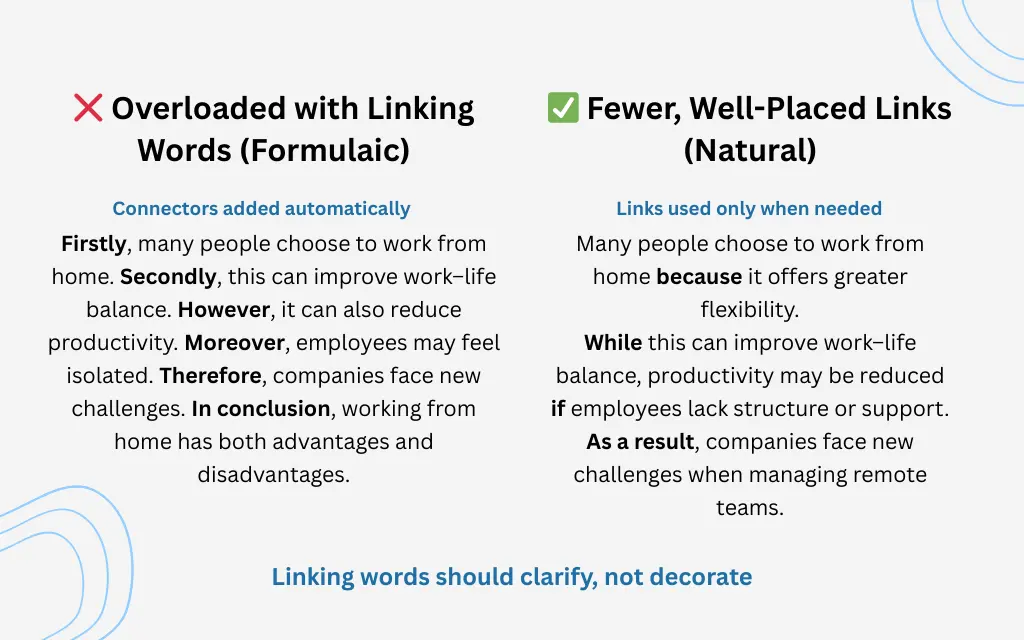
Overusing words like however, moreover, or in addition often makes writing sound unnatural and repetitive. Examiners notice this quickly.
True cohesion comes from a combination of devices working together, often quietly.
How Linking Words Should Actually Be Used
Linking words work best when they clarify a relationship that might otherwise be unclear.
For example, contrast words help when two ideas might be confused. Cause-and-effect words help explain why something happens. Time markers help organise sequences.
Problems arise when linking words are added automatically at the start of every sentence. This creates a formulaic rhythm that examiners associate with memorised writing.
Reference Words: A Powerful but Overlooked Tool
Reference words such as this, these, such, it, and they are some of the most effective cohesion devices.
They allow you to refer back to an idea without repeating it fully. When used clearly, they make writing smoother and more natural.
However, unclear reference is a common problem. If it is not obvious what this or they refers to, cohesion breaks down.
Examiners value precise reference more than frequent linking words.
Repetition Done Well (and Done Badly)
Repetition is not always negative. Repeating key terms can strengthen cohesion when done deliberately.
For example, repeating the main topic of the essay in different paragraphs helps the reader stay oriented. However, repeating the same phrasing without variation feels limited.
Strong writers repeat ideas, not sentences. They vary form while keeping meaning consistent.
Paragraph-Level Cohesion
Cohesion operates at sentence level and paragraph level.
Within a paragraph, ideas should build naturally. Each sentence should connect clearly to the one before it. When a sentence introduces a new idea too suddenly, cohesion feels weak.
Paragraph cohesion improves when:
- Sentences follow a logical order
- Reference words are clear
- Supporting ideas link back to the main point
A useful visual here would show arrows linking sentences within a paragraph.
Cohesion Between Paragraphs
Cohesion does not stop at the end of a paragraph.
Good IELTS writing signals progression between paragraphs without repeating introductions or using heavy transitions. Often, a simple reference to the previous idea is enough.
For example, a paragraph that builds on a limitation mentioned earlier does not need a dramatic connector. A subtle reference feels more natural and more advanced.
Why Overusing Linking Words Lowers Scores
Overuse of linking words is one of the most common linking words IELTS writing problems.
When every sentence begins with a connector, the writing feels mechanical. Examiners interpret this as a lack of flexibility.
Cohesion should feel invisible. When it becomes obvious, it often means it is being overused.
This is why many Band 6.5–7 essays improve simply by removing unnecessary connectors.
Cohesion in Task 1 Writing
In Task 1, cohesion helps compare data, show trends, and move between features.
Effective cohesion allows the reader to follow changes without confusion. Poor cohesion makes descriptions feel like disconnected statistics.
Subtle reference, clear comparison language, and controlled sentence flow matter more than advanced linking words.
Cohesion in Task 2 Writing
In Task 2, cohesion supports argument development.
Ideas must connect logically across sentences and paragraphs. When cohesion is weak, arguments feel jumpy or repetitive.
Strong Task 2 cohesion often comes from:
- Clear topic sentences
- Logical progression
- Controlled use of reference
This creates an essay that feels guided rather than assembled.
What Higher-Band Writing Does Differently
Higher-band writing uses cohesion devices sparingly and purposefully.
Instead of relying on obvious connectors, it uses:
- Clear sentence order
- Accurate reference
- Natural repetition
This creates writing that feels confident and effortless, even when grammar and vocabulary are relatively simple.
How to Improve Cohesion Without Memorising Lists
The most effective way to improve cohesion is to focus on clarity, not connectors.
Ask yourself:
- Can the reader easily follow this idea?
- Is it clear what this sentence refers to?
- Does this sentence belong here?
These questions improve cohesion more than memorising lists of linking words.
Conclusion
Cohesion devices IELTS writing is not about adding more linking words. It is about guiding the reader smoothly from one idea to the next.
Examiners reward writing that feels natural, clear, and logically connected. This comes from balanced use of linking words, clear reference, and controlled repetition.
By simplifying how you link ideas (rather than forcing structure) you can significantly improve coherence, cohesion, and overall writing scores.
To continue developing this skill, explore the related Learn English Weekly grammar and writing guides linked below, where cohesion is applied in real Task 1 and Task 2 examples.
Related IELTS Grammar Lessons
Glossary
Cohesion (noun) — How ideas are connected on the surface level of writing
Cohesion device (noun) — A word or structure used to link ideas
Reference (noun) — Using words to point back to earlier ideas
Connector (noun) — A word that links clauses or sentences
Flow (noun) — How smoothly writing is read
Practice Questions
- True or False: More linking words always improve cohesion.
- Which is part of cohesion?
A) Vocabulary difficulty
B) Reference words - Why can overusing connectors lower a score?
- Short answer: Name one cohesion device.
- True or False: Cohesion affects both Task 1 and Task 2.
Answers
- False
- B
- It makes writing feel mechanical
- Reference / linking word / repetition
- True
Join 1,300+ English learners
Get free English lessons, IELTS tips and useful vocabulary by email.
No spam. Just practical English you can use.