
Introduction to Task 1 Trend Vocabulary
Many IELTS candidates believe that higher scores come from writing longer sentences or using complicated grammar. In Writing Task 1, this belief often causes the opposite result. Examiners regularly see answers that attempt complex structures but lose clarity, accuracy, and control.
What actually improves scores is not complexity for its own sake, but controlled sentence structures that clearly describe data. Understanding how to move from simple sentences to more complex ones, without losing accuracy, is a key step towards a higher band.
This lesson explains IELTS Task 1 sentence structures in a practical, examiner-friendly way. You will see how simple patterns form the foundation of strong answers, how more advanced structures are built on top of them, and how to decide when complexity genuinely helps your score.
If you are practising map questions, combine these sentence patterns with accurate Task 1 map vocabulary for describing location, direction, and development.
Practise English every weekday with me
Get short Mon–Fri English practice in LINE with LEW Daily, plus regular feedback to help you improve.
Explore LEW DailyNT$399/month • Cancel anytime

Why Sentence Structure Matters in Task 1
In Task 1, examiners assess grammar under Grammatical Range and Accuracy, but this criterion does not reward complexity alone. Instead, it rewards the ability to use a range of structures accurately and appropriately.
Band 6 candidates often try to force advanced grammar into every sentence. As a result, meaning becomes unclear, errors increase, and the writing feels tense rather than controlled. By contrast, Band 7 and Band 8 responses usually rely on a mix of simple and moderately complex sentences that guide the reader smoothly through the data.
Sentence structure, then, is about choice. You choose a simple structure when clarity matters most, and a more complex one when it genuinely helps you connect ideas.
Simple Sentence Structures: The Foundation
Simple sentences are the backbone of most strong Task 1 responses. They are direct, clear, and easy to control, which makes them ideal for describing key data points.
A simple Task 1 sentence usually focuses on one main idea, such as a rise, a fall, or a comparison. For example, a sentence might state that a figure increased over a period, or that one category was higher than another.
A weaker response often avoids simple sentences because they feel “too easy”. A stronger response uses them confidently, especially when introducing new information. Clear data deserves clear structure.
A helpful visual here would show a basic bar chart with one data point highlighted, alongside a single clear sentence describing it.
Combining Ideas with Compound Sentences
Once simple sentences are under control, candidates can begin to connect related ideas using compound structures. These sentences join two closely related points, often using connectors such as and, but, or while.
In Task 1, compound sentences are particularly useful for comparisons. They allow you to show contrast or similarity without overloading the sentence.
Compare these two approaches in prose:
A weaker approach separates the ideas into multiple short sentences, which can feel repetitive.
A stronger approach connects them, showing the relationship more clearly and naturally.
The key is restraint. If both ideas are closely linked, a compound sentence works well. If not, keeping them separate often improves clarity.
Introducing Complex Sentences Carefully
Complex sentences add depth by showing relationships such as cause, contrast, or time. In IELTS Task 1, they are useful, but only when used carefully.
A complex sentence typically includes a main clause and a subordinate clause. This allows you to add context without creating a new sentence. For example, you might describe a change over time while explaining when or under what condition it occurred.
Band 6 candidates often attempt complex sentences too early, before they can control them. This leads to unclear reference, incorrect punctuation, or tense errors. Band 7 and Band 8 candidates use complex sentences selectively, usually after the main trend is already clear.
The principle is simple: complexity should support meaning, not replace it.
Using Time Clauses to Describe Change
Time clauses are especially common in Task 1, as many visuals show change over a period. When used well, they help organise information smoothly.
For example, instead of writing separate sentences for different years, a candidate might combine them into one sentence that shows progression. This reduces repetition and improves flow.
However, time clauses require accurate tense use. A common IELTS writing structures error is mixing past and present forms inconsistently. Controlled use of time clauses demonstrates both grammatical range and accuracy, which examiners value highly.
Relative Clauses for Adding Detail
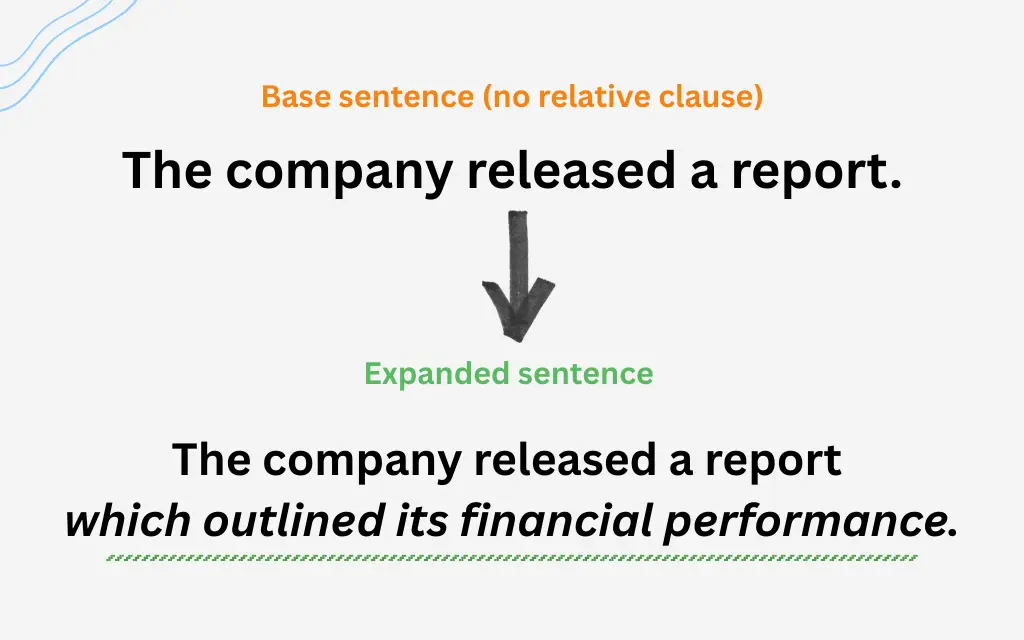
Relative clauses allow you to add extra information about a noun, such as a category or a figure, without starting a new sentence. In Task 1, they are useful for giving brief clarification.
For example, a category can be identified and described in the same sentence. This feels natural and avoids choppy writing.
That said, relative clauses are optional. They should be used only when the extra detail helps the reader understand the data more clearly. Overusing them can make sentences heavy and difficult to follow.
Avoiding Over-Complex Structures
One of the most common mistakes in complex sentences for IELTS is overloading a single sentence with too many ideas. When candidates try to include trend description, comparison, time reference, and explanation all at once, accuracy often suffers.
Examiners do not reward long sentences that are difficult to read. They reward writing that feels controlled and deliberate. Breaking a complex idea into two clearer sentences often improves both coherence and grammar accuracy.
A good rule is to read your sentence aloud. If it feels difficult to say smoothly, it is probably too complex for Task 1.
If you are practising process diagrams, combine these sentence patterns with accurate IELTS process vocabulary so your writing sounds clear, precise, and natural.
Mixing Sentence Types for a Natural Style
High-scoring Task 1 responses do not rely on one type of sentence. Instead, they use a natural mix of simple, compound, and complex structures.
Simple sentences often introduce key data. Compound sentences highlight comparisons. Complex sentences add context or time relationships. This variation creates a calm, professional tone that examiners associate with higher bands.
The aim is not to showcase grammar knowledge, but to communicate data clearly.
How Examiners Interpret Sentence Control
Examiners read Task 1 responses quickly and consistently. When they see controlled sentence structures, they infer that the candidate understands both the data and the language.
Frequent errors in complex sentences suggest that a candidate is attempting grammar beyond their control. In contrast, accurate simple and compound sentences suggest confidence and reliability.
This is why emphasising control over complexity is essential. A Band 8 response often looks simpler on the surface than a Band 6 response, but it feels clearer and more accurate.
Conclusion
Strong IELTS Task 1 sentence structures are built from the ground up. Simple sentences form the base, compound sentences create connection, and complex sentences add depth when needed.
By focusing on clarity, accuracy, and controlled progression from simple to complex, you can improve both grammatical range and overall coherence. This approach aligns closely with how examiners assess Task 1 writing.
To continue developing this skill, explore Learn English Weekly’s Task 1 grammar guides and examiner marking explanations, where sentence structure choices are shown in real context.
Related IELTS Task 1 Lessons
Glossary
Sentence structure (noun) – The way a sentence is organised grammatically
Simple sentence (noun) – A sentence with one main clause
Compound sentence (noun) – A sentence joining two main clauses
Complex sentence (noun) – A sentence with a main clause and a subordinate clause
Clause (noun) – A group of words with a subject and verb
Practice Questions
- True or False: Complex sentences always score higher in Task 1.
- Which sentence type is best for introducing key data?
A) Complex
B) Simple - Why can over-complex sentences lower a score?
- Short answer: Name one sentence type useful for comparisons.
- True or False: Examiners value control more than ambition in grammar.
Answers
- False
- B
- They reduce clarity and increase errors
- Compound sentence
- True
Join 1,300+ English learners
Get free English lessons, IELTS tips and useful vocabulary by email.
No spam. Just practical English you can use.