
Introduction to Keywords vs Paraphrasing in IELTS Reading
IELTS candidates often prepare for the Reading test by memorising long vocabulary lists and practising how to “find keywords” in passages. This approach feels logical. Every question contains important words, and every answer must appear somewhere in the text.
Yet for many learners, this method leads to confusion rather than confidence. They underline words, scan quickly, and feel relieved when they notice something similar in the passage. When results arrive, however, their score is often lower than expected.
This happens because IELTS does not test your ability to match words. It tests your ability to recognise meaning when ideas are expressed in different ways.
This lesson explains how keywords and paraphrasing work together in IELTS Reading, why relying on keywords alone is risky, and how you can read more accurately under exam conditions.
Practise English every weekday with me
Get short Mon–Fri English practice in LINE with LEW Daily, plus regular feedback to help you improve.
Explore LEW DailyNT$399/month • Cancel anytime

Why Keyword Searching Feels Comfortable for Learners
For many students, keyword searching feels like a safe survival strategy. When time is limited and texts are long, focusing on familiar words gives a sense of control.
In many classrooms, teachers introduce reading practice by highlighting names, dates, places, and technical terms. At an early stage, this is helpful because it teaches students how to locate information.
Problems begin when keyword searching becomes the main strategy.
When candidates depend too heavily on keywords, they start expecting answers to repeat the same vocabulary. If identical words do not appear, they panic, hesitate, or guess.
Consider this example:
Question:
Many people now work from home.
Text:
Remote working has become increasingly common in recent years.
A keyword-based reader may fail to connect work from home with remote working, even though the meaning is clearly the same.
This is where many reading scores are lost.
How IELTS Uses Paraphrasing to Test Understanding
IELTS Reading passages are deliberately written to prevent simple word matching. Examiners use paraphrasing to check whether you understand ideas rather than individual words.
Paraphrasing means expressing the same meaning using different vocabulary, grammar, or structure.
Common examples include:
- increase → rise, expand, grow
- problem → difficulty, issue, challenge
- important → essential, significant, crucial
- because → due to, owing to, as a result of
Sometimes the change is small. At other times, it is more complex.
Example:
Original idea:
Many children lack access to quality education.
Paraphrase:
A large number of young people are unable to benefit from effective schooling.
The vocabulary changes completely, but the meaning remains the same.
IELTS questions are built around this principle. If you only search for matching words, you will miss many correct answers.
Keywords Still Matter (As Navigation Tools)
Keywords are not useless. They still play an important role in IELTS Reading. The problem lies in how many candidates use them.
Keywords should be treated as signposts, not solutions.
They help you locate the relevant part of the passage. Once you arrive there, your focus must change from searching to understanding.
Strong readers usually think in two stages:
First: Where is this topic discussed?
Second: How is this idea expressed here?
Example:
Question:
The invention was first used in medical research.
Keywords: invention, first, medical
These words help you locate the paragraph. But the answer may appear like this:
The device was initially applied in laboratory experiments involving human health.
No words match directly, yet the meaning is identical.
This is why successful candidates use keywords to navigate and paraphrasing skills to confirm.
Common Mistakes When Using Keywords and Paraphrasing
Many reading errors come from misunderstanding how these two skills should work together.
Choosing Answers with Matching Words
Some candidates believe that answers repeating question vocabulary are safer. In IELTS, this is often wrong.
Example:
Question:
The study was completed in 2015.
Text:
The research began in 2015 and continued for several years.
The year matches, but the meaning does not. The study was not completed in 2015.
Ignoring Synonyms Under Pressure
In vocabulary exercises, learners recognise synonyms easily. In exams, stress blocks this ability.
Examples:
- purchase → buy
- elderly → old people
- decline → fall
Training yourself to notice these links in context is essential.
Focusing on Words Instead of Ideas
IELTS tests ideas, relationships, and claims. It does not test isolated vocabulary.
If you focus only on individual words, you miss logical connections.
Always ask:
What is the writer actually saying here?
How to Train Paraphrasing Recognition
Paraphrasing recognition is a skill that develops through deliberate practice.
The first step is to stop thinking only in terms of vocabulary and start thinking in terms of meaning.
When reading a sentence, try to restate it mentally.
Example:
The company experienced a sharp decline in profits.
Mental paraphrase:
The company suddenly made much less money.
This habit trains your brain to process ideas instead of surface language.
Other useful training methods include:
- rewriting short passages in your own words
- paraphrasing questions before answering them
- comparing your paraphrases with model answers
If you can paraphrase a question accurately, you are more likely to recognise the correct answer.
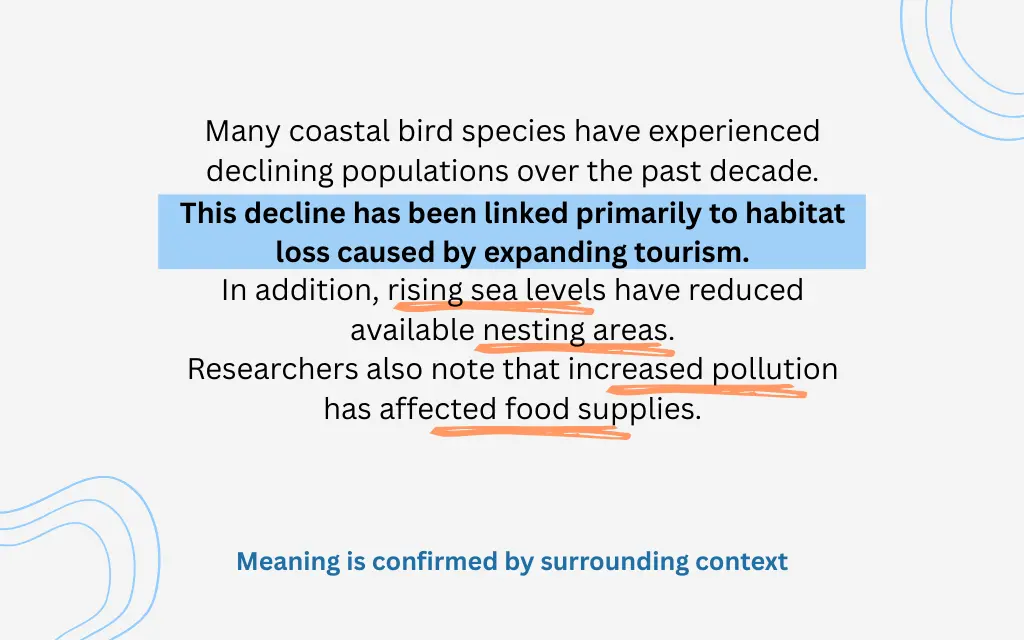
Using Context to Confirm Meaning
Good readers never rely on one word alone. They always check context.
Context means the surrounding sentences, explanations, and examples that support an idea.
If you see a sentence about “declining populations”, examine what follows. Is the writer discussing migration, ageing, disease, or environmental change?
Understanding this wider picture protects you from traps.
Long-Term Benefits of Trap Awareness
When you learn to recognise traps, accuracy improves, confidence grows, and panic decreases.
You stop guessing and start making evidence-based decisions.
This leads to more stable and predictable reading scores.
Conclusion
IELTS reading traps are not tricks. They are part of the assessment design.
They test whether you can read carefully, think critically, and stay calm under pressure.
By understanding how traps work and reading like an examiner, you can avoid unnecessary mistakes and protect your score.
Related IELTS Reading Lessons
Glossary
Keyword (noun) — a word that signals the main topic of a question
Paraphrase (noun/verb) — expressing the same idea using different words
Context (noun) — surrounding information that gives meaning
Synonym (noun) — a word with a similar meaning to another
Distractor (noun) — a misleading wrong answer
Practice Questions
- Why are keywords alone unreliable in IELTS Reading?
- True or False: IELTS usually repeats question vocabulary in answers.
- Which skill helps you understand reformulated ideas?
- What is a distractor?
- Why is context important?
Answers
- Because IELTS tests meaning through paraphrasing.
- False.
- Paraphrasing recognition.
- A misleading wrong option.
- It confirms meaning and prevents mistakes.
Join 1,300+ English learners
Get free English lessons, IELTS tips and useful vocabulary by email.
No spam. Just practical English you can use.