Introduction to Advanced Vocabulary Hurting IELTS Scores
Lots of IELTS candidates believe that the fastest way to improve their writing score is to use more “advanced” vocabulary. They memorise long word lists, practise rare synonyms, and deliberately avoid simple words, worrying that basic language will look weak to the examiner.
Ironically, this approach often leads to lower scores.
In IELTS writing, advanced vocabulary IELTS misuse is one of the most common hidden problems. It does not usually make an essay unreadable, but it quietly reduces clarity, accuracy, and examiner confidence. Over time, this limits the band score far more than candidates expect.
This lesson discusses why “advanced vocabulary” can hurt IELTS scores, how examiners really judge vocabulary, and what to focus on instead if you want reliable improvement.
Practise English every weekday with me
Get short Mon–Fri English practice in LINE with LEW Daily, plus regular feedback to help you improve.
Explore LEW DailyNT$399/month • Cancel anytime

Where the “Advanced Vocabulary” Myth Comes From
The belief that advanced vocabulary equals higher scores is understandable. Many language exams reward complexity, and many preparation books emphasise long word lists.
However, IELTS writing does not assess vocabulary in isolation. It assesses lexical resource, which includes range, accuracy, and appropriateness. Advanced words only help when they are used naturally and correctly.
The myth persists because candidates confuse difficulty with quality.
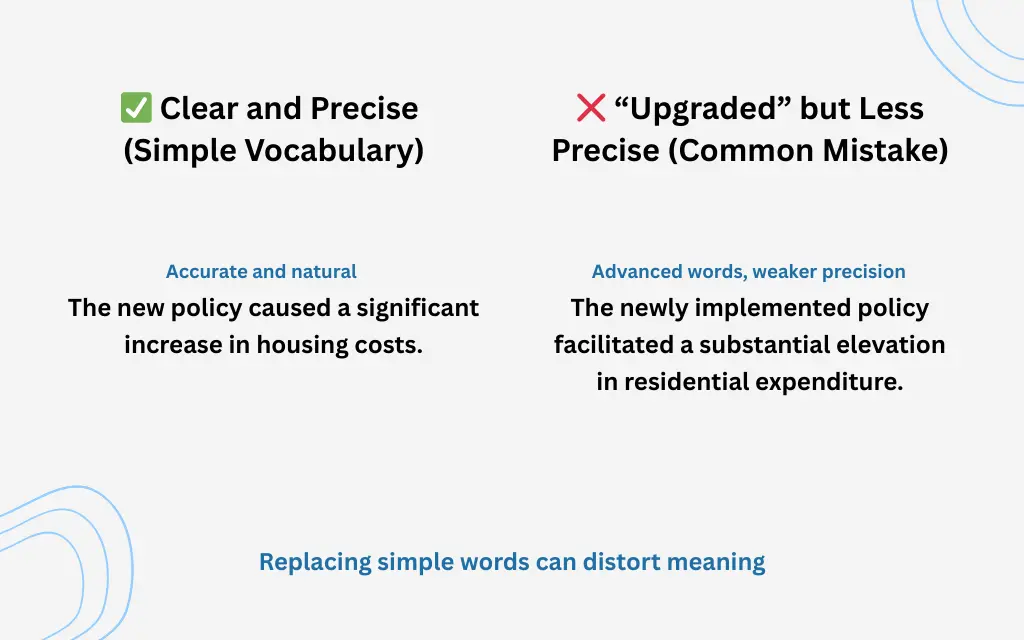
A useful visual here would show two sentences side by side: one using simple but precise language, and one using complex vocabulary awkwardly.
How Examiners Actually Judge Vocabulary
Examiners are not impressed by rare words. They are impressed by writing that feels natural, clear, and controlled.
When reading, examiners ask themselves:
- Does the word fit the context?
- Is the meaning clear immediately?
- Does the vocabulary help the idea, or distract from it?
If a word forces the reader to pause or reinterpret the sentence, it works against the score.
This is why vocabulary that looks impressive to learners often looks risky to examiners.
The Difference Between “Advanced” and “Appropriate”
In IELTS writing, appropriate vocabulary is far more valuable than advanced vocabulary.
Appropriate words:
- Match the topic
- Match the tone
- Are used accurately
- Sound natural in academic English
Advanced words that are slightly misused often sound forced. Even when they are technically correct, they can feel unnatural or exaggerated.
Examiners associate this with memorisation rather than genuine language control.
Memorised Vocabulary Is Easy to Spot
One of the biggest problems with memorised vocabulary IELTS strategies is that they leave a recognisable pattern.
Essays often contain:
- Unnatural synonyms for common words
- Phrases that do not match the surrounding language level
- Sudden jumps in tone
These patterns signal that vocabulary was inserted rather than chosen naturally. Examiners are trained to notice this.
Once memorisation is suspected, examiners become more cautious with higher band awards.
Vocabulary Accuracy Matters More Than Vocabulary Range
Vocabulary range means showing some variety. Vocabulary accuracy means using words correctly and precisely.
In IELTS, accuracy carries more weight.
A limited range used accurately can still score well. A wide range used inaccurately almost always limits the band.
This is why many candidates get stuck at Band 6.5 or 7 despite learning hundreds of new words.
Common “Advanced Vocabulary” Mistakes in IELTS Writing
Many IELTS vocabulary mistakes come from trying to replace simple words unnecessarily.
For example, candidates may avoid common verbs like increase, cause, or important, replacing them with less familiar options that slightly distort meaning.
These substitutions rarely improve the sentence. Often, they introduce subtle errors that reduce clarity.
Why Simple Vocabulary Often Scores Higher
Simple vocabulary is not basic vocabulary. Words like increase, reduce, problem, and benefit are widely used in academic English.
Examiners expect to see them.
When used accurately and supported by clear ideas, these words feel confident and natural. Avoiding them can make writing sound strained.
High-band essays often contain many common words used precisely.
Vocabulary and Examiner Trust
Examiners develop a sense of trust as they read.
When vocabulary is accurate and natural, trust increases. The examiner relaxes and focuses on ideas.
When vocabulary feels forced or slightly off, trust decreases. The examiner becomes alert to potential errors.
This emotional response matters more than many candidates realise. Trust supports higher scores.
Vocabulary Problems That Affect Both Task 1 and Task 2
Vocabulary misuse affects both writing tasks, but in slightly different ways.
In Task 1, inappropriate vocabulary can distort data description or exaggerate trends. In Task 2, it can weaken arguments or make opinions sound unnatural.
In both tasks, clarity matters more than sophistication.
This is why focusing on controlled, familiar vocabulary improves overall performance.
Why Candidates Feel Vocabulary Is Holding Them Back
Many candidates feel their vocabulary is “not good enough” because they compare themselves to model answers.
What they often miss is that model answers are written without exam pressure, often edited multiple times, and designed to showcase features.
Examiner-level writing in real exams is calmer, simpler, and more controlled.
Comparing exam writing to polished models often leads candidates to overreach.
What Higher-Band Writing Does Differently
Higher-band writing does not avoid advanced vocabulary, but it does not chase it either.
Instead, it:
- Uses common words confidently
- Introduces more specific vocabulary only when needed
- Avoids unnecessary synonyms
This balance creates writing that feels natural, precise, and easy to read.
How to Improve Vocabulary Without Hurting Your Score
The goal is not to learn more words, but to use words better.
Effective improvement comes from:
- Reducing repeated vocabulary errors
- Strengthening collocations you already use
- Practising word choice in full sentences
This approach increases accuracy first. Range grows naturally over time.
A Better Question to Ask Yourself
Instead of asking:
“Is this word advanced enough?”
Ask:
“Is this the most natural word here?”
This single question improves vocabulary decisions more than memorising any word list.
Conclusion
Advanced vocabulary IELTS strategies often hurt scores because they prioritise appearance over control. Examiners reward clarity, accuracy, and natural language, not memorised complexity.
Using simpler vocabulary accurately is not a weakness. It is a strength. When vocabulary supports meaning rather than competing with it, writing becomes clearer and scores become more reliable.
To continue improving, explore the related Learn English Weekly vocabulary and grammar guides linked below, where word choice is shown in real IELTS contexts.
Related IELTS Grammar Lessons
Glossary
Advanced vocabulary (noun) — Rare or complex words beyond everyday use
Accuracy (noun) — Correct and appropriate language use
Appropriateness (noun) — Suitability of a word for context and tone
Memorised language (noun) — Learned phrases used without full control
Lexical resource (noun) — IELTS criterion for vocabulary assessment
Practice Questions
- True or False: Rare vocabulary always improves IELTS scores.
- What do examiners value more?
A) Difficulty
B) Appropriateness - Why is memorised vocabulary risky?
- Short answer: Name one problem caused by forced vocabulary.
- True or False: Simple words are acceptable in Band 8+ writing.
Answers
- False
- B
- It sounds unnatural and reduces trust
- Loss of clarity / incorrect meaning
- True
Join 1,300+ English learners
Get free English lessons, IELTS tips and useful vocabulary by email.
No spam. Just practical English you can use.