
Introduction to Yes / No / Not Given Questions
Many IELTS candidates feel confident when they see Yes / No / Not Given questions in the Reading test. They look familiar. They seem simple. After all, you only have three choices.
Yet in practice, this question type causes serious confusion.
Students often mix it up with True / False / Not Given. Others answer based on their own knowledge instead of the passage. Some rush and guess when they feel unsure.
This is why yes no not given IELTS questions regularly reduce reading scores, even for strong English learners.
These questions do not test general understanding. They test whether you can recognise the writer’s opinion and separate it from facts and assumptions.
This lesson explains how Yes / No / Not Given questions really work, how they differ from True / False / Not Given, and how you can approach them calmly and accurately on exam day.
Practise English every weekday with me
Get short Mon–Fri English practice in LINE with LEW Daily, plus regular feedback to help you improve.
Explore LEW DailyNT$399/month • Cancel anytime

Understanding Yes / No / Not Given Questions
Before learning strategies, it is important to understand what this task is testing.
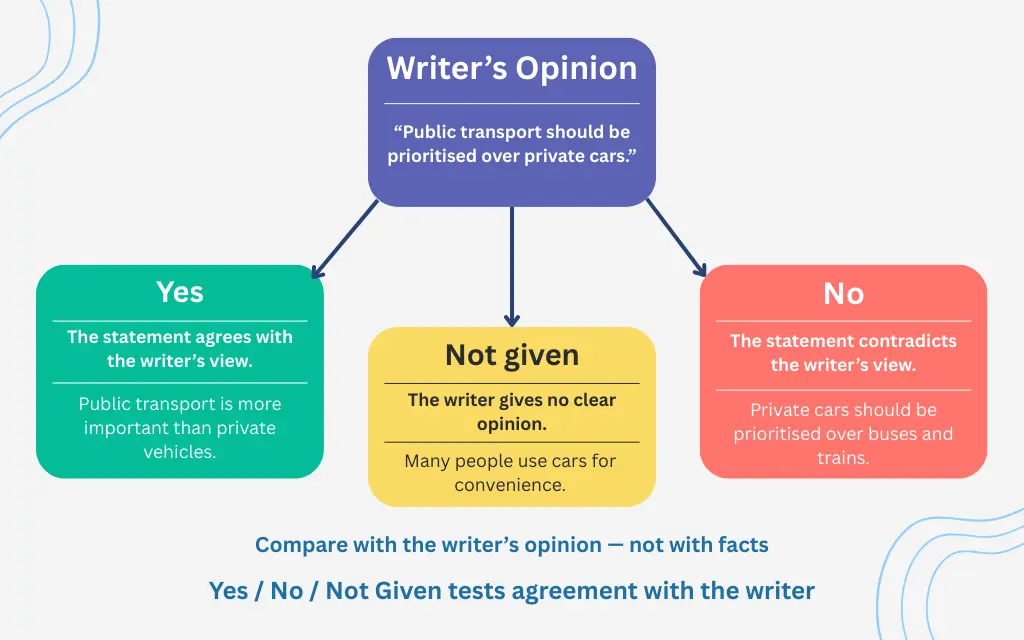
In Yes / No / Not Given questions, you decide whether a statement agrees with the writer’s view in the passage.
You are not checking facts.
You are checking opinions.
This is the key difference.
What This Task Really Tests
In these questions, the passage usually contains:
- Arguments
- Evaluations
- Judgements
- Attitudes
- Recommendations
Your job is to compare the statement with the writer’s position, not with reality.
Yes / No / Not Given vs True / False / Not Given
One reason this task is difficult is that it looks almost identical to True / False / Not Given.
However, the logic is different.
The Core Difference
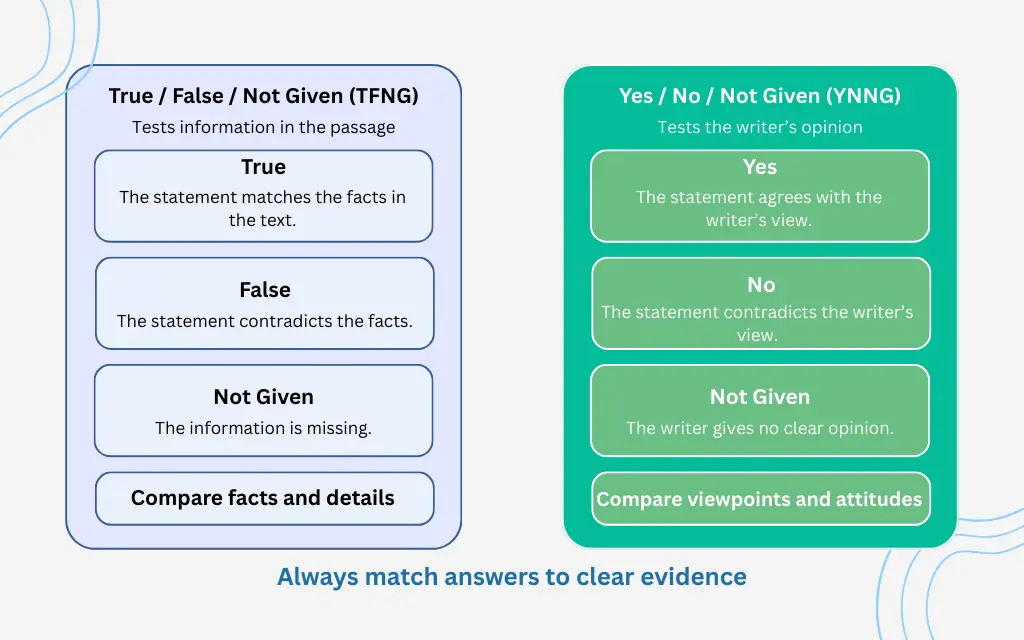
True / False / Not Given checks facts.
Yes / No / Not Given checks opinions.
Example:
Passage:
“Many researchers believe online learning will replace traditional classrooms.”
Statement:
“Online learning will definitely replace traditional classrooms.”
This is an opinion, not a fact.
So the question becomes:
Does this match the writer’s view?
Not:
Is it true in real life?
This shift in thinking is essential.
How Answers Work in YNNG
Each answer has a precise meaning.
Yes — the statement agrees with the writer’s view.
No — the statement contradicts the writer’s view.
Not Given — the writer gives no clear opinion.
You are matching viewpoints, not information.
Why Candidates Struggle With YNNG Questions
Most mistakes come from predictable thinking habits.
Using Personal Knowledge
Many candidates think:
“I know this is true.”
But IELTS does not care.
Only the passage matters.
Missing Indirect Opinions
Writers rarely say:
“In my opinion…”
Instead, they use subtle language:
“It appears that…”
“There is growing concern…”
“Some experts argue…”
If you miss these signals, you miss the answer.
Confusing Silence With Disagreement
If the passage does not mention something, the answer is Not Given.
It is not No.
This is one of the biggest scoring problems.
Step-by-Step Strategy for YNNG Questions
Strong candidates follow a clear mental process.
Step 1: Recognise That This Is an Opinion Task
Before reading, remind yourself:
“This is about viewpoint.”
Not facts.
Not data.
Not general knowledge.
Step 2: Locate the Relevant Section
Use keywords to find the paragraph.
Do not rely on memory.
Re-read carefully.
Opinions are often spread across several sentences.
Step 3: Identify the Writer’s Position
Look for stance markers:
“The author suggests…”
“There is little evidence…”
“It is widely accepted…”
These show attitude.
Step 4: Compare Meaning, Not Words
Ask:
Does it match?
Does it contradict?
Or is it missing?
This leads directly to Yes, No, or Not Given.
Step 5: Decide and Move On
Do not overthink.
Clear opinion → decide.
No opinion → Not Given.
Then continue.
Recognising Writer Opinions in Reading Passages
To succeed with YNNG, you must become sensitive to opinion language.
Common Opinion Signals
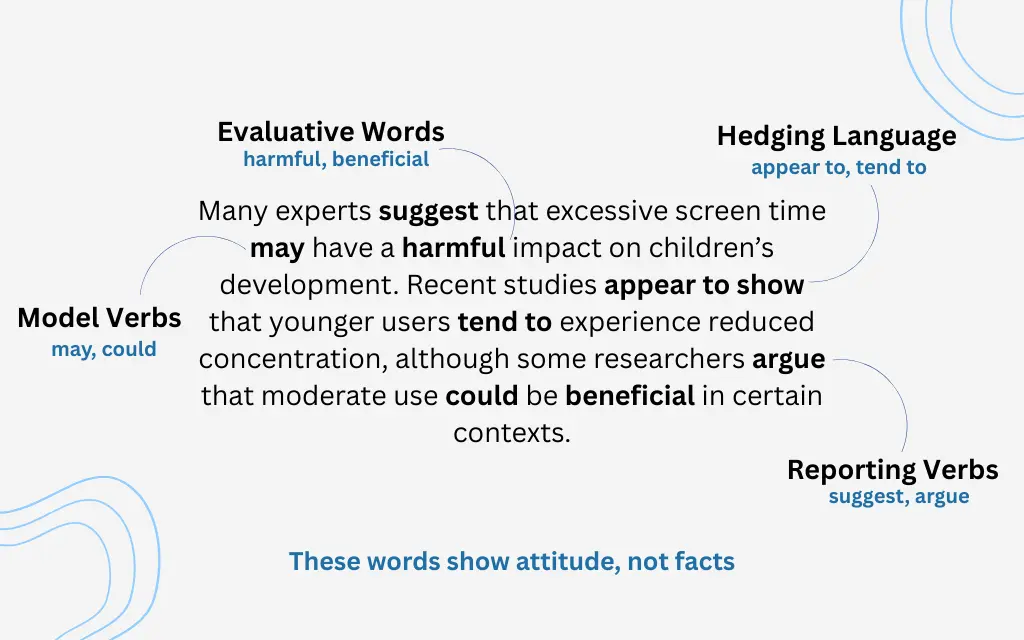
Writers often use:
- Modal verbs: may, might, could
- Reporting verbs: argue, suggest, claim
- Evaluative adjectives: harmful, beneficial
- Hedging: appears to, tends to
These signal attitude.
Distinguishing Writer vs Other Voices
Passages often quote others.
“Some critics argue…”
“Supporters believe…”
This is not always the writer’s view.
Look for agreement or distance.
Handling “Not Given” Correctly
Not Given is logical, not dangerous.
It means:
No clear stance is expressed.
When to Choose Not Given
Choose Not Given when:
- The idea is not mentioned
- It is only descriptive
- No evaluation appears
- No judgement is given
If you cannot find a position after careful reading, it is probably Not Given.
Time Management for YNNG Questions
These questions require careful reading, so timing matters.
Common Timing Errors
Some students reread whole passages.
Others overanalyse every sentence.
Both waste time.
Practical Timing Strategy
A balanced approach:
Scan → locate
Read 4–5 sentences
Decide in 60–90 seconds
Move on if unsure
Return later if needed.
Common Mistakes in Yes / No / Not Given
Treating It Like TFNG
Looking for facts instead of views leads to wrong answers.
Always focus on stance.
Choosing No Instead of Not Given
No = contradiction.
Not Given = no opinion.
Do not confuse them.
Ignoring Qualifiers
Words like:
mainly, partly, generally, rarely
Change meaning.
Missing them causes errors.
Reading Too Quickly
Opinions are subtle.
Slow down slightly.
How High-Scoring Candidates Think
Strong candidates think calmly:
“This is opinion.”
“Here is the stance.”
“It matches.”
“Yes.”
Or:
“No stance.”
“Not Given.”
No guessing.
No emotion.
This is trainable.
Using Practice Tests Effectively
Do not just check scores.
Analyse mistakes.
Ask:
Did I confuse fact and opinion?
Did I miss a signal word?
Did I assume too much?
Keep notes, patterns will appear.
Conclusion: Mastering Yes / No / Not Given
Yes / No / Not Given questions test careful reading and logical comparison.
If you focus on viewpoint, recognise opinion language, avoid personal assumptions, and practise structured analysis, your accuracy will rise steadily.
With training, this task becomes predictable and manageable.
Related IELTS Reading Lessons
Glossary
Opinion (noun)
A personal view expressed by the writer.
Stance (noun)
The position taken on an issue.
Qualifier (noun)
A word that limits meaning.
Hedging (noun)
Cautious language that avoids strong claims.
Inference (noun)
A conclusion based on evidence.
Practice Section
Questions
- (MCQ) What do YNNG questions mainly test?
A. Vocabulary
B. Writer’s opinion
C. Speed
D. Spelling - (True/False) Personal knowledge should influence answers.
- (Short Answer) Why is “Not Given” often chosen incorrectly?
- (MCQ) Which word often signals opinion?
A. Reported
B. Suggests
C. Measured
D. Calculated - (True/False) “No” means the writer gives no opinion.
Answers
- B
- False
- Because students confuse missing information with disagreement.
- B
- False
Join 1,300+ English learners
Get free English lessons, IELTS tips and useful vocabulary by email.
No spam. Just practical English you can use.