
Introduction to Fluency vs Accuracy in IELTS Speaking
Many IELTS Speaking candidates feel they are forced to make an uncomfortable choice.
If they focus on speaking fluently, they worry about grammar mistakes. If they slow down to be accurate, they fear sounding hesitant or unnatural. Some are even told to “prioritise fluency” while others are advised to “slow down and be perfect”.
This mixed advice creates confusion and often leads to lower scores.
Fluency vs accuracy in IELTS Speaking is not about choosing one over the other. It is about understanding how examiners balance both inside the band descriptors, how they interact during real performance, and how candidates can manage both under exam conditions without overthinking.
This lesson explains what fluency and accuracy really mean in IELTS Speaking, how they affect band scores, and how to practise them in a way that improves performance rather than increasing pressure.
Practise English every weekday with me
Get short Mon–Fri English practice in LINE with LEW Daily, plus regular feedback to help you improve.
Explore LEW DailyNT$399/month • Cancel anytime

Why fluency and accuracy are often misunderstood
The misunderstanding usually begins in the classroom.
Fluency and accuracy are often taught as opposing skills, even though they are closely linked in IELTS Speaking. Students are encouraged to speak freely, then criticised for mistakes. Later, they focus on grammar and suddenly struggle to maintain flow.
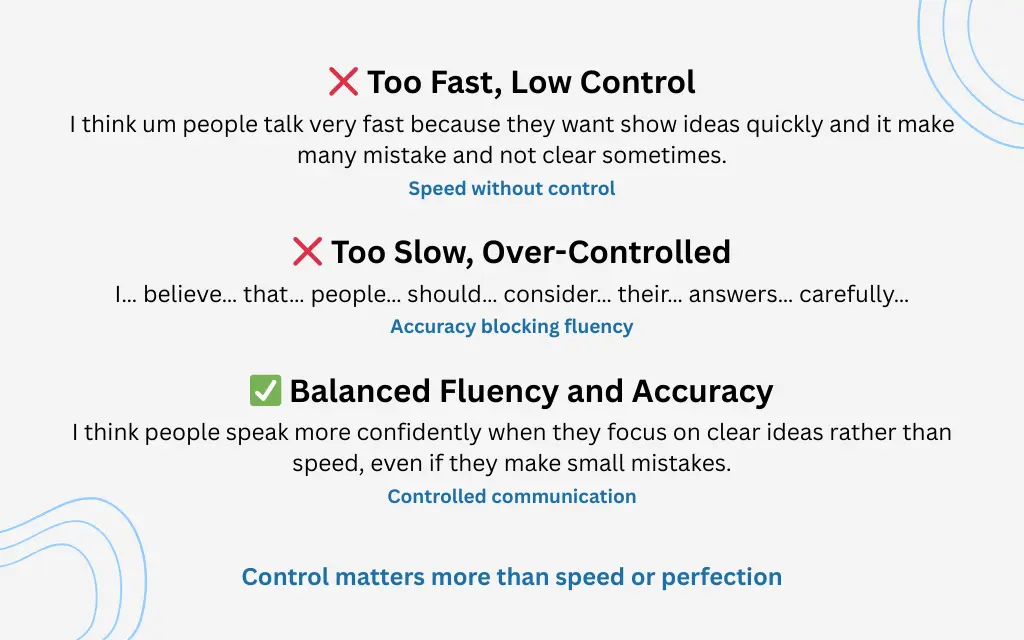
The IELTS Speaking test does not reward speed. It also does not reward perfection. It rewards controlled communication.
What fluency really means in IELTS Speaking
Fluency in IELTS Speaking does not mean speaking quickly or continuously.
Examiners define fluency as the ability to maintain a natural flow of speech, use pauses meaningfully, and avoid frequent breakdowns in communication.
How examiners recognise fluent speech
Fluent speakers pause, but their pauses sound natural. They do not restart sentences repeatedly or abandon ideas halfway through.
A fluent response often sounds calm and organised, even when the speaker is thinking.
For example, a speaker may say:
“I haven’t really thought about that before, but I suppose it’s mainly because…”
This short pause supports fluency rather than damaging it.
What accuracy really means in IELTS Speaking
Accuracy refers to how correctly grammar and sentence structures are used across the whole test.
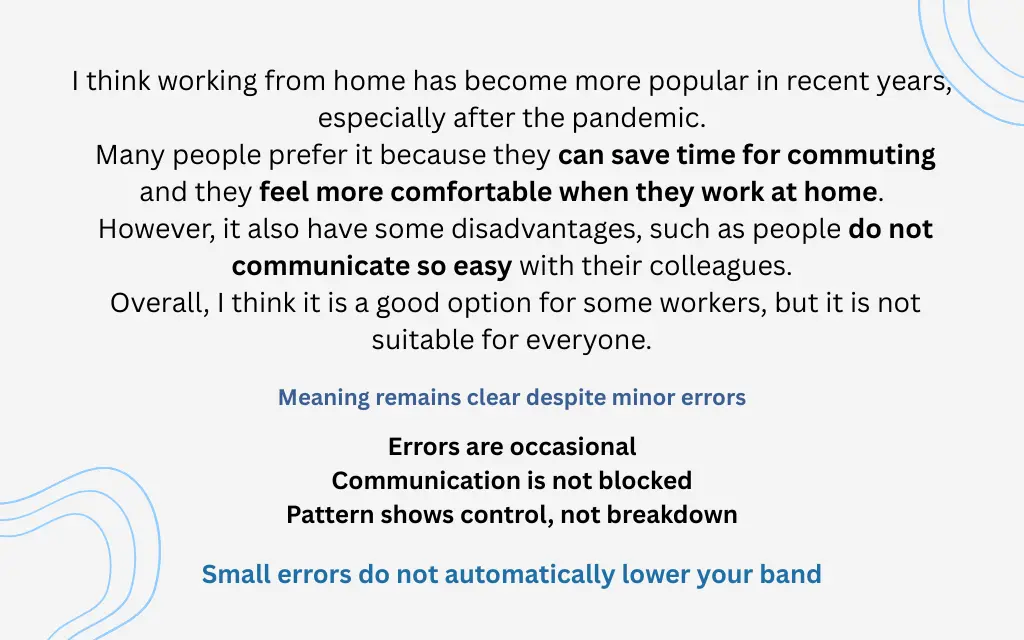
Accuracy is not measured sentence by sentence. Examiners listen for patterns.
They assess whether candidates show consistent control of basic grammar, attempt more complex structures, and make errors that usually do not block meaning.
One or two grammar mistakes do not lower a band score. Persistent errors, especially with basic structures, do.
How fluency and accuracy interact in the band descriptors
In IELTS Speaking, fluency and accuracy are assessed under different criteria, but they influence each other.
Fluency is assessed under Fluency and Coherence.
Accuracy is mainly assessed under Grammatical Range and Accuracy.
If a candidate speaks so carefully that flow breaks down, fluency scores drop. If a candidate speaks so quickly that grammar collapses, accuracy scores drop.
Examiners are trained to look for balance.
This is why strong Band 7 speakers often speak calmly rather than quickly, make occasional errors but recover naturally, and maintain coherence even when grammar is not perfect.
Why over-focusing on accuracy lowers fluency
Many candidates aiming for Band 7 or above become overly cautious.
They mentally plan every sentence, correct themselves repeatedly, or restart phrases mid-sentence. This leads to unnatural rhythm, frequent hesitation, and loss of coherence.
In examiner marking, hesitation is far more noticeable than a small article or tense error.
Trying to sound perfect often lowers the fluency score more than it raises the accuracy score.
Why ignoring accuracy limits band score potential
At the opposite extreme, some candidates are told to “just speak”.
While this can improve confidence, it often caps scores around Band 6. Frequent grammar errors prevent examiners from awarding higher bands, regardless of how fluent the speaker sounds.
Fluency alone does not compensate for repeated basic errors, incorrect verb forms, or unclear sentence structure.
Accuracy provides the control examiners expect at higher bands.
What examiners expect at different band levels
Understanding expectations reduces pressure.
At Band 6, examiners expect generally fluent speech with noticeable but manageable errors and limited control of complex grammar.
At Band 7, examiners expect fluent, organised speech with flexible grammar and mostly accurate use. Errors should not affect understanding.
At Band 8 and above, examiners expect natural fluency, strong grammatical control, and only rare minor errors.
Fluency usually stabilises first. Accuracy improves gradually.
How to practise fluency without sacrificing accuracy
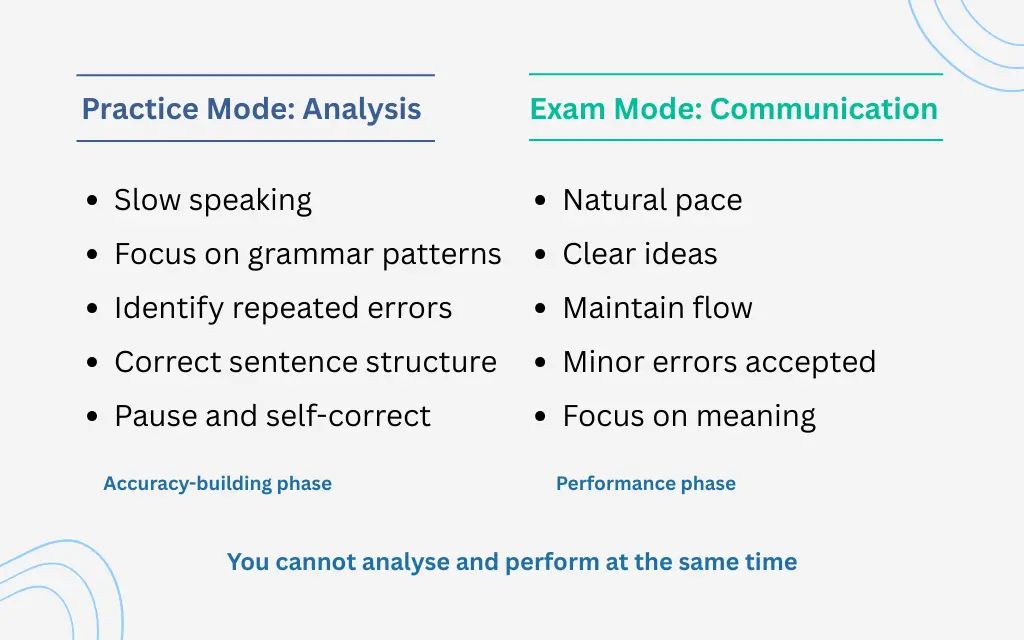
The key is separating practice modes.
Some practice sessions should focus on speaking freely, maintaining flow, and developing ideas naturally. Other sessions should focus on analysing grammar patterns, correcting repeated errors, and improving sentence control.
Trying to monitor grammar while speaking in real time is what causes hesitation.
What to focus on during the speaking test
During the test, your role is not to analyse language.
Your focus should be on communicating ideas clearly, maintaining a natural rhythm, and allowing small errors to pass.
If you notice a mistake, only correct it if the correction is immediate and natural. Otherwise, continue speaking.
Examiners expect control, not perfection.
Common myths about fluency and accuracy
One common myth is that fast speakers score higher. This is false.
Another is that grammar mistakes automatically lower band scores. This is also false.
Examiners listen for overall performance patterns, not isolated slips. Understanding this often reduces pressure and improves both fluency and accuracy naturally.
Conclusion
Fluency vs accuracy in IELTS Speaking is not a choice.
It is a balance built through smart preparation and calm exam-day execution. Fluency creates flow. Accuracy provides control. Together, they form the performance examiners reward.
When candidates stop trying to perform perfectly and focus on communicating effectively, speaking scores improve more consistently.
Related IELTS Speaking Lessons
Glossary
Fluency (noun) — ability to speak smoothly and naturally without excessive hesitation
Accuracy (noun) — correctness of grammar and language use
Coherence (noun) — logical connection and organisation of ideas
Band score (noun) — final IELTS score awarded for performance
Self-correction (noun) — correcting one’s own speech while speaking
Comprehension & Practice Questions
- True or False: Fluency means speaking as fast as possible.
- Multiple choice: Which criterion includes fluency?
A) Lexical Resource
B) Fluency and Coherence
C) Pronunciation - Short answer: Do grammar mistakes automatically lower your band score?
- True or False: Over-focusing on accuracy can harm fluency.
- Short answer: What should you focus on during the speaking test?
Answers
- False
- B
- No, only persistent or serious errors do
- True
- Clear, natural communication
Join 1,300+ English learners
Get free English lessons, IELTS tips and useful vocabulary by email.
No spam. Just practical English you can use.