
Introduction to Formal vs Informal Language in IELTS Writing
One of the easiest ways to lose marks in IELTS writing is not through grammar mistakes or weak ideas, but through tone. Candidates often write clearly and accurately, yet their essays feel slightly wrong for the task. The issue is rarely obvious, but examiners notice it immediately.
IELTS writing requires a specific register. Language that sounds natural in everyday conversation can feel out of place in an academic essay or report. When this happens, examiner confidence drops, even if the meaning is clear.
This lesson explains what formal language in IELTS writing really means, how it differs from informal language, where candidates most often lose control of tone, and how to adjust your writing style without sounding forced or unnatural.
Practise English every weekday with me
Get short Mon–Fri English practice in LINE with LEW Daily, plus regular feedback to help you improve.
Explore LEW DailyNT$399/month • Cancel anytime

What “formal” actually means in IELTS writing
Formal language in IELTS does not mean complicated, old-fashioned, or unnatural English. It also does not mean using long words wherever possible.
In IELTS writing, formal language is best understood as language that is:
- neutral in tone
- objective rather than personal
- appropriate for academic discussion
You are writing as an informed observer, not as a participant in a conversation.
A useful way to think about this is context. IELTS writing should sound like something you would read in a newspaper analysis, report, or academic article. It should not sound like a chat message, online comment, or spoken discussion.
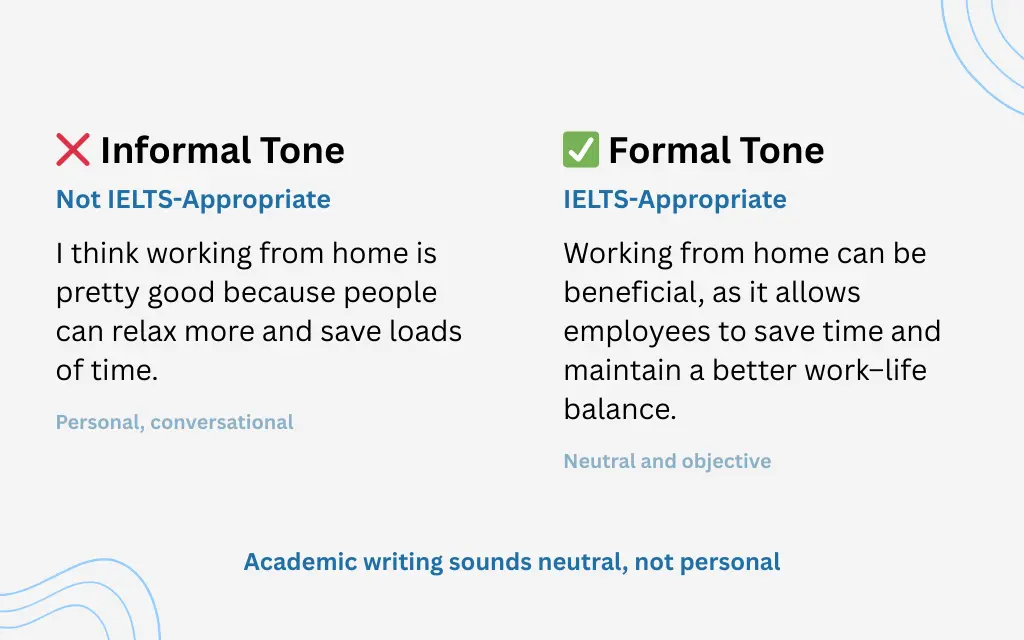
Why informal language lowers your IELTS score
Informal language affects several assessment criteria at the same time, which is why it can quietly reduce scores.
How examiners interpret informal tone
When informal language appears, it suggests:
- limited awareness of academic register
- weak control of writing style
- reliance on spoken English habits
Even when the meaning is clear, the tone does not match the task. This creates a mismatch between content and context.
Examiners read quickly and continuously. Informal language interrupts that flow. They may not consciously identify every informal phrase, but the overall impression is that the writing lacks academic control.
Where informal language most commonly appears
Informal language usually enters IELTS writing unintentionally. Candidates are not trying to be casual. They are simply writing the way they speak.
Task 2 essays
Task 2 is particularly sensitive to tone. Because you are discussing opinions and arguments, it is easy to slip into conversational phrasing.
Personal comments, emotional emphasis, and rhetorical questions often sound informal on the page, even if grammar is correct.
Task 1 reports
Task 1 is more factual, but informal language still appears, especially in introductions and overviews. Words and phrases that feel harmless in speech can weaken the academic tone of a data description.
Common informal features examiners notice
Informality is rarely caused by one single word. It is usually a pattern.
Spoken connectors
Linking ideas the way they are linked in speech rather than writing can make an essay feel conversational instead of structured.
Personal reference
Unnecessary use of “I”, “we”, or “you” in Task 2 often weakens academic tone, particularly when discussing general issues.
Casual emphasis
Using conversational intensifiers to sound persuasive can replace logical development. This makes arguments feel emotional rather than reasoned.
None of these automatically fail an essay. However, repeated use creates a tone that does not align with academic writing.
Formal language does not mean difficult language
One of the most common misunderstandings is the belief that formal writing must sound complex.
In reality, strong formal writing often uses:
- clear verbs
- precise nouns
- controlled sentence structure
Examiners do not reward exaggerated formality or memorised academic phrases. Forcing advanced vocabulary often makes writing sound unnatural and reduces clarity.
Strong formal writing feels calm, balanced, and confident. It does not try to impress the reader.
Adjusting tone without rewriting everything
Improving formality does not require a complete change in writing style. Small adjustments often have the biggest effect.
Practical tone adjustments
Formality can often be improved by:
- removing unnecessary personal language
- choosing neutral verbs instead of emotional ones
- replacing spoken phrases with written equivalents
Examiners assess overall register, not perfection. If most of the essay sounds appropriately formal, one or two minor slips will not significantly affect your score.
Formal vs informal in Task 1 writing
Task 1 requires a consistently formal tone because it is descriptive and analytical.
Informal language in Task 1 often appears when candidates:
- describe trends emotionally rather than factually
- use conversational phrases to summarise data
- personalise what should be objective description
Task 1 writing should feel detached and precise. You are reporting information, not reacting to it.
Formal vs informal in Task 2 writing
Task 2 allows opinion, but still requires formality.
You may evaluate ideas, discuss causes, and explain consequences, but always in a measured and neutral way. A strong Task 2 essay reads like a reasoned argument rather than a spoken debate.
This control of tone is one of the clearest differences between Band 6 and Band 7 writing.
How examiners recognise appropriate writing style
Examiners do not count informal words or follow a checklist. They form an overall impression.
If the essay feels organised, neutral, and controlled, the register is likely appropriate. If it feels conversational or emotional, something is wrong, even if grammar accuracy is high.
Reading your essay aloud is a useful self-check. If it sounds like something you would say rather than write, it may be too informal.
Practising formality effectively
The most effective way to practise formal language is not memorising lists of academic vocabulary.
Instead:
- read high-quality IELTS model answers
- notice tone rather than vocabulary difficulty
- practise rewriting short informal sentences into neutral ones
Over time, your writing style will adjust naturally.
Conclusion
Formal language in IELTS writing is not about sounding clever or complicated. It is about sounding appropriate for an academic task.
Many candidates lose marks not because their ideas are weak, but because their writing style does not match the context of the exam. By focusing on neutral tone, controlled expression, and avoiding spoken habits, you can improve your writing score without changing what you want to say.
Related IELTS Vocabulary Lessons
Glossary
Formal language (noun) — neutral, academic style used in professional or educational writing
Informal language (noun) — casual, conversational language used in speech or personal communication
Register (noun) — the level of formality used in language
Tone (noun) — the overall attitude expressed through language
Academic writing (noun) — structured, objective writing used in educational contexts
Practice Questions
- True or False: Formal language in IELTS means using long, complex words.
- Multiple choice: What is the main problem with informal language in IELTS writing?
A) It shortens essays
B) It changes spelling rules
C) It creates a mismatch with academic context - Short answer: Why does spoken English often sound informal in writing?
- True or False: Task 2 allows opinions but still requires a formal tone.
- Short answer: Name one way to make writing sound more formal without changing meaning.
Answers
- False
- C
- Because it includes conversational tone and personal phrasing
- True
- Remove unnecessary personal language or spoken connectors
Join 1,300+ English learners
Get free English lessons, IELTS tips and useful vocabulary by email.
No spam. Just practical English you can use.