
Introduction to IELTS Listening Form Completion
There are names to spell. Numbers to catch. Dates, prices, addresses, and strict word limits. The layout can look busy and intimidating. However, IELTS listening form completion is actually one of the most predictable question types in the entire exam.
It appears frequently. It follows a clear structure. And with the right approach, it is highly scoreable.
In this lesson, you will learn how listening gap fill IELTS tasks work, why candidates lose simple marks, and how to approach form completion calmly and strategically on test day.
Practise English every weekday with me
Get short Mon–Fri English practice in LINE with LEW Daily, plus regular feedback to help you improve.
Explore LEW DailyNT$399/month • Cancel anytime

What Is IELTS Listening Form Completion?
Form completion usually appears in Section 1 of the Listening test, although it occasionally appears in Section 2.
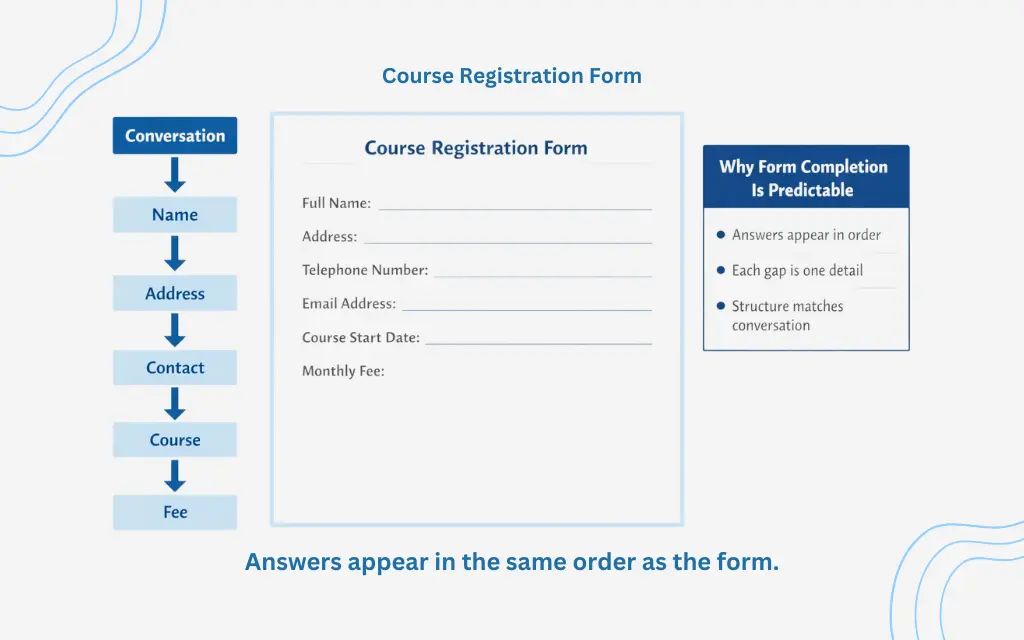
You will see a form that needs to be completed while you listen to a conversation. The situation is normally practical and everyday, such as:
- Booking accommodation
- Registering for a course
- Enquiring about services
- Making a complaint
The form mirrors real-life paperwork. It may include:
Name
Address
Telephone number
Email
Dates
Prices
Simple personal details
Most importantly, the answers appear in order. The form follows the same sequence as the conversation.
Why Form Completion Is So Common in IELTS
IELTS tests real-world listening ability.
In everyday life, you frequently need to:
Provide personal details
Confirm information
Spell your name
Repeat numbers
Form completion reflects these practical skills.
Because this task appears so often, mastering it can significantly improve your overall IELTS listening band score. Strong candidates treat it as an opportunity to secure reliable marks early in the test.
How the Conversation Typically Works
In most cases, two people are speaking. One asks questions. The other provides information.
For example:
Receptionist: “Can I take your full name, please?”
Caller: “Yes, it’s Daniel Foster. That’s F-O-S-T-E-R.”
The answer is “Foster”.
However, you must also be prepared for clarification or correction:
Caller: “It’s Daniel Foster — actually, that’s Foster with an E-R at the end.”
If you stop listening too soon, you may miss the corrected version. This is where many listening gap fill IELTS mistakes occur.
Understanding Word Limits
Before the recording begins, always read the instruction carefully.
It may say:
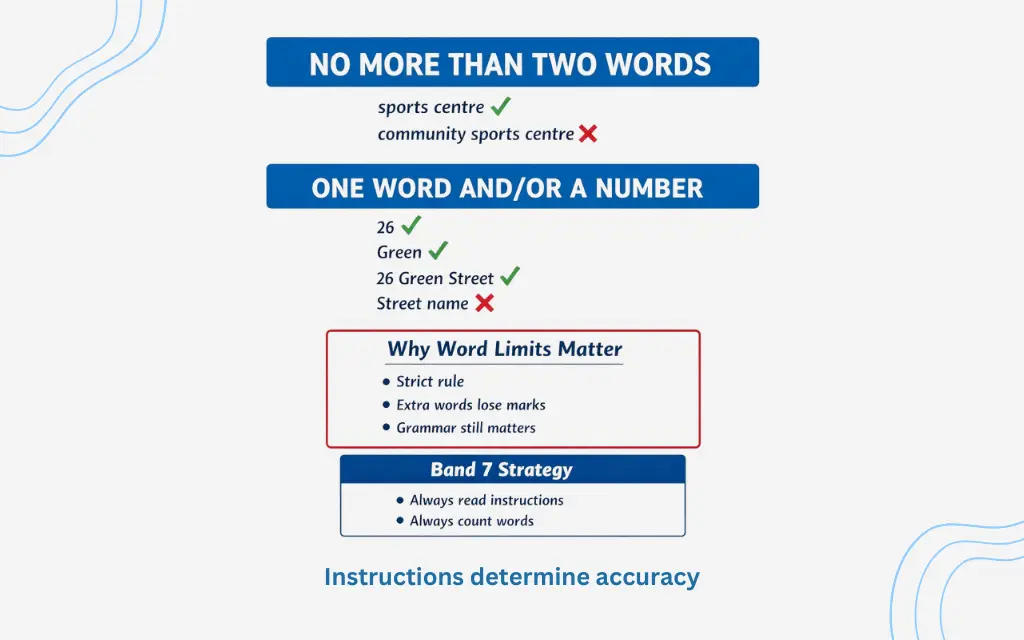
NO MORE THAN TWO WORDS
ONE WORD AND/OR A NUMBER
These limits are strict.
If the answer is “26 Green Street” and the instruction says ONE WORD AND/OR A NUMBER, you must think carefully about what fits grammatically and within the word count.
Many candidates lose marks not because they misunderstood the recording, but because they ignored the instruction.
The Information You Must Recognise
Although the specific content changes, the answer types are highly predictable.
In IELTS listening form completion, you are commonly required to catch:
Names (often spelled)
Phone numbers
Postcodes
Dates
Times
Prices
Room numbers
Course names
For example:
“The course starts on the 17th of October.”
The answer may simply be “17 October”.
Precision matters.
Spelling: The Silent Mark Killer
Spelling is one of the most common causes of lost marks.
If the speaker says:
“That’s L-E-W-I-S.”
You must write “Lewis”, not “Louis”.
If you spell it incorrectly, the answer is marked wrong — even if your listening was accurate.
IELTS accepts both British and American spelling in general vocabulary (for example, “centre” or “center”), but proper nouns must match exactly what you hear.
Accuracy here directly affects your band score.
Numbers and Dates: Listening With Precision
Numbers often cause avoidable mistakes.
For example:
“The total cost is one hundred and fifty pounds.”
You should write “150”.
Or:
“It’s double three, seven, five, zero.”
This means 33750.
Pay attention to grouping and repetition.
For dates, you might hear:
“The 5th of July.”
Acceptable answers include:
5 July
July 5
As long as spelling is correct and the format is clear.
Recognising Corrections
One of the most common IELTS listening form completion traps is correction.
The speaker may state incorrect information and then change it.
For example:
“It’s 21 Bridge Road — sorry, that should be 31 Bridge Road.”
The correct answer is 31 Bridge Road.
Listen for words such as:
Sorry
Actually
I mean
Let me correct that
These often signal that the earlier information was incorrect.
Strategy Before the Recording Starts
Preparation time is crucial.
Before the audio begins:
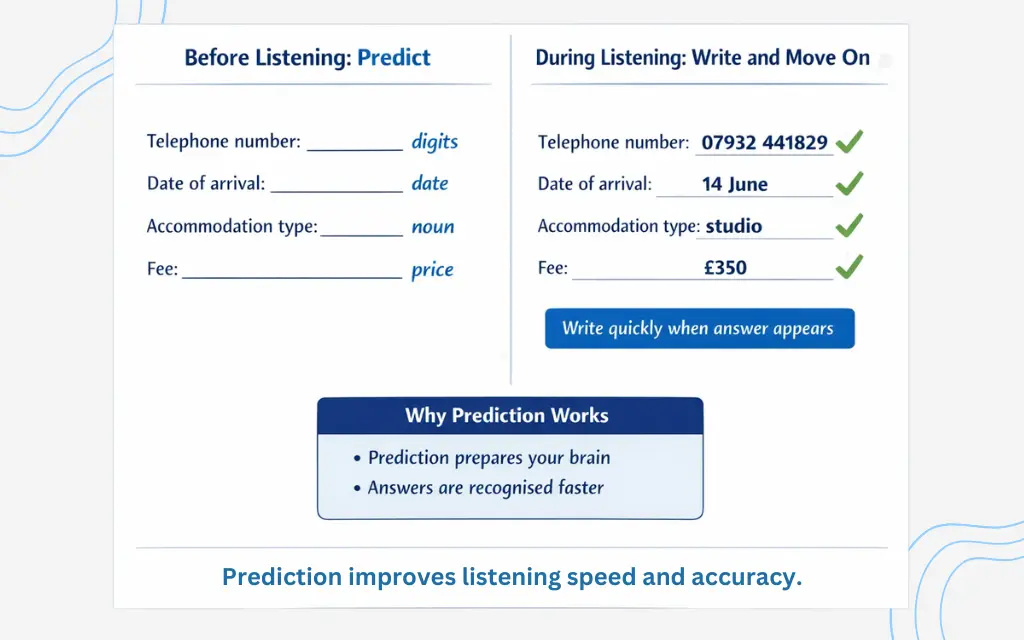
Look at the structure of the form.
Identify the type of information required for each gap.
If the blank follows “Telephone number”, expect digits.
If it follows “Date of arrival”, expect a date.
If it follows “Type of accommodation”, expect a noun.
This prediction allows your brain to react more quickly when the answer appears.
Staying Calm During the Task
Form completion usually appears early in the Listening test. If you panic at the beginning, it can affect your confidence for the remaining sections.
Instead:
Focus on one gap at a time.
Keep listening even if you miss one answer.
Avoid freezing or mentally replaying what you missed.
The questions follow the order of the conversation. You do not need to search randomly across the page.
This structure is your advantage.
How Form Completion Influences Your IELTS Listening Band Score
Because this question type is common and predictable, it has a strong impact on your final IELTS listening band score.
Candidates who practise form completion thoroughly often secure most of these marks.
Those who neglect it tend to lose points through:
Careless spelling
Mishearing numbers
Ignoring corrections
Exceeding word limits
Small mistakes add up quickly.
But with structured practice, this is one of the easiest areas to improve.
Conclusion
IELTS listening form completion may appear simple, but it demands precision.
You must:
Listen for detail
Respect word limits
Spell accurately
Recognise corrections
Write clearly and quickly
The encouraging part is that this task is highly structured and predictable. When you master it, you build confidence at the very start of the Listening test.
To continue strengthening your Listening skills, explore:
IELTS Listening Section 1 Explained
Common IELTS Listening Mistakes
How IELTS Listening Is Marked
Secure the predictable marks first. Your overall score will follow.
Related IELTS Listening Lessons
-
-
IELTS Listening Section 1 Explained
- Spelling and Plurals in IELTS Listening
- IELTS Listening – Complete Guide to Sections and Question Types
-
IELTS Listening Section 1 Explained
Glossary
Form Completion (n.)
A Listening task where you fill in missing information on a form.
Word Limit (n.)
The maximum number of words allowed in an answer.
Correction (n.)
When a speaker changes previously stated information.
Proper Noun (n.)
The name of a person or place that requires a capital letter.
Band Score (n.)
Your IELTS score from 1 to 9.
Practice Section
(MCQ) Form completion most commonly appears in:
A. Section 1
B. Section 3
C. Section 4
D. Writing Task 1
(True/False) Spelling mistakes are allowed in form completion.
(Short Answer) Why is reading the word limit important?
(MCQ) Which word often signals a correction?
A. Firstly
B. Sorry
C. Therefore
D. Additionally
(True/False) The answers in form completion usually follow the order of the conversation.
Answers
A
False
Because exceeding the word limit or writing too many words loses the mark.
B
True
Join 1,300+ English learners
Get free English lessons, IELTS tips and useful vocabulary by email.
No spam. Just practical English you can use.