
Introduction to IELTS Speaking Part 2 Structure
IELTS Speaking Part 2 often feels unpredictable, even for confident speakers.
You are given an unfamiliar topic, one minute to prepare, and then expected to speak continuously for up to two minutes. Many candidates struggle here not because of weak English, but because their answers lose shape halfway through. Ideas appear, then disappear, and fluency breaks down.
This lesson breaks down how to structure IELTS Speaking Part 2 answers in a clear, examiner-friendly way. You will learn how to organise ideas naturally, without memorising scripts or relying on rigid templates, so that your response stays controlled from start to finish.
Practise English every weekday with me
Get short Mon–Fri English practice in LINE with LEW Daily, plus regular feedback to help you improve.
Explore LEW DailyNT$399/month • Cancel anytime

Why structure matters more than ideas in Part 2
Many learners believe Part 2 rewards creativity or storytelling. From an examiner’s perspective, this is not the case.
Examiners are listening for control. Structure helps you:
- avoid stopping too early
- reduce hesitation
- organise ideas logically
- maintain fluency under pressure
A well-structured answer using simple language will consistently score higher than an unstructured answer filled with ambitious vocabulary.
What IELTS Speaking Part 2 is really testing
IELTS Speaking Part 2 is known as the long turn. The examiner does not guide you once you begin speaking.
This part of the test focuses heavily on:
- fluency and coherence
- ability to develop ideas independently
- consistency of grammar and vocabulary
Structure allows you to demonstrate all three at the same time. Without it, even strong language can sound fragmented.
Understanding the cue card before you plan structure
Before applying structure, it is important to understand the cue card itself.
Each cue card includes:
- a main topic
- several guiding prompts
- an instruction to explain or describe
The prompts are support, not rules. You are not required to answer them in order, and you are not penalised for adding relevant ideas. This flexibility is what allows one clear structure to work across many different topics.
A simple, examiner-friendly Part 2 structure
There is no official “correct” structure, but strong candidates almost always follow a recognisable pattern.
A reliable structure includes:
- a clear opening
- development of main ideas
- explanation or personal perspective
- a natural ending
This shape helps you speak for the full time without rushing, repeating yourself, or panicking.
How to start your Part 2 answer clearly
The opening sets the tone for the entire response.
Your aim is to settle into the topic calmly and show control. A short introduction gives you thinking time and signals organisation to the examiner.
For example, you might briefly explain what the topic is or why you chose it. Simple sentences work best here. There is no need for complex grammar at the start.
Developing your main ideas naturally
After the opening, move into development.
Rather than listing information, slow your ideas down. A practical approach is to:
- describe what happened or what something is
- add context or background
- include one or two specific details
This approach helps you expand ideas naturally and prevents you from running out of content too early.
Adding explanation and personal perspective
Stronger answers move beyond description.
At this stage, you might explain:
- why something was important
- how you felt about it
- what effect it had on you
This level of explanation often separates Band 6 from Band 7 because it shows depth and coherence, not just narration.
Ending your answer smoothly
Many candidates stop speaking abruptly when time feels tight.
A strong ending simply signals closure. You might:
- summarise why the topic matters
- explain how you feel about it now
- connect the topic to the present
A natural ending shows time awareness and structural control, both of which examiners value.
Using the one-minute preparation time for structure
The preparation minute is not for writing sentences.
Use it to:
- decide your opening idea
- choose two or three points to develop
- plan a simple ending
Writing keywords rather than full sentences keeps your delivery natural and reduces memorisation.
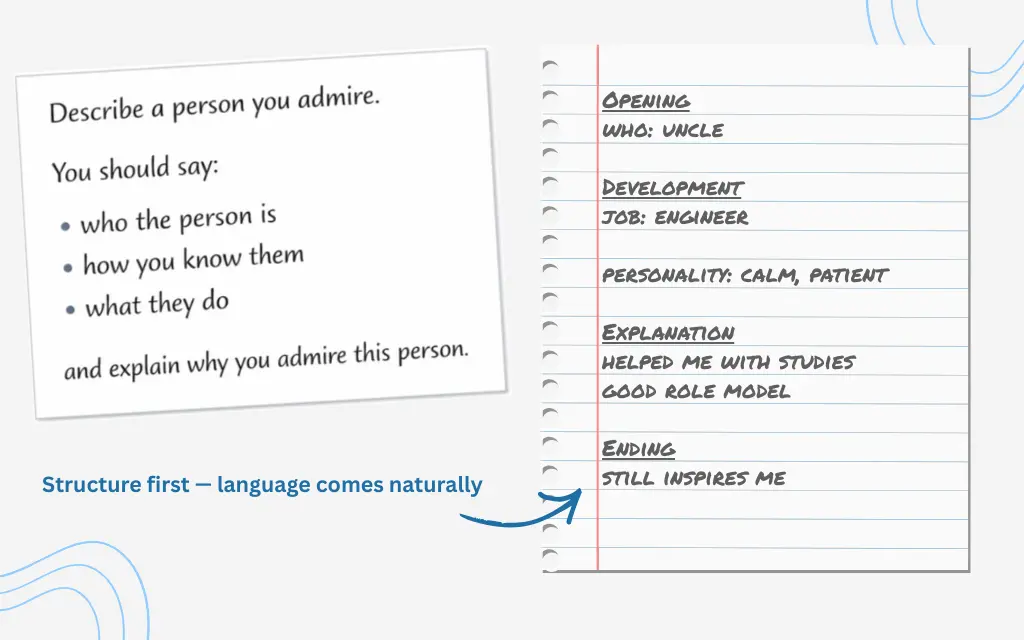
Example: structuring a Part 2 answer step by step
Imagine a cue card asking you to describe a memorable journey.
A structured response could:
- introduce the journey briefly
- explain where you went and why
- describe one or two key moments
- reflect on why it was memorable
Notice that this structure focuses on flow rather than treating each bullet point as a separate mini-answer.
Common structural mistakes in Part 2
Several patterns repeatedly limit scores:
- answering each prompt separately like a list
- over-planning, leading to hesitation
- repeating the same idea in different words
These problems usually appear when candidates do not have a clear structural plan.
What to do if you lose structure mid-answer
Losing your place can happen to anyone.
If it does:
- pause briefly
- return to your main topic
- add explanation rather than new ideas
Small pauses are acceptable. Staying calm and organised matters far more than continuing perfectly.
How structure affects your speaking band score
Clear structure supports all four speaking criteria:
- fluency and coherence through logical flow
- lexical resource through controlled word choice
- grammatical range by reducing rushed errors
- pronunciation by maintaining steady pace
This is why structure is one of the most powerful tools in IELTS Speaking Part 2.
How to practise Part 2 structure effectively
Effective practice focuses on process, not repetition.
You should:
- practise different cue card topics
- plan structure in one minute
- record yourself speaking
- listen for clarity and flow
With repetition, the structure becomes automatic.
Conclusion
IELTS Speaking Part 2 does not reward memorisation or creativity. It rewards control.
When your answer has a clear, flexible structure, you speak longer, hesitate less, and make fewer mistakes. Most importantly, you sound organised and confident to the examiner.
By focusing on structure rather than content, Part 2 becomes predictable instead of stressful.
Related IELTS Speaking Lessons
Glossary
Cue card (noun) — a task card with a topic and prompts
Long turn (noun phrase) — the extended speaking section in IELTS
Fluency (noun) — ability to speak smoothly and continuously
Coherence (noun) — logical organisation of ideas
Prompt (noun) — a guiding question or instruction
Comprehension & Practice Questions
- True or False: IELTS Speaking Part 2 is mainly about creativity.
- Multiple choice: How long is the preparation time in Part 2?
A) 30 seconds
B) 1 minute
C) 2 minutes - Short answer: Why is structure important in Part 2?
- True or False: You must answer every cue card bullet point equally.
- Short answer: What should your ending do?
Answers
- False
- B
- It helps organise ideas and maintain fluency
- False
- Signal a natural conclusion
Join 1,300+ English learners
Get free English lessons, IELTS tips and useful vocabulary by email.
No spam. Just practical English you can use.