
Introduction to IELTS Reading Time Management
IELTS candidates leave the Reading test with the same thought: “I knew the answers, but I ran out of time.”
This is rarely a language problem. In most cases, it is a strategy problem.
In IELTS Reading, strong vocabulary and grammar do not help if you cannot reach the final questions. Finishing the paper is part of the skill being tested.
This lesson breaks down how to manage your time in IELTS Reading, how to stay calm under pressure, and how to complete all three passages with confidence.
Practise English every weekday with me
Get short Mon–Fri English practice in LINE with LEW Daily, plus regular feedback to help you improve.
Explore LEW DailyNT$399/month • Cancel anytime

Why Time Is Your Biggest Enemy in IELTS Reading
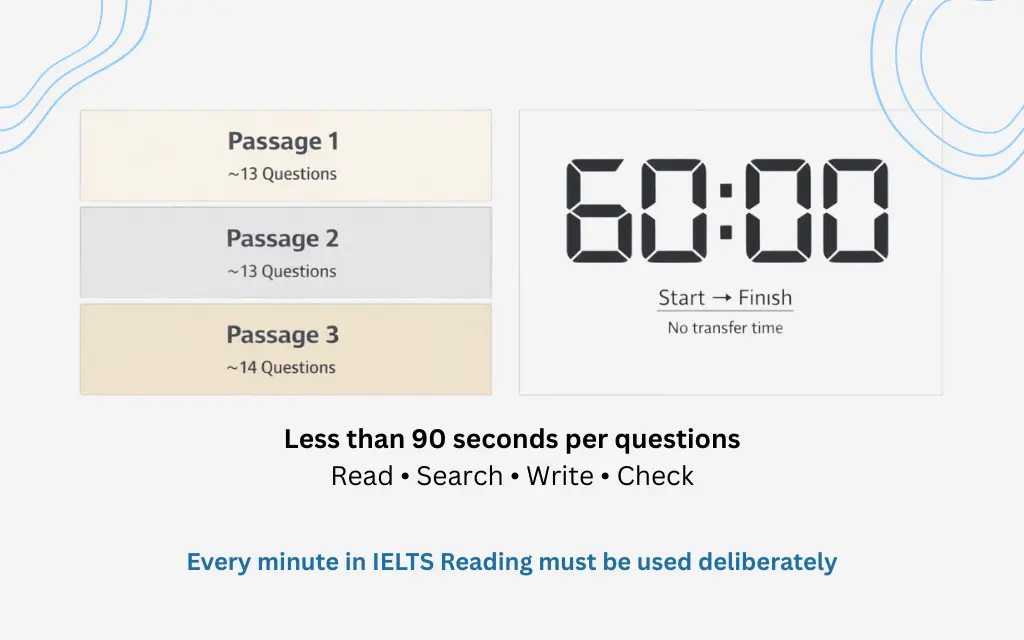
You are given three long passages, 40 questions, and 60 minutes. There is no extra time to transfer answers.
This means you have less than 90 seconds per question, including reading, thinking, checking, and writing.
The test is not designed for slow, careful reading. It is designed for fast, controlled decision-making under pressure.
How the Reading Test Is Designed Around Time Pressure
IELTS Reading is intentionally demanding.
As the test progresses, the passages become denser, vocabulary becomes less familiar, and questions require more comparison and inference. At the same time, your concentration naturally decreases.
Examiners are not only testing comprehension. They are also observing whether you can prioritise, move on when necessary, and stay focused until the end.
Strong time management shows that you can function effectively in academic reading conditions.
Understanding a Realistic Time Structure
Before improving timing, it helps to know what balanced pacing looks like.
Most successful candidates aim for:
- Passage 1: about 15 minutes
- Passage 2: about 20 minutes
- Passage 3: about 25 minutes
This reflects the increasing difficulty of the texts.
If you spend too long on the first passage, you almost guarantee problems in the final section. Time lost early is rarely recovered later.
Why Many Candidates Run Out of Time
Time problems usually come from habits developed during practice.
Some candidates read IELTS texts like novels, trying to understand every sentence. This wastes valuable minutes on information that is never tested.
Others become stuck on one difficult question and refuse to move on. Spending four or five minutes on a single item can cost several easy marks later.
Weak skimming and scanning skills also cause time loss. Without them, students repeatedly search the same areas of the text.
Finally, excessive checking destroys pacing. While basic checking is useful, constant doubt slows progress.
The Role of Skimming and Scanning in Time Control
Time management is impossible without reading strategy.
Skimming allows you to understand structure and locate ideas quickly. Scanning allows you to find specific information without rereading entire sections.
Together, these skills prevent random searching and repeated reading.
Candidates who struggle with timing usually struggle with these techniques first. Improving them often leads to immediate score improvement.
A Practical 60-Minute Reading Plan
Having a simple plan reduces panic and improves consistency.
A realistic structure looks like this:
At the start, spend about three minutes skimming all three passages to understand difficulty and topic.
Then move into the main answering phase, following your timing targets for each passage.
In the final two minutes, check spelling, missing answers, and unfinished questions.
This plan does not need to be followed rigidly, but it gives you direction when stress rises.
Managing Time Within Each Passage
Each passage contains several question types, and not all are equally demanding.
A practical approach is to begin with tasks that are usually quicker, such as short answers or matching. This builds momentum and confidence.
More complex items can be marked and returned to later. Skipping temporarily is not weakness. It is time control.
Keeping movement through the paper is essential. Once momentum breaks, panic often follows.
Example: Smart Time Management in Action
Imagine you are working on Passage 2 and meet a difficult multiple-choice question.
A weak strategy is to reread the passage, worry, and spend several minutes trying to force an answer.
A stronger strategy is to make a provisional choice, mark the question, and continue. When you return later, extra context often makes the answer clearer.
Many high scorers use this approach naturally. They protect time first, then refine later.
How to Use Guessing Properly
Guessing is part of IELTS Reading strategy. There is no penalty for wrong answers.
Leaving blanks guarantees lost marks. An educated guess gives you a chance.
When time is short, choose the best-supported option and move on. Confidence in imperfect situations is a tested skill.
Dealing with Panic and Time Pressure
Even well-prepared candidates experience moments of stress.
Common signs include rereading the same lines, frozen thinking, and rushing without checking.
When this happens, pause briefly. Take a breath. Look at the time. Reconnect with your plan.
Ten seconds of reset can prevent several minutes of wasted effort.
Adjusting Strategy for Weak Passages
Sometimes one passage feels unusually difficult. This is normal.
Do not fight it emotionally. Shift your focus to maximising marks elsewhere.
IELTS rewards balance. A strong overall performance matters more than perfection in one section.
Letting go of one weak area can protect your final band score.
Time Management and Question Types
Different tasks require different timing awareness.
True / False / Not Given questions require careful comparison, but overthinking wastes time.
Matching Headings works best after quick skimming. Reading every paragraph fully is inefficient.
Summary and table completion benefit from grammar prediction before scanning.
Multiple choice questions are faster when options are read before returning to the text.
Understanding these patterns improves pacing naturally.
Training Timing at Home
Timing improves only when practice includes pressure.
Untimed reading builds comfort but not exam skill. Real improvement comes from full tests under strict conditions.
Use official-style papers. Set a timer. Use an answer sheet. Simulate exam conditions.
This trains your brain to make decisions quickly and calmly.
Building Reading Stamina
Reading for one hour under pressure is physically and mentally demanding.
If you tire quickly, your accuracy drops near the end.
Build stamina gradually. Start with 20-minute sessions and increase over time. Your concentration will strengthen naturally.
The Examiner’s Perspective on Timing
Examiners do not see your process. They see only your answers.
A candidate who finishes with solid accuracy usually outperforms a stronger reader who leaves questions blank.
Completion matters.
From an examiner’s perspective, finishing the paper is part of academic competence.
Long-Term Benefits of Good Time Management
Strong timing improves more than speed.
Accuracy rises because you have time to check evidence. Stress decreases because you feel organised. Confidence grows because you know you can finish.
Over time, scores become more stable and predictable.
This is especially important for candidates retaking IELTS.
Conclusion
Time management is not a secondary skill in IELTS Reading. It is a foundation skill.
By controlling pace, using skimming and scanning effectively, and training under pressure, you give yourself the best chance of reaching your target band.
When timing is under control, language ability can finally show.
Related IELTS Reading Lessons
Glossary
Time management (noun) — planning how to use time efficiently
Stamina (noun) — ability to stay focused for long periods
Momentum (noun) — continuous forward progress
Strategy (noun) — a planned method for success
Pacing (noun) — controlling working speed
Comprehension & Practice Questions
True or False: Reading every word carefully improves timing.
Multiple choice: How long should Passage 3 usually take?
A) 10 minutes
B) 25 minutes
C) 40 minutes
Short answer: Why is guessing important?
True or False: You should spend equal time on all passages.
Short answer: What should you do when panic starts?
Answers
False
B
It prevents losing marks on blanks
False
Pause, breathe, and refocus
Join 1,300+ English learners
Get free English lessons, IELTS tips and useful vocabulary by email.
No spam. Just practical English you can use.