
Introduction to Task 1 Map Comparisons
IELTS candidates feel confident when they see charts or graphs, but hesitate the moment they are given maps. There are no numbers, no obvious trends, and no clear “increase” or “decrease” language to rely on. As a result, otherwise strong candidates often underperform on this task.
In reality, IELTS Task 1 maps are one of the most predictable Task 1 question types once you understand how examiners expect changes to be compared. The task is not about creativity or background knowledge. It is about clear comparison, logical organisation, and controlled language.
This lesson will explain how to write Task 1 map reports properly, how to compare changes clearly, and how to avoid the common mistakes that limit scores. If you approach maps with the right structure and mindset, they become far less intimidating.
Practise English every weekday with me
Get short Mon–Fri English practice in LINE with LEW Daily, plus regular feedback to help you improve.
Explore LEW DailyNT$399/month • Cancel anytime

What Makes Task 1 Maps Different from Other Task 1 Tasks
Maps are different because they show spatial change, not numerical data. Instead of describing trends over time, you are describing how a place has changed between two points, or how two layouts differ.
This changes the language you use. Trend vocabulary such as rose or declined is usually inappropriate. Instead, examiners expect you to describe development, removal, relocation, and transformation.
Another key difference is that maps almost always involve comparison. Even when there is only one map, it usually represents a “before” and “after” situation. Understanding this comparative nature is essential.
A helpful visual here would show two versions of the same map side by side, with changes highlighted using colour or arrows.
What Examiners Are Looking For in Map Descriptions
When examiners assess IELTS writing maps, they apply the same four criteria as other Task 1 questions, but with a slightly different focus.
For Task Achievement, they want to see that you have identified the main changes and summarised them clearly. Describing every small detail is not required and can even be harmful.
For coherence, they expect a logical grouping of changes, not a random tour around the map.
For lexical resource, accuracy matters more than range. Using the right verbs for change is far more important than variety.
For grammar, controlled sentence structures and clear comparisons are key.
Understanding the Maps Before You Start Writing
One of the biggest reasons candidates struggle with map comparison in IELTS is that they start writing too quickly. Before writing anything, you should take time to study the maps carefully.
Ask yourself:
- What are the most obvious changes?
- What has been added, removed, or modified?
- Are the changes concentrated in one area or spread across the map?
- Is the purpose of the area the same or different?
You do not need to mention every feature. Your goal is to identify the main developments that define the change.
A useful visual here would show a map with only the major changes highlighted, while unchanged areas are faded.
Writing the Introduction for Task 1 Maps
The introduction for Task 1 maps should clearly state what location is shown and what kind of comparison is being made.
Unlike charts, there is no need to mention numbers or trends. The sentence should simply explain that the maps show changes to a place over a period of time, or compare two layouts.
A common mistake is trying to describe specific changes in the introduction. This weakens structure and confuses the examiner. The introduction should remain neutral and factual.
In most cases, one calm, well-written sentence is enough.
Writing an Effective Overview for Maps
The overview is crucial in Task 1 maps and is one of the main reasons candidates lose marks.
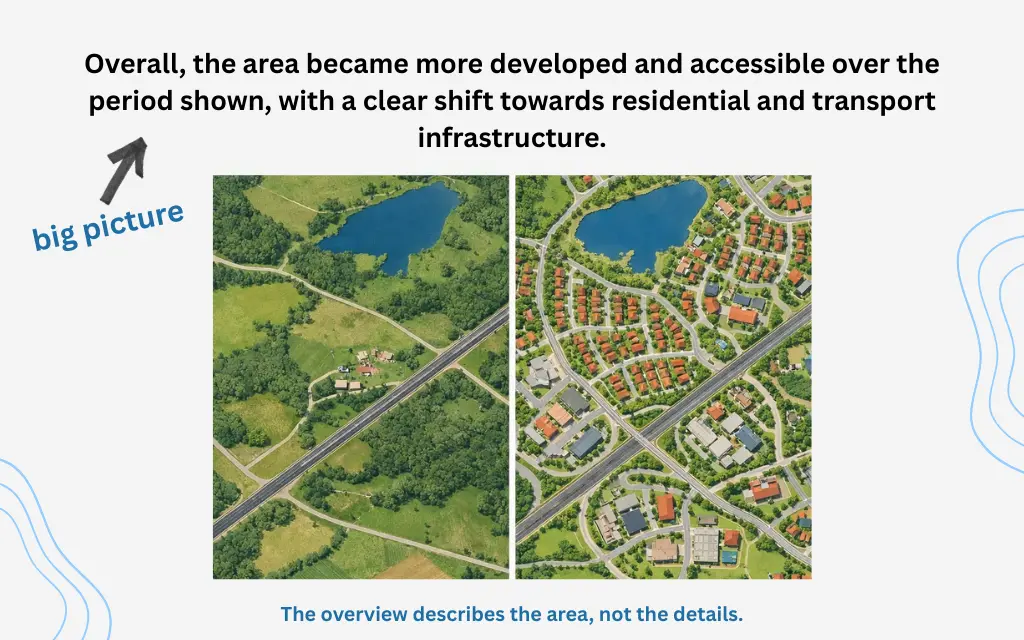
A strong overview summarises the overall nature of the changes. It answers the question: What happened to this place as a whole?
For example, the overview might explain that the area became more developed, more residential, or more accessible. It might also mention whether changes were extensive or limited.
What it should not do is list individual changes or locations. Those belong in the body paragraphs.
Organising Body Paragraphs for Map Comparisons
Clear organisation is essential for map tasks. Examiners want to see that you can group changes logically rather than describing them randomly.
A common and effective approach is to group changes by type rather than by location. For example, you might describe new constructions together and removals together, or infrastructure changes separately from land use changes.
Another approach is to divide the map into areas, such as the north and south, if that suits the changes shown. The best structure depends on the map, but the principle is always the same: make the comparison easy to follow.
Avoid describing features one by one in the order you notice them. This often leads to disorganised writing. See how changes are organised and compared in a complete report with our IELTS map sample answer.
Language for Describing Changes on Maps
Map tasks rely heavily on verbs that describe change. These verbs are different from trend vocabulary and should be chosen carefully.
Commonly used verbs describe actions such as construction, removal, expansion, or replacement. Accuracy matters more than variety. Using a small set of verbs well is better than misusing advanced ones.
Prepositions are also important in map descriptions. Errors with to, into, from, or by are common and can affect grammar scores.
Sentence length should be controlled. Clear sentences that describe one or two changes are easier to manage and easier for the examiner to follow. You can see more vocabulary and example answers in our IELTS Map Vocabulary guide.
Using Comparison Language Naturally
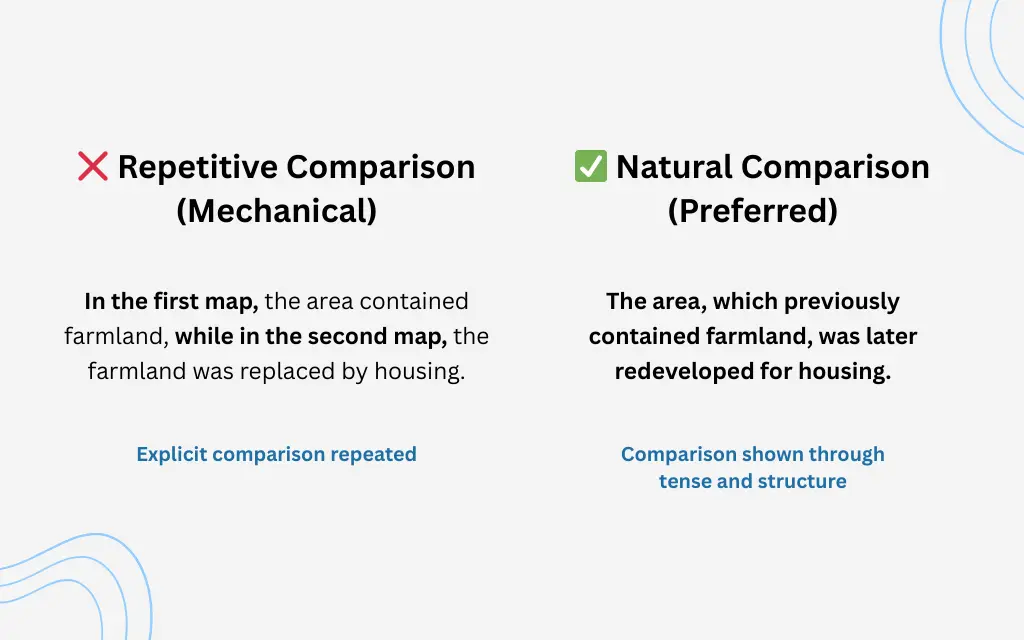
Because Task 1 maps always involve comparison, comparative structures are very useful. However, these should be used naturally, not mechanically.
Instead of repeating “in the first map” and “in the second map” in every sentence, you can often imply comparison through verb tense or structure.
For example, describing what used to exist before explaining what replaced it creates a clear contrast without sounding repetitive.
Common Mistakes in IELTS Task 1 Maps
Several mistakes appear frequently in map writing.
One is describing unchanged features. Examiners are interested in change, not stability.
Another is missing the overview or making it too detailed. This limits the Task Achievement score.
Some candidates also try to explain why changes happened. This introduces opinion and speculation, which is not required and can lower scores.
Finally, poor organisation is common. Jumping around the map without a clear structure makes the report difficult to follow.
How Maps Fit into the Overall Task 1 Strategy
Maps test a slightly different skill set from charts and graphs, but the underlying principles are the same. Clear introduction, strong overview, logical organisation, and controlled language are always rewarded.
Candidates who understand this often find that improving map writing also improves their overall Task 1 performance. The discipline of grouping information and focusing on key features transfers well to other task types.
Conclusion
IELTS Task 1 maps are not about memorising phrases or describing every detail. They are about clear comparison and logical explanation of change.
By understanding the maps first, writing a neutral introduction, summarising the main changes in the overview, and grouping details sensibly, you can approach map tasks with confidence.
To continue building this skill, explore related Learn English Weekly guides on Task 1 sentence structures and Task 1 overviews, where map comparisons are shown in the wider Task 1 context.
Related IELTS Task 1 Lessons
Glossary
Map (noun) – A visual showing the layout of an area
Comparison (noun) – Showing similarities or differences
Development (noun) – The process of building or expansion
Feature (noun) – A structure or element shown on a map
Overview (noun) – A brief summary of the main changes
Practice Questions
- True or False: Trend vocabulary is usually suitable for Task 1 maps.
- What should an overview for maps focus on?
A) Individual buildings
B) Overall changes - Why is grouping changes useful in map writing?
- Short answer: Name one common mistake in Task 1 maps.
- True or False: Explaining why changes happened improves your score.
Answers
- False
- B
- It improves clarity and organisation
- Missing overview / poor organisation / describing unchanged features
- False
Join 1,300+ English learners
Get free English lessons, IELTS tips and useful vocabulary by email.
No spam. Just practical English you can use.