
Introduction to Task 1 Process Diagrams
For many IELTS candidates, process diagrams feel unfamiliar and uncomfortable. There are no numbers, no trends, and no obvious comparisons. As a result, students often panic when they see one and assume it is harder than charts or graphs.
In reality, an IELTS Task 1 process diagram is one of the most predictable Task 1 types once you understand how examiners expect it to be handled. The language is controlled, the structure is logical, and the marking criteria are applied in a very consistent way.
This lesson will explain how to write Task 1 process diagrams step by step. You will learn what examiners are looking for, how process writing differs from chart writing, and how to explain each stage clearly without memorising fixed templates.
Practise English every weekday with me
Get short Mon–Fri English practice in LINE with LEW Daily, plus regular feedback to help you improve.
Explore LEW DailyNT$399/month • Cancel anytime

What Makes Process Diagrams Different from Other Task 1 Tasks
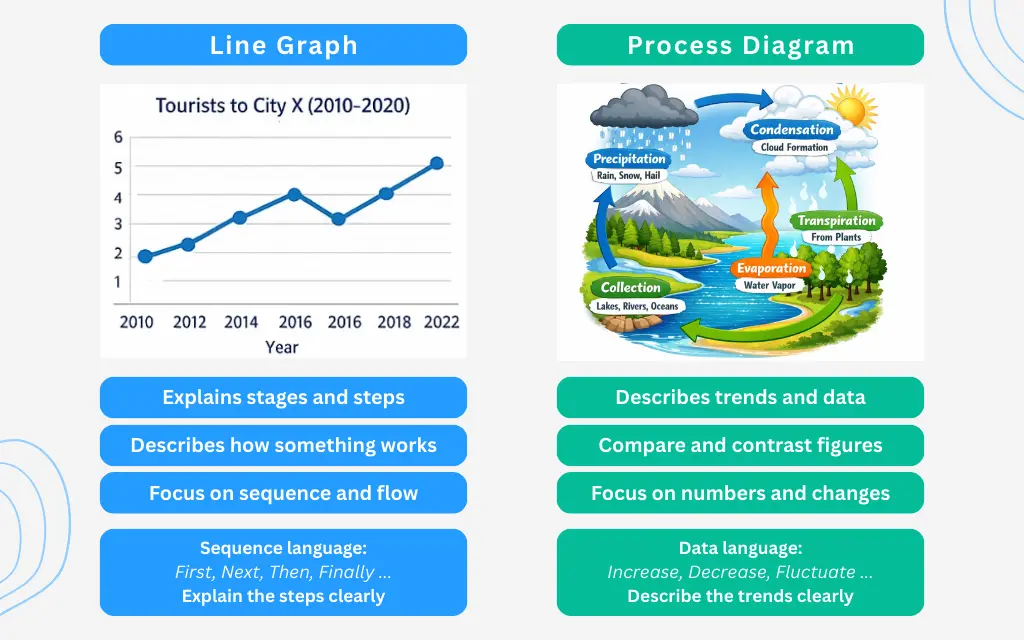
Process diagrams are different because they do not show data. Instead, they show how something works or how something is made, usually from start to finish.
This changes the focus of your writing. Instead of describing trends or comparisons, you are explaining stages and sequences. Accuracy, clarity, and logical flow matter far more than vocabulary range or complex grammar.
Many candidates lose marks because they treat process diagrams like charts. They describe stages as if they were trends, or they search for comparisons that do not exist. Understanding this difference is the first step to improving your score.
What Examiners Expect in Task 1 Process Writing
Examiners assess process diagrams using the same four criteria as all Task 1 tasks, but they apply them slightly differently.
For Task Achievement, examiners look for a clear overview and an accurate description of the main stages. They want to see that you understand the process as a whole, not just individual steps.
For coherence, they expect information to be presented in a logical sequence, usually following the order shown in the diagram.
For lexical resource, accuracy matters more than range. Using the correct verbs for processes is more important than variety.
For grammar, clear sentence structures and correct passive forms are particularly important.
Understanding the Process Before You Write
One of the biggest mistakes candidates make in process diagram IELTS writing is starting too quickly. Before writing anything, you should take a moment to understand the diagram fully.
Ask yourself:
- Where does the process begin?
- Where does it end?
- How many main stages are there?
- Is the process linear or cyclical?
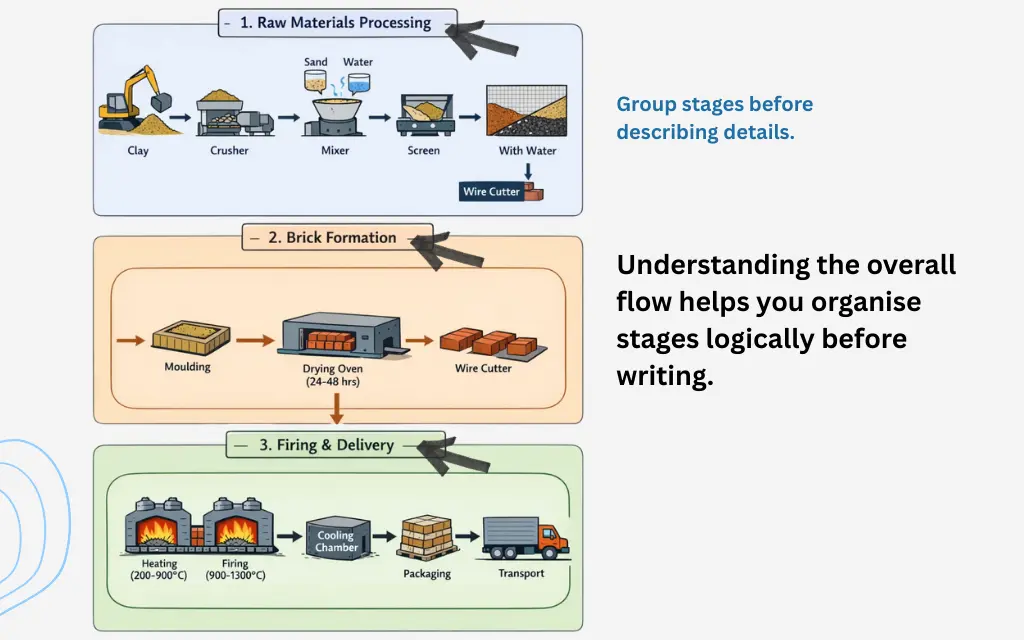
You do not need to describe every small detail in the same level of depth. Your job is to understand the overall flow, then decide how to group stages logically in your writing.
Writing the Introduction for a Process Diagram
The introduction for a process diagram is usually very straightforward. Its purpose is to state what process is shown.
Unlike charts, you do not need to mention time or comparisons. The language should be factual and neutral.
A common problem is trying to add explanation or background knowledge. Examiners do not expect this. They only want to know what the diagram illustrates.
A strong introduction usually fits into one simple sentence. If it feels longer, it is often trying to do too much.
Writing a Clear Overview for Process Diagrams
The overview is just as important in process diagrams as it is in other Task 1 tasks. Missing it can limit your score.
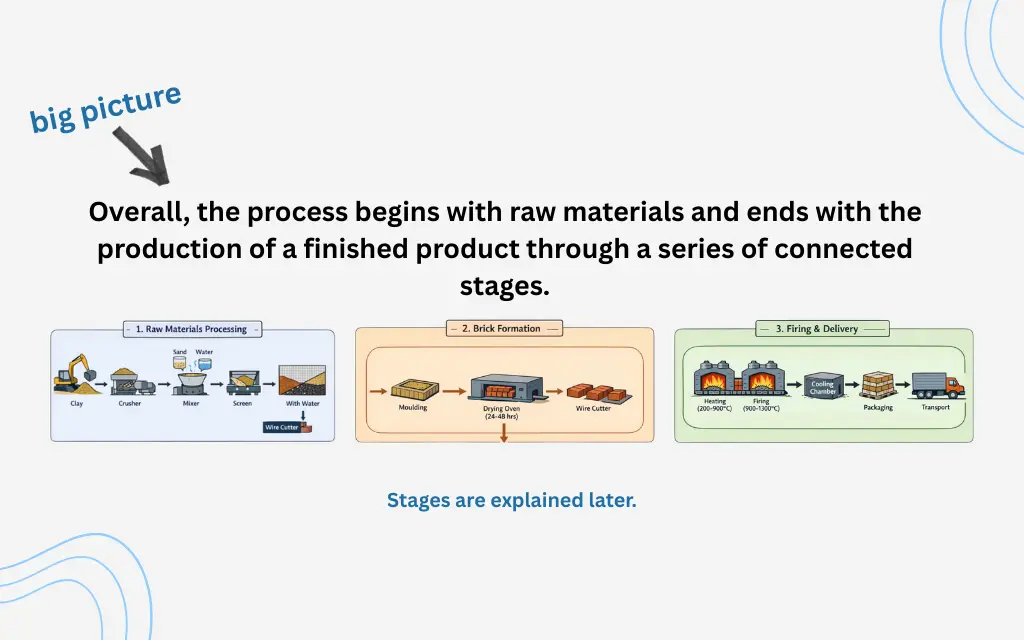
In a Task 1 process explanation, the overview summarises the main stages and often mentions whether the process is linear or cyclical.
A weaker overview might simply repeat that there are several stages. A stronger overview briefly explains where the process starts and finishes, or highlights a key transformation.
The overview should not describe each stage in detail. That belongs in the body paragraphs.
Organising the Body Paragraphs
Once the overview is written, the body of your answer explains the process in more detail.
The most natural way to organise body paragraphs is by grouping stages, not by writing one sentence per step. This helps your writing feel controlled rather than mechanical.
For example, early preparation stages can be described together, followed by later transformation stages. The exact grouping depends on the diagram.
What matters is that the order follows the diagram clearly. Examiners should be able to trace each sentence back to a stage visually without confusion. See how the stages are grouped into a complete report in our IELTS process diagram sample answer.
Using Sequencing Language Naturally
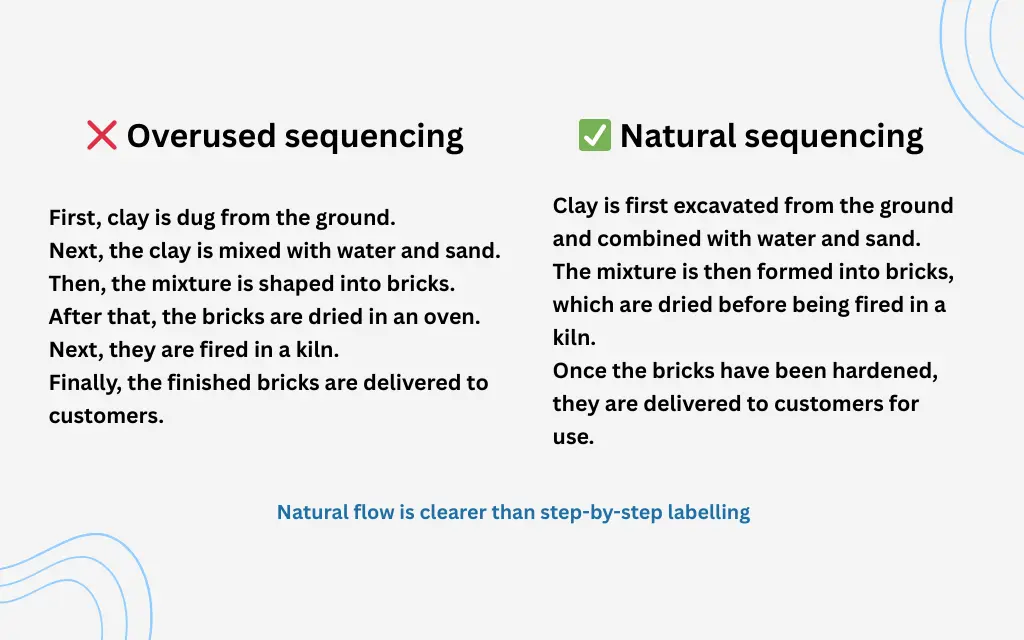
Sequencing is central to process writing, but it should sound natural, not repetitive.
Words like first, next, and finally are useful, but they should not appear in every sentence. Examiners prefer smooth progression rather than obvious step-by-step labelling.
Often, verb tense and sentence structure can show sequence without constant connectors. This creates a more natural academic tone.
Passive Voice in Process Diagrams
The passive voice is very common in process diagrams because the focus is on what happens, not who does it.
For example, materials are often described as being heated, mixed, or transported. This is normal and expected.
However, many candidates overuse the passive voice or form it incorrectly. The goal is clarity, not formality.
Active voice can also be used where appropriate, especially when the diagram clearly shows an agent or system performing an action.
Balance and accuracy matter more than rigid rules.
Avoiding Common Process Diagram Mistakes
Several mistakes appear frequently in Task 1 process writing.
One is adding information that is not shown in the diagram. Examiners penalise this because it suggests guessing rather than describing.
Another mistake is missing stages or describing them in the wrong order. This affects Task Achievement and coherence.
Some candidates also try to compare stages or evaluate efficiency. This turns the task into an opinion, which is not required and can lower the score.
Language That Works Well for Process Descriptions
Process diagrams rely heavily on process verbs. These verbs describe actions such as forming, transferring, heating, or assembling.
You do not need an advanced vocabulary range. What examiners want is precision. Using the same verb accurately is better than using several inaccurately.
Sentence length should be controlled. Long sentences with multiple actions often lead to grammar errors and confusion.
For a deeper list of useful verbs, sequencing phrases, passive structures, and transformation language, read this guide to IELTS process diagram vocabulary.
Checking Your Process Diagram Answer
Before finishing, it is worth checking your answer calmly.
Ask yourself:
- Is the overall process clear from the overview?
- Are all main stages included?
- Is the sequence easy to follow?
- Have I avoided adding information not shown?
If the answer to these questions is yes, your response is likely meeting examiner expectations.
Conclusion
An IELTS Task 1 process diagram is not a trick question. It rewards clarity, organisation, and accurate language rather than complexity.
By understanding the process first, writing a clear overview, grouping stages logically, and using calm, precise language, you can approach process diagrams with confidence.
To develop this skill further, explore related Learn English Weekly guides on Task 1 introductions, Task 1 overviews, and examiner marking, where process diagrams are placed in the wider Task 1 context.
Related IELTS Task 1 Lessons
Glossary
Process diagram (noun) – A visual showing how something is made or how it works
Stage (noun) – One step in a process
Sequence (noun) – The order in which stages occur
Passive voice (noun) – A structure where the action is emphasised, not the actor
Overview (noun) – A brief summary of the main stages or flow
Practice Questions
- True or False: Process diagrams require trend vocabulary.
- What should an overview for a process diagram focus on?
A) Numbers
B) Main stages - Why is grouping stages useful in body paragraphs?
- Short answer: Name one common mistake in process diagrams.
- True or False: Adding background knowledge can improve your score.
Answers
- False
- B
- It improves clarity and organisation
- Missing stages / wrong order / adding extra information
- False
Join 1,300+ English learners
Get free English lessons, IELTS tips and useful vocabulary by email.
No spam. Just practical English you can use.