
Introduction to Punctuation in IELTS Writing
IELTS candidates assume punctuation is a minor detail. They focus on vocabulary, grammar structures, and ideas, believing that commas and full stops are too small to affect a band score.
This belief causes more damage than most learners realise.
While punctuation is not marked as a separate criterion, it directly affects clarity, coherence, and grammatical accuracy. Poor punctuation can make a well-written sentence confusing, or even change its meaning entirely. In IELTS writing, that confusion is noticed immediately by the examiner.
This lesson will explain how punctuation in IELTS writing actually affects your score, which punctuation errors matter most, and how to use punctuation confidently without overthinking it.
Practise English every weekday with me
Get short Mon–Fri English practice in LINE with LEW Daily, plus regular feedback to help you improve.
Explore LEW DailyNT$399/month • Cancel anytime

Does Punctuation Really Affect IELTS Scores?
Punctuation does not appear as a standalone band descriptor, but it plays a supporting role across all writing criteria.
Examiners read quickly and continuously. When punctuation is missing, inconsistent, or incorrect, it interrupts comprehension. That interruption affects how your grammar and coherence are perceived.
In other words, punctuation does not earn marks directly, but it can quietly lose them.
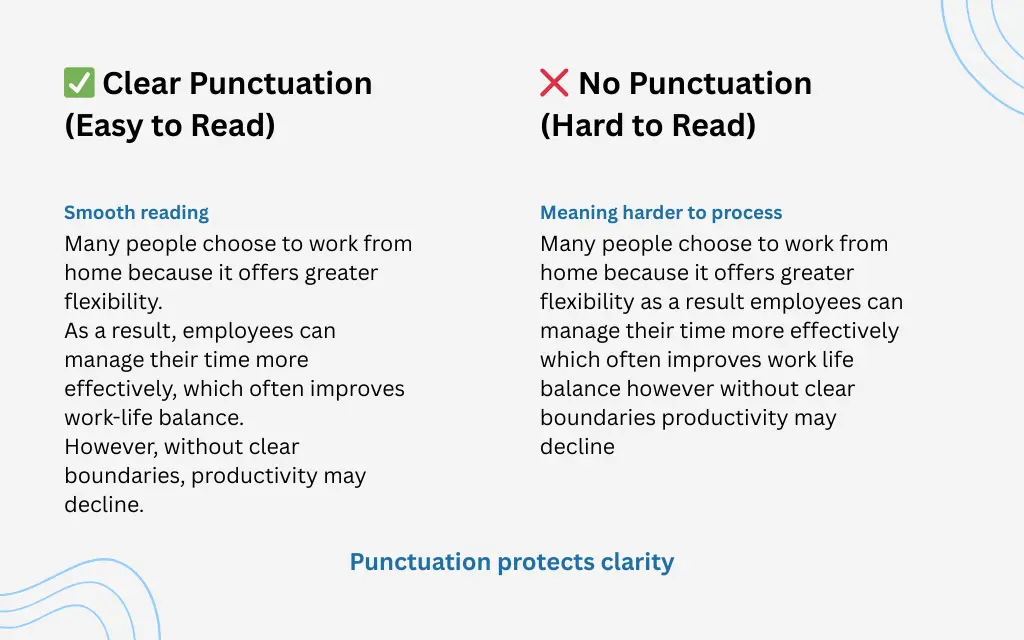
How Examiners Notice Punctuation Problems
Examiners do not analyse punctuation rule by rule. Instead, they react instinctively to readability.
If a sentence flows smoothly, punctuation is assumed to be correct. If a sentence must be reread to understand its structure, punctuation immediately becomes part of the problem.
This is why punctuation errors often lower scores indirectly. They create the impression of weak grammatical control, even when vocabulary and ideas are strong.
Full Stops: The Foundation of Clear Writing
The most important punctuation mark in IELTS writing is the full stop.
Many candidates write sentences that are far too long, connecting multiple ideas without clear endings. This results in run-on sentences that confuse the examiner and reduce clarity.
Clear sentence boundaries signal control. They allow the reader to follow your argument step by step rather than decoding it.
When in doubt, shorter sentences with clear full stops are safer than long sentences with unclear structure.
Commas: The Most Common IELTS Punctuation Problem
Commas cause more issues than any other punctuation mark in IELTS writing.
Some learners avoid commas completely. Others use them too often, inserting them wherever they pause mentally. Both approaches lead to problems.
In IELTS, commas are primarily used to separate ideas within a sentence, clarify clause boundaries, or organise lists. When misplaced, they can blur meaning or break sentence structure.
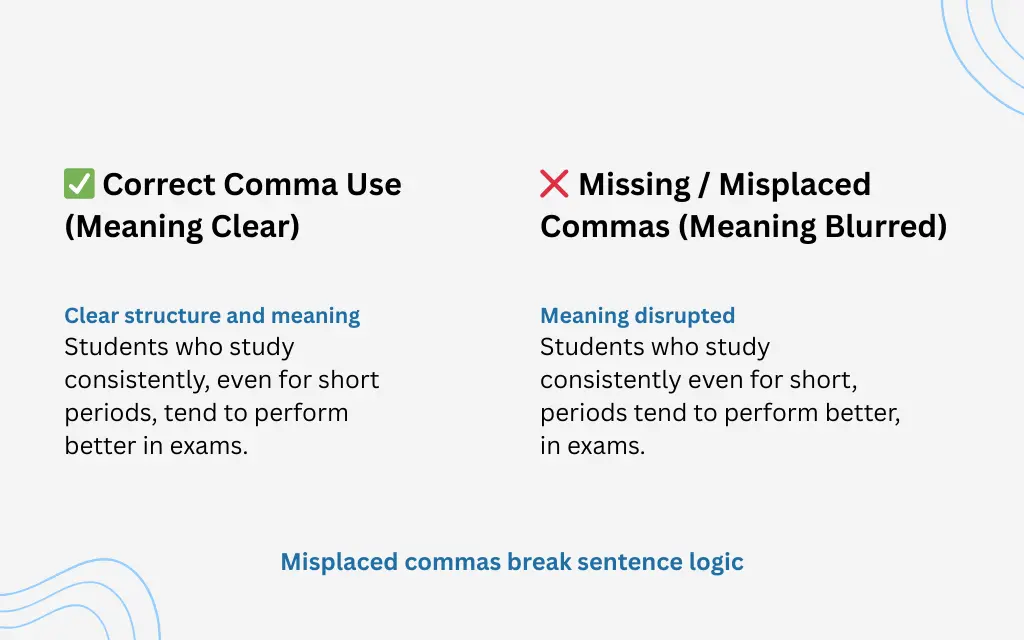
Commas and Complex Sentences
Complex sentences rely heavily on accurate comma use.
When a subordinate clause comes at the beginning of a sentence, a comma usually separates it from the main clause. When extra information is added in the middle of a sentence, commas help signal that the core structure has not changed.
Without commas, complex sentences become difficult to process. This is one reason why candidates who attempt advanced grammar sometimes score lower than expected.
Lists and Punctuation in Task 1 and Task 2
Lists appear frequently in IELTS writing, especially in Task 2 examples and Task 1 descriptions.
Using commas correctly in lists improves readability and professionalism. Missing commas can make items merge together, while unnecessary punctuation can look awkward or informal.
Consistency matters more than perfection. A clear, simple list structure is always preferable to an ambitious but unstable one.
Apostrophes: Small Mark, Big Confusion
Apostrophes are often misused or avoided entirely by IELTS candidates.
The most common issue is confusing possession with plural forms. This can make otherwise accurate sentences look careless.
In academic writing, apostrophes appear mainly in possessive structures rather than contractions. Overusing contractions can make writing sound informal, which is risky in IELTS Task 2.
Colons and Semicolons: Do You Need Them?
Many learners believe that using colons and semicolons will make their writing look more academic.
In reality, these punctuation marks are not required for high IELTS scores. When used incorrectly, they often create more problems than benefits.
If you are confident with them, they can be used sparingly. If not, you can safely ignore them and still achieve Band 8 or Band 9.
Examiners reward clarity, not punctuation ambition.
Capital Letters and Formatting Awareness
Capitalisation is part of punctuation awareness.
Errors with capital letters at the beginning of sentences, with proper nouns, or in headings can signal inattention rather than language weakness. While small, these errors accumulate.
Clear, consistent formatting helps the examiner focus on your ideas rather than surface-level distractions.
Punctuation in Task 1 vs Task 2
Punctuation plays slightly different roles across tasks.
In Task 1, punctuation supports factual clarity. Commas help separate figures, clauses describe trends, and full stops prevent overcrowded descriptions.
In Task 2, punctuation supports argument flow. Sentence boundaries and commas guide the reader through reasoning, examples, and conclusions.
Using punctuation appropriately for the task shows awareness rather than memorisation.
Common Punctuation Errors That Cost Marks
Most punctuation-related score losses come from a small number of repeated issues.
These include missing full stops, overlong sentences, incorrect comma placement in complex sentences, and inconsistent apostrophe use.
These errors rarely appear alone. They tend to cluster, gradually reducing the overall impression of accuracy.
How to Improve Punctuation Without Studying Rules
The most effective way to improve punctuation is not memorising rules, but reading your writing aloud.
When you pause naturally, punctuation is often needed. When you run out of breath, the sentence is probably too long.
This practical approach mirrors how examiners experience your writing and leads to faster improvement than rule-based study alone.
How to Check Punctuation in the Exam
You do not need to check every comma during the exam.
Instead, focus on sentence endings first. Make sure each sentence ends clearly. Then check any long sentences for clarity.
If a sentence looks crowded, split it. This single adjustment improves punctuation, grammar, and coherence simultaneously.
Conclusion
Punctuation in IELTS writing does matter, not because examiners count commas, but because punctuation shapes clarity.
Clear punctuation supports grammar accuracy, coherence, and readability. Poor punctuation undermines them quietly but consistently.
By focusing on sentence boundaries, controlled comma use, and avoiding unnecessary complexity, you can improve your writing without extra memorisation.
For further improvement, explore related grammar guides on Learn English Weekly that show how punctuation supports sentence structure and examiner expectations.
Related IELTS Grammar Lessons
Glossary
Punctuation (noun) — Marks used in writing to organise sentences and clarify meaning
Comma (noun) — A punctuation mark used to separate parts of a sentence
Full stop (noun) — A punctuation mark used to end a sentence
Apostrophe (noun) — A mark showing possession or omission
Run-on sentence (noun) — A sentence with no clear ending
Practice Questions
- True or False: Punctuation is a separate marking criterion in IELTS writing.
- Short answer: Why can punctuation errors lower grammar scores indirectly?
- Multiple choice: Which punctuation mark is most important for clarity?
A) Comma
B) Full stop
C) Apostrophe - True or False: Colons and semicolons are required for Band 8+.
- Short answer: What is the simplest way to check punctuation during the exam?
Answers
- False
- They reduce clarity and interrupt comprehension
- B
- False
- Check sentence endings and split long sentences
Join 1,300+ English learners
Get free English lessons, IELTS tips and useful vocabulary by email.
No spam. Just practical English you can use.