
Introduction to Task 1 Introduction Types
For many IELTS candidates, the introduction in Writing Task 1 feels deceptively simple. It is short, factual, and usually only one sentence long, yet it causes more problems than students expect. Some introductions sound awkward. Others repeat the task question almost word for word. And some candidates try to be creative, which usually backfires.
The truth is that the IELTS Task 1 introduction is not a place to impress the examiner. It has one clear job: to show that you understand what the visual is about and can describe it accurately in your own words.
This lesson will explain how to write Task 1 introductions properly for all major Task 1 types, why examiners care about them, and how to keep your introductions safe, clear, and flexible, without memorising fixed templates.
Practise English every weekday with me
Get short Mon–Fri English practice in LINE with LEW Daily, plus regular feedback to help you improve.
Explore LEW DailyNT$399/month • Cancel anytime

What an IELTS Task 1 Introduction Is Designed to Do
An IELTS Task 1 introduction serves a very specific purpose. It tells the examiner what information is presented and how it is organised. Nothing more, and nothing less.
Examiners expect the introduction to paraphrase the task question. This shows that you can understand the prompt and express the same idea using different language. It does not require interpretation, analysis, or opinion.
A strong introduction answers three quiet questions in the examiner’s mind:
- What type of visual is this?
- What is being measured or shown?
- What is the scope (time, categories, or process)?
If those points are clear, the introduction has done its job.
What an Introduction Is Not
Many Task 1 introductions lose marks not because they are incorrect, but because they try to do too much.
An introduction is not an overview. It should not describe trends, comparisons, or conclusions. Those belong in the overview paragraph. It is also not a background paragraph. Examiners do not expect extra context or explanations beyond the visual itself.
Another common mistake is copying the task question with only small grammatical changes. This does not demonstrate paraphrasing skill and can limit the score for lexical resource.
A good introduction is neutral, factual, and restrained.
A Safe Structure for All Task 1 Introductions
Although Task 1 visuals vary, the structure of the introduction is remarkably consistent. Most strong introductions can be written in a single sentence that follows a simple pattern.
The sentence usually:
- Identifies the visual (chart, graph, table, diagram, map)
- States what is being shown
- Mentions the time frame or categories, if relevant
This structure is flexible. You are not memorising a sentence, but a sentence shape that can be adapted to any task.
Writing Introductions for Charts Showing Change Over Time
Charts that show change over time are extremely common in Task 1. These include line graphs and many bar charts.
In these cases, the introduction should clearly mention:
- What is changing
- Over what period of time
There is no need to describe how it changes in the introduction. That belongs in the overview.
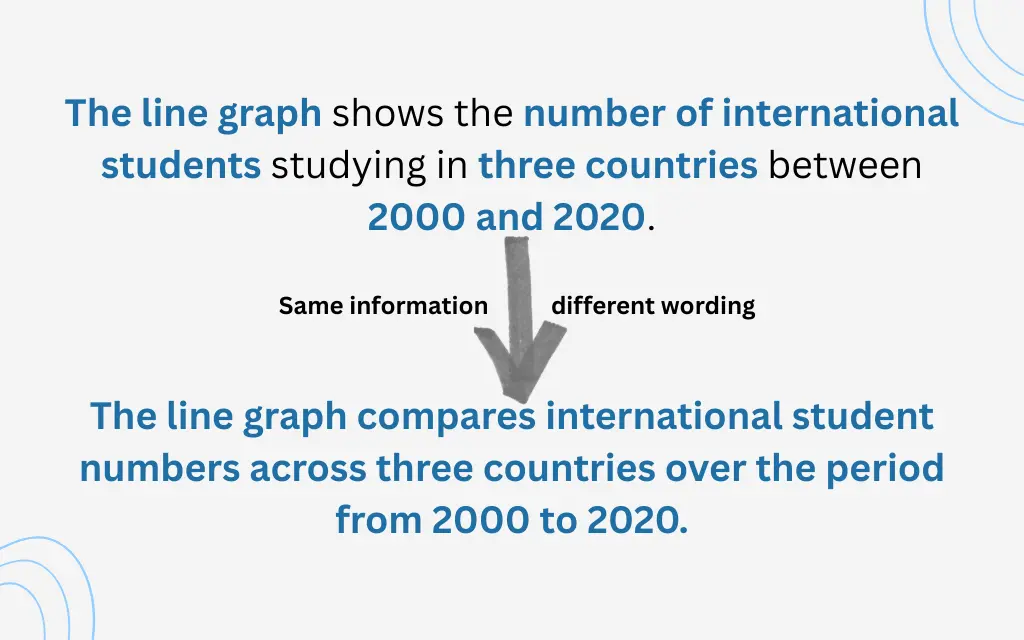
A weaker introduction might sound repetitive because it mirrors the task question too closely. A stronger introduction rephrases the same idea naturally, often by changing the verb or sentence structure.
For example, instead of saying that something “shows changes”, it might say that the chart “illustrates trends” or “compares figures” over a given period.
Writing Introductions for Comparisons (No Time Element)
Some Task 1 visuals compare categories at a single point in time. These are often bar charts or tables.
Here, the introduction should focus on:
- What is being compared
- Between which groups or categories
Because there is no time change, words related to trends should be avoided. Using time language in these introductions can confuse the examiner.
A clear, factual sentence that explains what the data compares is all that is required. Examiners are not looking for complexity here, only accuracy.
Writing Introductions for Tables
Tables often cause uncertainty because they can include both time and category information.
The key with tables is to decide what the main organisational feature is. Is the table mainly comparing years? Or mainly comparing categories?
Your introduction should reflect that focus. If both are equally important, the sentence can mention both briefly, but clarity should always come first.
Many candidates try to describe too much in table introductions. This usually leads to long, awkward sentences. Keeping the sentence clean and factual helps maintain control.
Writing Introductions for Process Diagrams
Process diagrams are different from charts and graphs because they do not show numerical data.
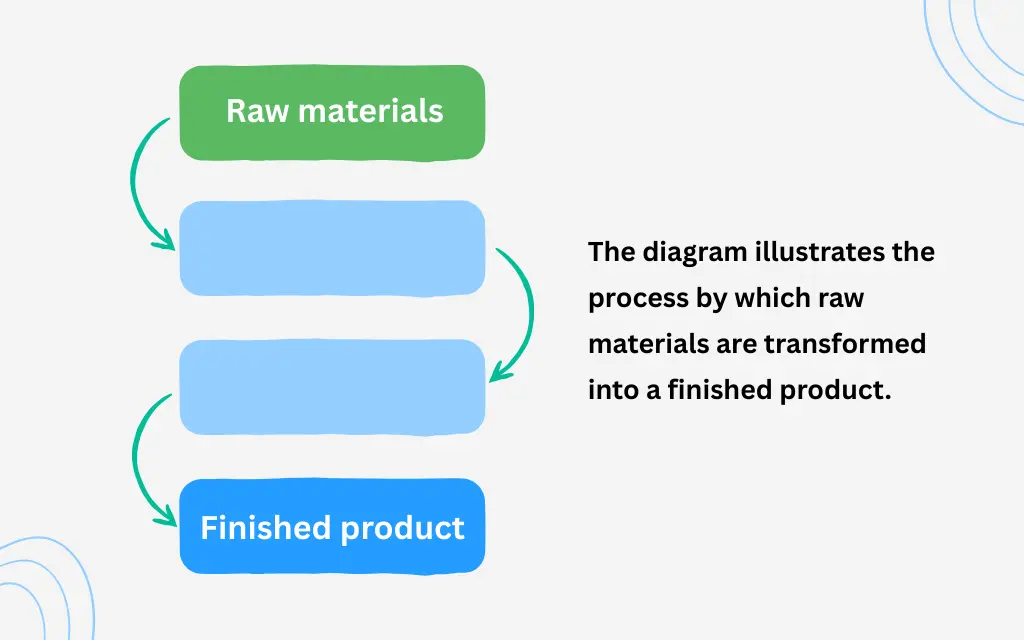
For process diagrams, the introduction should explain:
- What process is shown
- What the start and end points are
There is no need to mention steps or sequence yet. That comes later in the body paragraphs.
The language here is descriptive rather than comparative. Verbs such as illustrates or shows are common and perfectly acceptable.
Writing Introductions for Maps
Map tasks often show changes to a location over time or compare different layouts.
A good introduction for maps identifies:
- The location
- The time frame or comparison being made
It should not describe specific changes such as new buildings or removed features. Those details belong later in the report.
Map introductions benefit from calm, neutral phrasing. Trying to sound sophisticated often leads to unclear sentences.
Language Choices That Improve Introductions
Strong IELTS writing introductions for Task 1 rely on safe, accurate vocabulary. There is no advantage in using rare or dramatic words here.
Verbs such as illustrates, shows, compares, and presents are commonly used because they are clear and reliable. Variety is helpful, but accuracy matters more than range at this stage.
Sentence length should be controlled. One well-written sentence is usually enough. Two short sentences can also work, but longer introductions often introduce errors unnecessarily.
Common Introduction Mistakes That Limit Scores
Several mistakes appear repeatedly in Task 1 introductions.
One is including an opinion or conclusion. Another is describing trends too early. Both blur the boundary between the introduction and the overview.
Another frequent issue is grammatical error caused by long noun phrases. Candidates often try to pack too much information into one sentence and lose control of articles or prepositions.
Finally, some candidates omit the introduction entirely and start with the overview. This can confuse the examiner and weaken the overall structure of the answer.
Checking Your Introduction Before Moving On
Before writing the overview, it is worth checking your introduction quickly.
A simple test is to ask:
- Does this sentence clearly describe the visual?
- Have I paraphrased rather than copied?
- Have I avoided analysis or conclusions?
If the answer to all three is yes, your introduction is doing its job.
Conclusion
The IELTS Task 1 introduction is short, but it plays an important role in shaping the examiner’s first impression of your writing. When it is clear, accurate, and well-controlled, it supports coherence and prepares the reader for what follows.
By focusing on paraphrasing the task, keeping language neutral, and adjusting your sentence to the visual type, you can write strong introductions consistently, without memorising fixed templates.
To build on this skill, explore related Learn English Weekly guides on Task 1 overviews, sentence structures, and examiner marking to see how introductions fit into the full response.
Related IELTS Task 1 Lessons
Glossary
Introduction (noun) – The opening sentence or paragraph that describes the task
Paraphrase (verb) – To express the same idea using different words
Visual (noun) – The chart, graph, table, map, or diagram in Task 1
Category (noun) – A group or type being compared
Time frame (noun) – The period shown in the data
Practice Questions
- True or False: An introduction should describe trends.
- Which verb is most suitable for a neutral Task 1 introduction?
A) Argues
B) Illustrates - Why is copying the task question a problem?
- Short answer: Name one thing an introduction should include.
- True or False: One sentence is usually enough for a Task 1 introduction.
Answers
- False
- B
- It does not demonstrate paraphrasing skill
- What the visual shows / the subject of the data
- True
Join 1,300+ English learners
Get free English lessons, IELTS tips and useful vocabulary by email.
No spam. Just practical English you can use.