
Introduction to IELTS Verb Tenses
IELTS learners spend months revising English verb tenses, yet still lose marks in the writing test. They memorise tables, practise rare forms, and worry about rules that almost never appear in IELTS answers.
The problem is not effort. It is focus.
IELTS does not reward how many tenses you know. It rewards how accurately and appropriately you use the few tenses that matter. This is why understanding IELTS verb tenses from an exam perspective is so important.
In this lesson, we will strip grammar back to what examiners actually notice. You will see which tenses are essential for IELTS writing, which ones cause the most errors, and how tense choice affects clarity, coherence, and band scores.
Practise English every weekday with me
Get short Mon–Fri English practice in LINE with LEW Daily, plus regular feedback to help you improve.
Explore LEW DailyNT$399/month • Cancel anytime

How Examiners Really Judge Verb Tense Use
Examiners do not tick off tense names. They assess accuracy, consistency, and control.
When reading an essay or report, examiners ask:
- Is the tense appropriate for the meaning?
- Is it used consistently?
- Does it help clarity rather than confuse it?
A candidate who uses three tenses accurately will score higher than one who attempts ten tenses with frequent errors. This is why verb tense errors in IELTS writing are more damaging than limited range.
Why Tense Choice Matters in IELTS Writing
Verb tense affects how the reader understands time, cause, and development.
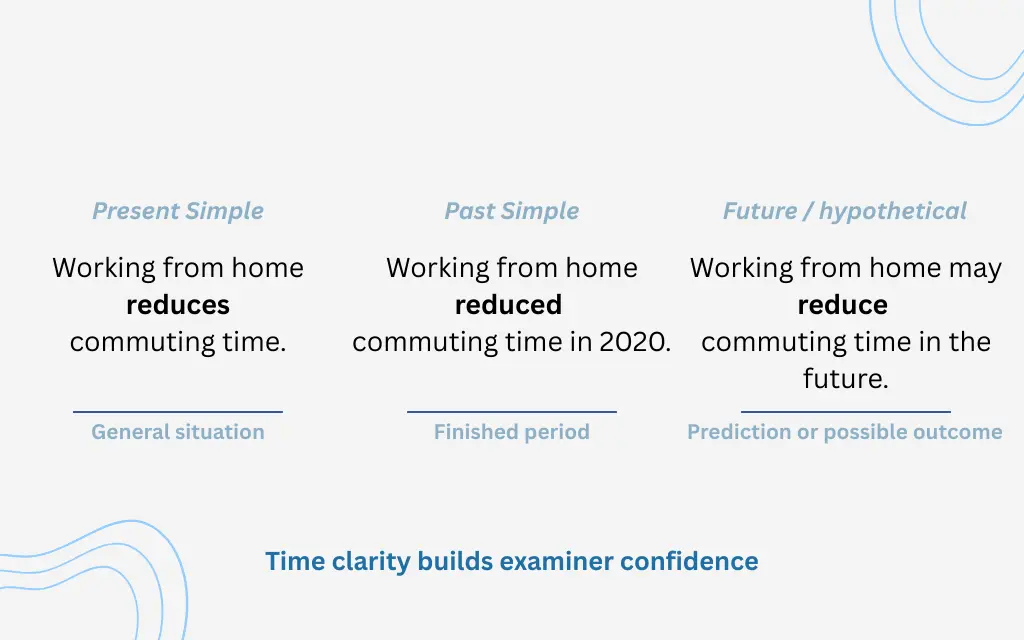
In Task 1, tense tells the examiner whether data describes the past, present, or future. In Task 2, it shows whether ideas are general truths, past examples, or hypothetical outcomes.
When tense use is unclear, the examiner has to pause and interpret meaning. That hesitation lowers confidence in the writing, and confidence is key in band decisions.
The Most Important Tenses for IELTS Task 2
Task 2 essays focus on ideas, opinions, and general situations. As a result, a small group of tenses does most of the work.
The present simple is the backbone. It is used for general statements, opinions, and widely accepted facts. Most Task 2 sentences should naturally fall into this tense.
The present perfect appears when discussing change or development up to the present. It is useful, but often overused incorrectly.
The past simple is mainly used for specific examples from history or personal experience, but should be used carefully and sparingly.
Future forms appear in predictions and solutions, but do not need complex structures to be effective.
Present Simple: The Foundation of IELTS Writing
The present simple is the safest and most reliable tense in IELTS writing.
It is used to express opinions, describe general trends, and discuss social issues. Examiners expect it to be used accurately and consistently.
Most tense-related band losses come from errors in sentences that should be simple present. When learners try to “upgrade” these sentences unnecessarily, accuracy often drops.
Control of the present simple is far more valuable than variety without control.
Present Perfect: Useful but Risky
The present perfect often causes confusion.
It is useful when talking about change over time without specifying when something happened. However, many candidates use it when the past simple is required, or mix the two within the same paragraph.
In IELTS writing, incorrect present perfect use stands out immediately. Examiners notice tense confusion quickly because it affects meaning.
If you are unsure, it is often safer to use the present simple or past simple clearly rather than risk incorrect present perfect forms.
Past Simple: Specific, Not General
The past simple has a clear role: talking about completed events in the past.
In Task 2, this usually appears in examples. Problems occur when candidates describe general situations using the past tense, which makes ideas sound limited or outdated.
In Task 1, the past simple is essential when describing data from a finished time period. Here, accuracy matters more than variety.
Future Forms: Keep Them Simple
Future tense errors are common, but unnecessary.
Many candidates attempt complex future forms such as future perfect or conditional chains. In most cases, these are not required.
Simple future structures clearly express predictions and solutions and are perfectly acceptable for high band scores.
Examiners prefer clarity over ambition.
Consistency: A Bigger Issue Than Variety
One of the most common grammar for IELTS writing problems is tense inconsistency.
A paragraph may start in the present simple, shift into the past, then return to the present without reason. This confuses the reader and damages coherence.
Examiners are not forgiving of random tense changes. Consistency within sentences and across paragraphs is essential.
Verb Tenses in IELTS Task 1 vs Task 2
Task 1 and Task 2 have different tense priorities.
Task 1 requires accurate interpretation of time in visual data. The tense is often dictated by the chart or diagram itself. Misreading this leads to immediate errors.
Task 2 is more flexible, but still expects logical tense use. Essays that jump between past, present, and future without clear reason feel uncontrolled.
Understanding this difference helps reduce unnecessary mistakes.
Common Verb Tense Errors IELTS Examiners Notice
Some errors appear repeatedly in lower-band scripts.
These include incorrect subject-verb agreement in present simple sentences, confusion between past simple and present perfect, and unnecessary future forms.
What makes these errors costly is not their complexity, but their frequency. Repeated small tense mistakes reduce examiner confidence.
Do You Need Advanced Tenses for a High Band?
No.
Band 7, 8, and even 9 essays often rely on a narrow range of tenses used extremely well. Examiners reward precision, not display.
Advanced tenses are only helpful when they are needed for meaning. Using them simply to sound impressive often backfires.
This is why exam-focused grammar study is more effective than general grammar revision.
How to Check Your Own Tense Use
A simple self-check can reveal most tense problems.
Read one paragraph at a time and ask:
- What time am I talking about here?
- Does every verb match that time?
- Is there any unnecessary tense change?
This approach mirrors how examiners notice tense errors while reading.
Conclusion
Mastering IELTS verb tenses is not about learning everything English grammar offers. It is about controlling the small set of tenses that IELTS writing actually requires.
By prioritising accuracy, consistency, and appropriate tense choice, you reduce errors that examiners notice immediately and improve clarity across both Task 1 and Task 2.
To continue building exam-relevant grammar skills, explore related guides on Learn English Weekly that focus on accuracy, sentence control, and examiner marking criteria.
Related IELTS Grammar Lessons
Glossary
Verb tense (noun) — A form of a verb showing time
Present simple (noun) — A tense used for general truths and opinions
Present perfect (noun) — A tense linking past events to the present
Past simple (noun) — A tense for completed past actions
Consistency (noun) — Using the same tense logically within context
Practice Questions
- True or False: IELTS rewards the use of many different verb tenses.
- Short answer: Why is present simple so important in Task 2?
- Multiple choice: Which causes more problems in IELTS writing?
A) Limited tense range
B) Inaccurate tense use
C) Short sentences - True or False: Future perfect tense is essential for high bands.
- Short answer: What should you check when reviewing tense use?
Answers
- False
- It expresses general ideas and opinions clearly
- B
- False
- Accuracy, consistency, and meaning
Join 1,300+ English learners
Get free English lessons, IELTS tips and useful vocabulary by email.
No spam. Just practical English you can use.