
Introduction to Common IELTS Listening Mistakes
Students leave the IELTS Listening test feeling confident.
“I understood most of it.”
“It didn’t seem too difficult.”
Then the results arrive and the band score is lower than expected.
This experience is extremely common. The problem is rarely a lack of English ability. More often, it is a series of repeated IELTS listening mistakes that quietly reduce your score.
The Listening test is objective. Every lost mark has a specific cause. When you identify those causes, improvement becomes predictable.
This lesson explains the most common listening errors in IELTS, why they happen, and how to correct them efficiently.
Practise English every weekday with me
Get short Mon–Fri English practice in LINE with LEW Daily, plus regular feedback to help you improve.
Explore LEW DailyNT$399/month • Cancel anytime

Ignoring Instructions and Word Limits
One of the most damaging IELTS listening problems is failing to follow instructions precisely.
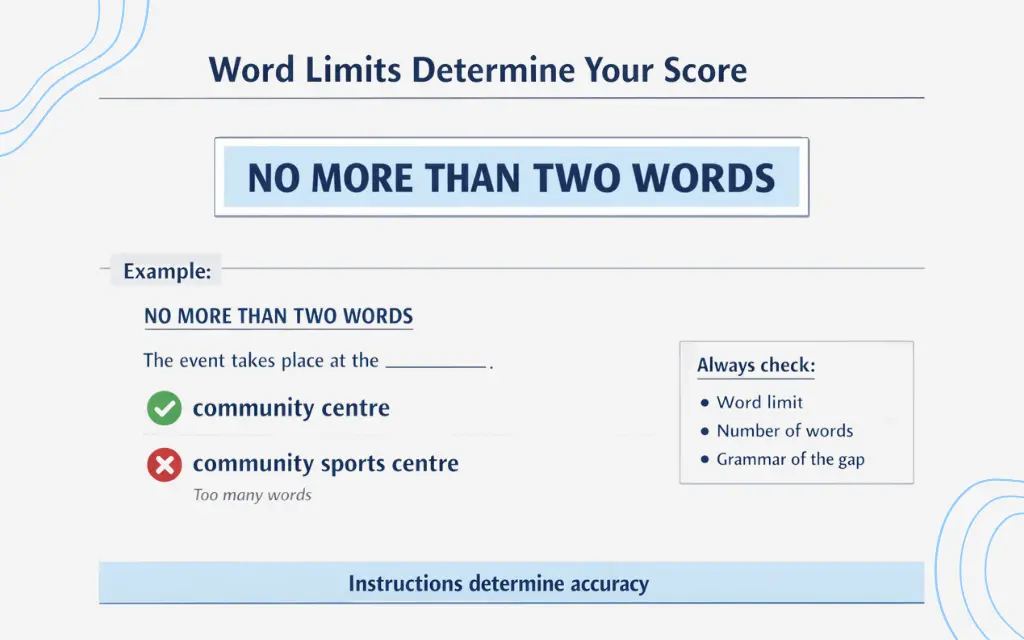
Each section clearly states a word limit, such as:
NO MORE THAN TWO WORDS
ONE WORD AND/OR A NUMBER
If the correct answer is “community sports centre” and the instruction says “NO MORE THAN TWO WORDS”, writing all three words makes the answer incorrect. Even perfect comprehension cannot save that mark.
This mistake usually happens because candidates focus entirely on the recording and forget to check the question carefully.
The solution is simple but powerful. Before each section begins, read the instructions again. Check the word limit. Check the grammar of the gap. Make this a routine habit.
Losing Focus After One Missed Answer
A very common IELTS listening mistake is emotional reaction.
You miss one answer. You start thinking about it. While you are thinking, the recording continues. Now you miss the next answer as well.
Listening tests move forward. They never pause. This is not a language issue. It is a concentration issue.
If you are unsure whether the answer was “15th June” or “15th July”, you must move on immediately. Leave the gap blank and refocus on the next question.
You can make an educated guess at the end. You cannot rewind the audio. High-scoring candidates protect their concentration at all costs.
Falling for Distractors
Distractors are deliberate corrections or changes in the recording. They are especially common in Section 3.
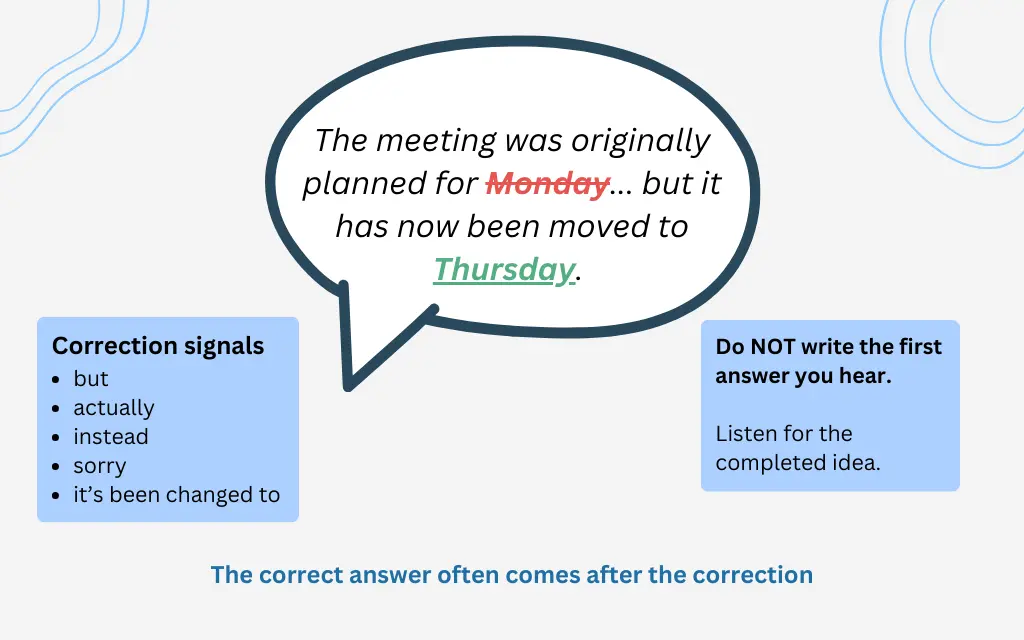
A speaker may say:
“The meeting was originally planned for Monday… but it has now been moved to Thursday.”
Students who react too quickly write “Monday” and lose the mark.
This happens because they stop listening as soon as they hear a familiar keyword.
To avoid this, train yourself to listen for completion. Wait until the speaker finishes the full idea. Words such as “actually”, “instead”, “sorry”, or “it’s been changed to” often signal the real answer.
Weak Spelling Accuracy
Spelling errors quietly reduce many Listening scores.
If the correct answer is “accommodation” and you write “acommodation”, the answer is wrong.
Band 6 candidates frequently lose two to four marks purely because of spelling.
The cause is simple. Students practise listening skills but neglect spelling review.
After each practice test, note incorrect spellings. Build a personal spelling list. Rewrite difficult words from memory. Words such as “environment”, “government”, “necessary”, and “opportunity” regularly appear in IELTS.
This is one of the easiest improvements you can make.
Not Using Preparation Time Effectively
Before each section begins, IELTS gives you time to read the questions. Many students use this time passively.
Strong candidates predict.
If the sentence reads:
“The hotel is located near the ______.”
You already know the answer will be a noun, probably a place.
Prediction prepares your brain to recognise information faster. Without prediction, you process the recording more slowly and miss details.
Preparation time is part of the test. Use it strategically.
Writing Answers Too Early
Some candidates write answers the moment they hear a familiar word.
However, IELTS frequently includes clarifications and adjustments.
For example:
“The course costs £250, but students receive a £50 discount.”
If the question asks for the final cost, writing “250” immediately results in a lost mark.
Patience improves accuracy. Listen until the full explanation is complete before deciding.
Poor Checking at the End
At the end of the Listening test, you have time to check answers. Many candidates underestimate how valuable this time is.
This is when you should:
Check spelling
Check word limits
Check singular and plural forms
For example, if the answer should be “tickets” and you wrote “ticket”, the grammar of the sentence may make it incorrect.
Careful checking often recovers one or two marks.
Weak Performance in Sections 3 and 4
Many IELTS listening problems appear in the final two sections.
Section 3 contains academic discussion between multiple speakers.
Section 4 is usually a continuous lecture.
Speech is faster. Vocabulary is more complex. Pauses are shorter. Band 6 candidates often perform well in Sections 1 and 2 but lose marks later.
Improvement requires exposure to university-style discussions and lecture recordings. Regular listening to academic podcasts or university talks builds familiarity and confidence.
Not Recognising Paraphrasing
IELTS rarely repeats question wording exactly.
If the question asks for the “main disadvantage”, the recording might refer to the “biggest drawback”. If you listen only for exact words, you will miss answers.
After practice tests, review paraphrasing patterns. Notice how ideas are reformulated. Build awareness of common synonyms such as:
problem and issue
benefit and advantage
expensive and costly
Paraphrasing recognition is essential for Band 7 and above.
Practising Without Analysing Mistakes
Perhaps the biggest IELTS listening mistake is practising without reflection.
Completing ten tests without reviewing errors is less effective than analysing three carefully.
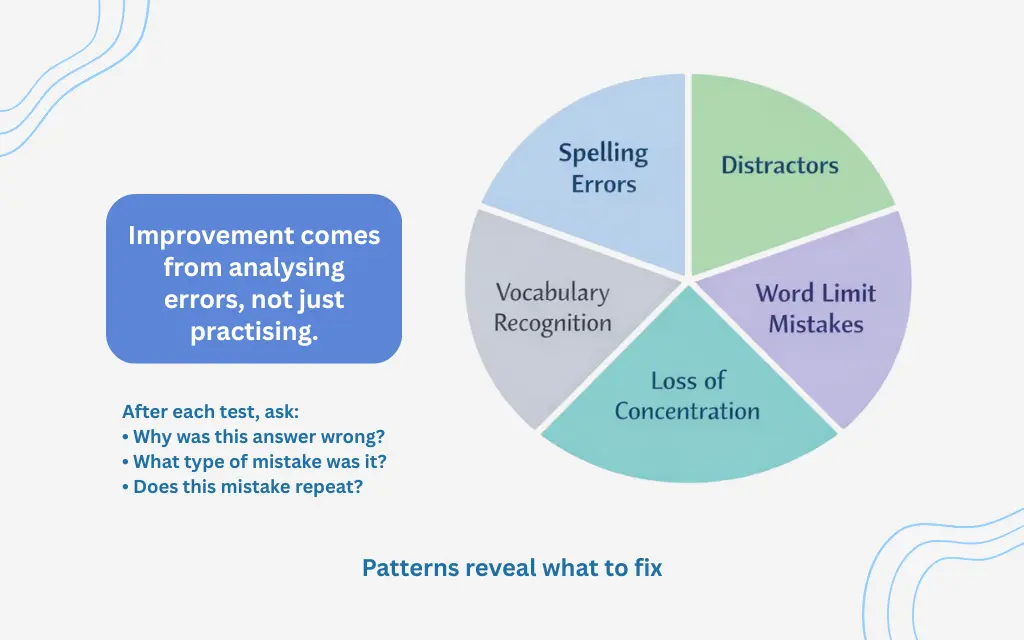
After each test, identify why each incorrect answer happened.
Was it spelling?
Was it a distractor?
Was it word limit confusion?
Was it loss of concentration?
Patterns will appear. When patterns appear, solutions become clear.
A Simple Diagnostic Approach
After your next practice test, categorise each incorrect answer.
If most mistakes come from spelling, focus there.
If most come from distractors, train active listening.
If most come from Sections 3 and 4, increase academic listening exposure.
Diagnosis turns frustration into direction.
Conclusion
Most IELTS listening mistakes are predictable and preventable.
They rarely come from low intelligence or poor English. They come from small habits that repeat under pressure.
When you:
Follow instructions precisely
Maintain concentration
Strengthen spelling accuracy
Recognise distractors
Analyse your errors
your IELTS listening band score improves steadily.
Small adjustments in Listening often produce noticeable band increases.
Related IELTS Listening Lessons
-
- IELTS Listening – Complete Guide to Sections and Question Types
- Common Traps in IELTS Reading Questions
-
How IELTS Listening Is Marked
- IELTS Listening – Complete Guide to Sections and Question Types
Glossary
Distractor (noun)
Incorrect information designed to mislead candidates.
Paraphrasing (noun)
Expressing the same idea using different words.
Word limit (noun)
The maximum number of words allowed in an answer.
Raw score (noun)
The total number of correct answers out of 40.
Band score (noun)
The final IELTS score from 1 to 9.
Practice Section
Questions
- (MCQ) What happens if you exceed the word limit?
A. Half marks
B. No penalty
C. The answer is incorrect
D. You lose one overall band - (True/False) Distractors are especially common in Section 3.
- (Short Answer) Why is prediction useful before listening?
- (MCQ) Which issue commonly reduces scores by 2–4 marks?
A. Accent
B. Spelling errors
C. Handwriting
D. Background noise - (True/False) Doing many practice tests without reviewing mistakes is effective preparation.
Answers
- C
- True
- It prepares your brain to recognise correct information more quickly.
- B
- False
Join 1,300+ English learners
Get free English lessons, IELTS tips and useful vocabulary by email.
No spam. Just practical English you can use.