
Introduction to IELTS Listening Section 2
Candidates feel confident after Section 1 of the Listening test, until Section 2 begins.
The voice changes. The structure shifts. The rhythm feels more formal.
And suddenly, the test feels harder.
IELTS Listening Section 2 is often underestimated. It is not academic like Section 4, and it does not involve a discussion like Section 3. Instead, it features a single speaker in a real-life context. Because it is a monologue listening IELTS task, there is no helpful repetition or clarification from another speaker.
This lesson explains what Section 2 really involves, why it feels more difficult than Section 1, the common task types (especially map labelling), and how to approach it with control and confidence.
When you understand how Section 2 works, it becomes structured rather than stressful.
Practise English every weekday with me
Get short Mon–Fri English practice in LINE with LEW Daily, plus regular feedback to help you improve.
Explore LEW DailyNT$399/month • Cancel anytime

What Is IELTS Listening Section 2?
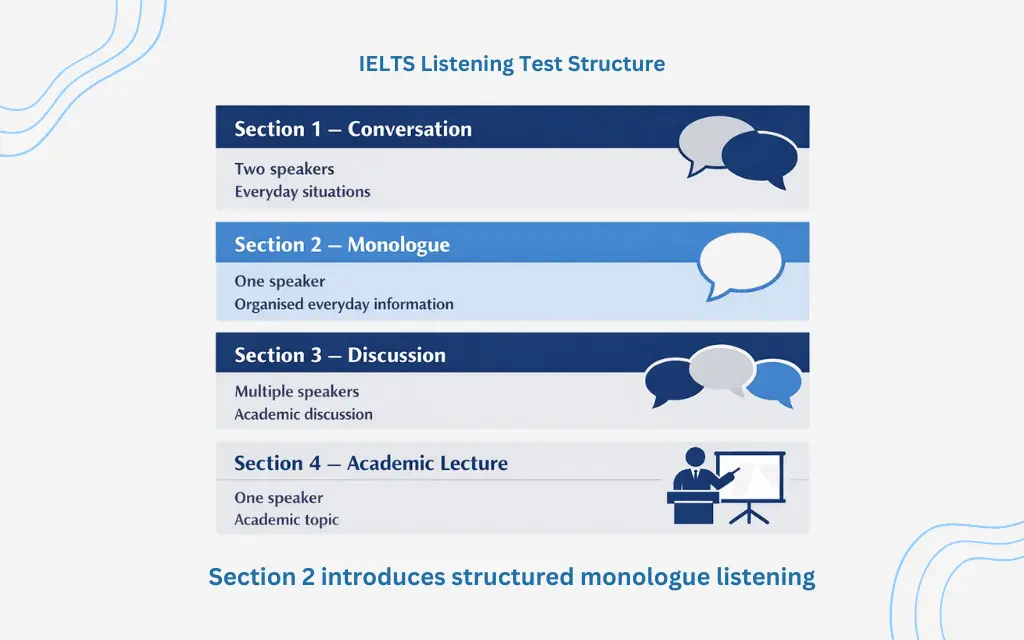
IELTS Listening Section 2 always features one speaker talking about a general, everyday situation. Unlike Section 1, there is no conversation. There is no back-and-forth exchange. You hear one continuous voice delivering organised information.
Typical contexts include:
- A guided tour
- Information about a local facility
- Instructions about an event
- A description of a place
- A public announcement
Although the setting is still non-academic, the speech is more structured and often delivered at a steady pace. The vocabulary remains accessible, but the organisation becomes more complex.
Why IELTS Listening Section 2 Feels Harder Than Section 1
Students often say Section 2 feels more difficult even though the language is not more advanced.
The main reason is this: you cannot rely on interaction.
In Section 1, if you miss something, the second speaker may repeat or clarify it. In Section 2, the speaker continues talking. There is no correction unless it is part of the script.
The section 2 listening IELTS format demands sustained concentration.
If your attention drifts for just a few seconds, you may lose two answers in sequence. The information flows logically, but it does not slow down for you. Section 2 tests focus more than vocabulary.
Common Question Types in IELTS Listening Section 2
Section 2 introduces more varied tasks than Section 1. While form completion can still appear, visual and spatial tasks become more common.
Map Labelling
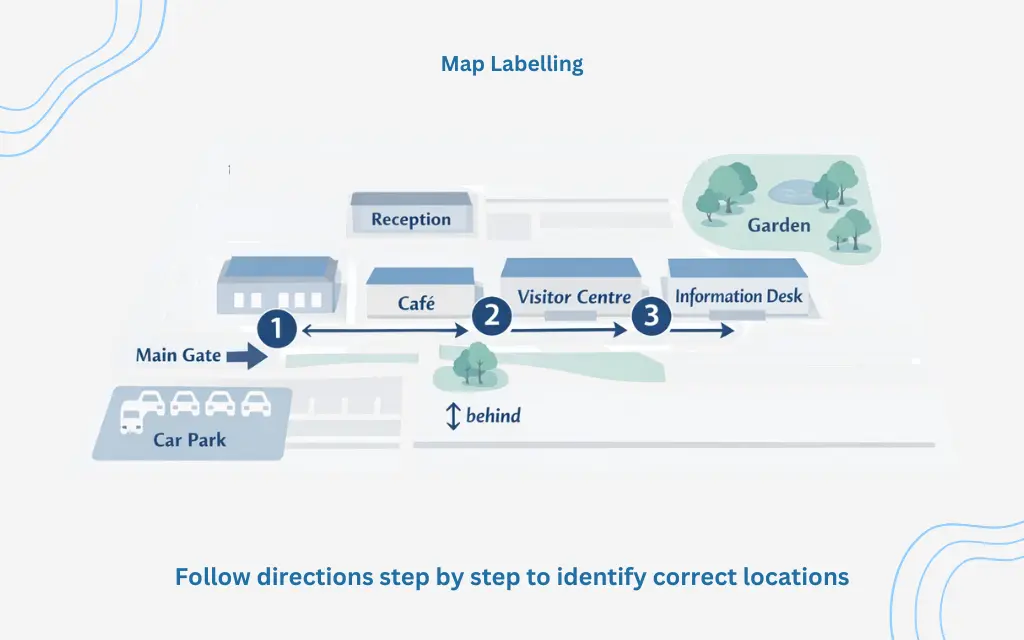
Map labelling is one of the most recognisable features of IELTS Listening Section 2.
You are given a map, plan, or diagram. The speaker describes locations, and you must label them correctly.
For example:
“If you enter through the main gate, you’ll see the café directly ahead. The visitor centre is to the left of the café, next to the information desk.”
To answer accurately, you must understand:
- Directional language
- Prepositions of place
- Movement and sequence
Multiple Choice
Section 2 may also include multiple choice questions. The speaker often mentions several possibilities before confirming the final answer. This creates distractors.
For example:
“Originally, we planned to hold the event in the main hall, but due to renovations, we’ve moved it to the conference centre.”
The first location is not the answer. The final decision is. Careful listening until the full statement ends is essential.
Matching Tasks
You may be required to match facilities with features or times.
For example:
Match each facility with its opening time. This requires quick scanning before listening and controlled attention during the recording.
Language Patterns You Must Recognise
Section 2 often includes specific language patterns. Becoming familiar with them increases your speed and accuracy.
Directional Language
Common phrases include:
- To the left of
- Opposite
- Behind
- Adjacent to
- In the corner
- At the end of the corridor
These expressions appear frequently in map questions. If you hesitate over them, you lose time.
Sequencing Language
The speaker usually guides you step by step through a place or process:
“First, walk through the entrance. Then turn right. After that, continue straight…”
If you lose track of the sequence, the labels become confusing. Stay mentally present and follow the path logically.
Correction and Emphasis
Just like Section 1, Section 2 includes distractors.
“The old museum building used to be near the lake, but the new exhibition centre is beside the theatre.”
The old location is irrelevant. The new one is correct.
Listen for contrast words such as:
- But
- However
- Instead
- Actually
These often introduce the real answer.
How to Approach Map Labelling Confidently
Map questions cause anxiety, but they are structured.
Before the recording begins:
- Study the map carefully
- Identify the starting point
- Notice compass directions (if given)
- Observe landmarks
Try to imagine physically walking through the space.
When the recording starts, follow the route logically. If the speaker says:
“As you enter…”
Begin from the entrance on the map.
The answers follow the spoken route. They do not jump randomly around the diagram.
If you miss one label, continue listening. Do not freeze.
Managing Concentration in a Monologue
Because Section 2 is a monologue listening IELTS task, mental stamina matters.
There are fewer natural pauses than in a conversation.
To maintain focus:
- Predict the answer type before listening
- Underline key words in the questions
- Keep your eyes on the current item
- Avoid reading too far ahead
Strong candidates focus only on the present question. This reduces overload.
Common Mistakes in IELTS Listening Section 2
Even capable students lose marks in predictable ways. One mistake is reacting to keywords too quickly without checking context.
Another is ignoring plural forms. If the answer should be “gardens” and you write “garden”, you may lose the mark.
Some candidates panic during map labelling and stop listening entirely. This leads to multiple missed answers in sequence.
Remember: one missed answer does not ruin the section.
Stay steady and continue.
How Section 2 Influences Your IELTS Listening Band Score
To achieve a strong IELTS listening band score, performance must be consistent across all four sections.
Section 2 is often where average candidates begin to lose reliability. High-scoring candidates treat Section 2 as another opportunity for stable marks.
If you develop confidence in:
- Directional language
- Distractor recognition
- Sustained concentration
your overall Listening score becomes more secure.
Section 2 is not the most advanced part of the test. But it separates careful listeners from distracted ones.
Conclusion
IELTS Listening Section 2 introduces the monologue format. There is one speaker. The information flows continuously. Visual tasks such as map labelling appear more frequently.
Success depends on:
- Concentration
- Understanding spatial language
- Recognising corrections
- Remaining calm under pressure
When you practise these skills deliberately, Section 2 becomes structured rather than intimidating.
To strengthen your Listening performance further, explore:
- How IELTS Listening is marked
- Common IELTS Listening mistakes
- IELTS Listening Section 1 Explained
Confidence builds step by step.
Related IELTS Listening Lessons
-
- IELTS Listening – Complete Guide to Sections and Question Types
-
Map Labelling in IELTS Listening
- Common IELTS Listening Mistakes (And How to Avoid Them)
- IELTS Listening – Complete Guide to Sections and Question Types
Glossary
Monologue (n.)
A speech delivered by one person without interaction.
Map Labelling (n.)
A task where you label locations on a map or diagram.
Directional Language (n.)
Words and phrases that describe position or movement.
Distractor (n.)
Incorrect information mentioned before or near the correct answer.
Band Score (n.)
The overall IELTS score from 1–9 based on correct answers.
Practice Section
(MCQ) IELTS Listening Section 2 usually involves:
A. A discussion between three students
B. A single speaker describing a situation
C. An academic lecture
D. A debate
(True/False) Answers in Section 2 appear in random order.
(Short Answer) Why are map labelling questions challenging?
(MCQ) Which language is especially important for Section 2?
A. Complex grammar
B. Academic theory
C. Directional language
D. Poetry
(True/False) Losing one answer in Section 2 means you will fail the whole section.
Answers
B
False
Because they require understanding direction and sequence while listening continuously.
C
False
Join 1,300+ English learners
Get free English lessons, IELTS tips and useful vocabulary by email.
No spam. Just practical English you can use.