
Introduction to IELTS Speaking Pronunciation
Pronunciation causes more confusion in IELTS Speaking than almost any other marking criterion.
Some candidates believe they need a British or American accent to score well. Others spend months drilling individual sounds, worrying about every mistake, and still feel unsure on test day. Some even reduce how much they speak because they are afraid of pronouncing words incorrectly.
In reality, IELTS speaking pronunciation is not about accent, perfection, or sounding “native”. It is about being clear, natural, and easy to understand across the whole test.
This lesson explains what pronunciation really means in IELTS Speaking, what examiners listen for, and how to improve your score without focusing on the wrong things.
Practise English every weekday with me
Get short Mon–Fri English practice in LINE with LEW Daily, plus regular feedback to help you improve.
Explore LEW DailyNT$399/month • Cancel anytime

Why pronunciation matters in IELTS Speaking
Pronunciation is one of the four marking criteria in the IELTS Speaking test, and it carries the same weight as fluency, vocabulary, and grammar.
This does not mean pronunciation is judged harshly. It means examiners want to know whether they can understand you comfortably throughout the test, without strain or repeated effort.
When pronunciation supports communication, it strengthens your overall score. When it regularly interferes with understanding, it can limit your band even if grammar and vocabulary are strong.
What examiners actually mean by “pronunciation”
When examiners assess pronunciation, they are not analysing individual sounds in isolation or judging how “native” you sound.
They listen for whether your speech is easy to follow over time, especially in longer answers.
In practice, this means examiners focus on:
- overall clarity across sentences
- natural rhythm and stress
- intelligibility when ideas become more complex
A few pronunciation errors are normal and expected. What matters is whether those errors create confusion or extra effort for the listener.
Accent vs clarity in IELTS Speaking
One of the most persistent myths in IELTS Speaking is that accent determines your score. This is not true.
You can have a strong regional accent and score highly. You can also have a near-native accent and score poorly. Accent itself is not a scoring category.
What matters is clarity.
If your accent does not interfere with understanding, it will not hold your score back. If it does interfere, even occasionally, examiners will notice.
How pronunciation affects listener effort
A useful way to understand pronunciation is through the idea of listener effort.
If the examiner has to concentrate hard, mentally replay words, or guess meaning from context, your pronunciation is working against you. If the examiner can follow your ideas easily, your pronunciation is doing its job, even if it is not perfect.
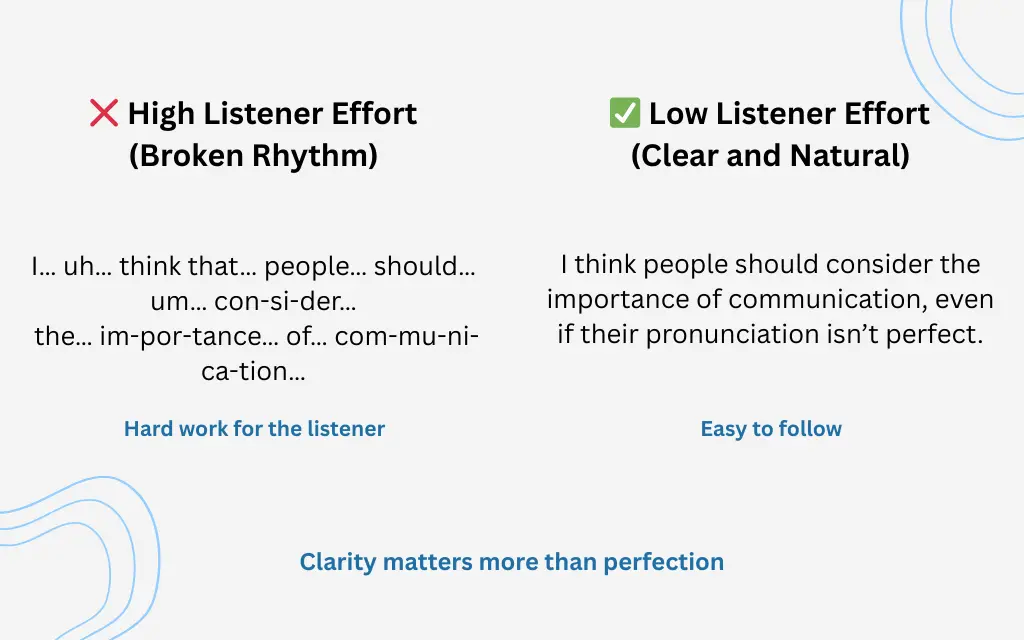
This contrast reflects how examiners actually experience pronunciation in real time.
Pronunciation across whole answers, not single words
Many candidates focus too much on individual words, especially when they practise.
In IELTS Speaking, examiners listen to connected speech, not isolated pronunciation. They notice how your speech holds together across sentences and ideas.
This includes:
- how words link together
- how stress moves across sentences
- whether speech sounds broken or flowing
A slightly mispronounced word inside a clear, well-paced sentence rarely causes a problem.
Stress and rhythm matter more than individual sounds
English pronunciation relies heavily on stress and rhythm, and this is where many problems arise.
Candidates may pronounce each word clearly but still sound difficult to follow. This usually happens when every word carries equal stress, pauses appear in unnatural places, or intonation remains flat.
These issues affect clarity far more than small sound errors, because they interfere with how meaning is packaged and delivered.
Sentence stress and meaning
Stress helps listeners understand what information matters most. Stressing the wrong word can change how a message sounds, even when all words are pronounced correctly.
Examiners are sensitive to whether your speech highlights key information naturally, especially in longer or more abstract answers.
Common pronunciation problems that lower scores
Pronunciation issues usually affect scores when they appear consistently rather than occasionally.
The most common problems examiners hear include:
- dropping word endings so meaning becomes unclear
- stressing the wrong syllable in key words
- speaking too quietly or too quickly under pressure
- unnatural pausing that breaks sentences
These patterns increase listener effort and make speech harder to follow over time.
Pronunciation and fluency are closely connected
Pronunciation does not exist in isolation. It interacts constantly with fluency.
When candidates worry too much about pronunciation, fluency often suffers. They hesitate, self-correct excessively, or shorten answers to avoid risk.
Examiners consistently prefer smooth, clear speech with minor pronunciation errors over hesitant, over-controlled speech that sounds fragmented.
Why over-correcting yourself can hurt
Self-correction feels responsible, but correcting every sound or word interrupts rhythm and breaks flow.
Minor pronunciation slips do not need fixing unless they cause misunderstanding. Allowing speech to continue naturally usually leads to a stronger overall impression.
Pronunciation across Parts 1, 2, and 3
Pronunciation is judged across the whole test, but its role feels slightly different in each part.
In Part 1, examiners notice how comfortable and natural your basic speech sounds.
In Part 2, they listen for sustained clarity over longer stretches of speech.
In Part 3, they focus on whether pronunciation supports discussion and abstract ideas.
Across all parts, consistency matters more than perfection.
What a Band 7 pronunciation performance sounds like
At Band 7, pronunciation is generally clear, natural enough not to distract, and flexible across different sentence types.
Noticeable accent features are normal at this level. What matters is that communication flows smoothly and meaning is easy to follow.
Candidates often reach Band 7 not by changing their accent, but by improving rhythm, stress, and confidence.
Improving pronunciation without overstudying phonetics
You do not need advanced phonetic training to improve pronunciation for IELTS Speaking.
Effective improvement focuses on awareness and usage:
- listening regularly to natural spoken English
- speaking full sentences aloud, not isolated words
- recording and replaying answers to notice patterns
Awareness of how you sound as a listener is far more useful than technical terminology.
Listening to yourself like an examiner
A powerful exercise is to listen to your own recordings and ask simple questions.
Is this easy to follow? Do my sentences sound complete? Would I understand this without effort?
Training yourself to listen this way aligns your practice with how examiners actually mark.
Conclusion
Pronunciation in IELTS Speaking is not about accent, perfection, or sounding like a native speaker.
It is about being clear, natural, and easy to understand throughout the test. When your pronunciation supports your ideas rather than distracting from them, you are meeting examiner expectations.
Focus on clarity, rhythm, and confidence, and your pronunciation score will rise naturally alongside your fluency.
Related IELTS Speaking Lessons
Glossary
Pronunciation (noun) — how words and sentences are spoken
Accent (noun) — a particular way of pronouncing a language
Clarity (noun) — how easy something is to understand
Intonation (noun) — the rise and fall of the voice when speaking
Stress (noun) — emphasis placed on certain words or syllables
Comprehension & Practice Questions
True or False: You need a British accent to score well in IELTS Speaking.
Multiple choice: What matters most in pronunciation assessment?
A) Accent accuracy
B) Phonetic knowledge
C) Clarity and intelligibility
Short answer: Why can over-correcting pronunciation hurt your score?
True or False: Pronunciation is judged only in Part 2.
Short answer: What is one effective way to practise pronunciation?
Answers
False
C
It interrupts fluency and rhythm
False
Recording and listening to your own answers
Join 1,300+ English learners
Get free English lessons, IELTS tips and useful vocabulary by email.
No spam. Just practical English you can use.