Introduction to Skimming and Scanning in IELTS Reading
Many IELTS candidates leave the Reading test with the same feeling: they understood the texts, but they ran out of time.
This is one of the most common problems in IELTS preparation, and it is rarely caused by low intelligence or weak vocabulary. More often, it comes from reading in the wrong way for this exam.
If you try to read every line carefully, you will not finish the paper. IELTS Reading rewards strategic reading under time pressure.
This lesson shows how to use skimming scanning IELTS techniques properly, when to apply each skill, and how they help you stay calm and accurate across all 40 questions.
Practise English every weekday with me
Get short Mon–Fri English practice in LINE with LEW Daily, plus regular feedback to help you improve.
Explore LEW DailyNT$399/month • Cancel anytime

Why Reading Speed Matters in IELTS
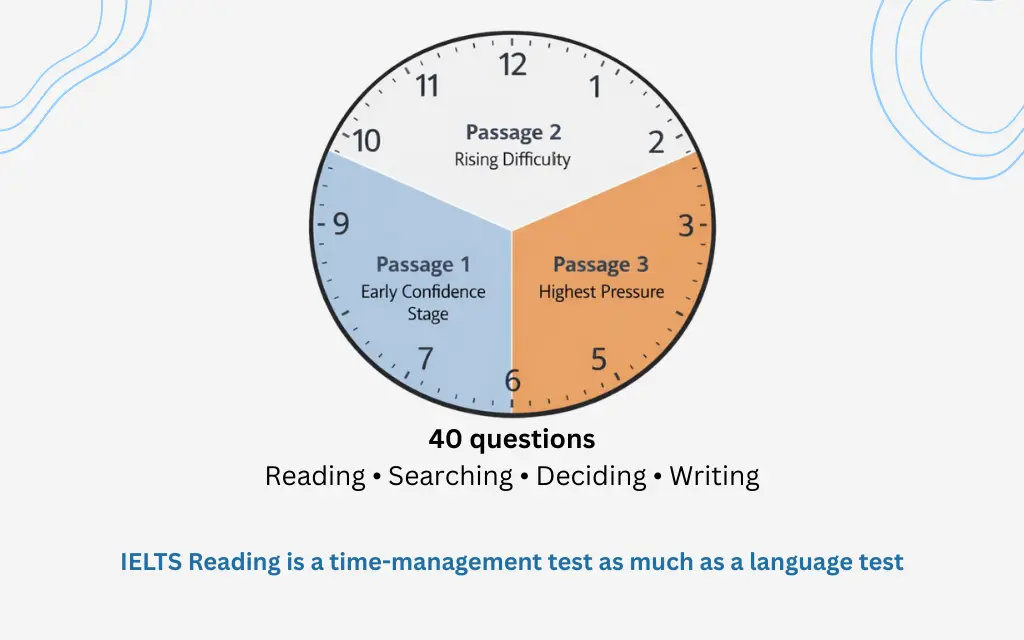
You have three long passages, 40 questions, and 60 minutes. That works out at less than two minutes per question, and that time includes reading, locating information, deciding, and writing the answer.
The test is not designed for slow, careful reading from start to finish. It is designed for controlled speed.
Skimming and scanning are not “shortcuts”. They are real reading habits used by students, researchers, and professionals who need to handle large amounts of text efficiently.
What Skimming and Scanning Really Mean
Many students mix these skills together, so they use the wrong technique at the wrong time. It helps to separate them clearly.
Skimming means reading quickly for overall meaning and structure. You are trying to understand the topic, the direction of the passage, and what each paragraph is mainly about. You are not trying to understand every sentence.
Scanning means searching for a specific piece of information. You are hunting for a name, a date, a number, a keyword, or a phrase that signals the location of an answer. You ignore most of the text until you find the target.
When these skills are used correctly, you read less but understand more of what matters.
When to Use Skimming in the IELTS Reading Test
Skimming is most useful at the beginning of a passage, before you fully engage with questions.
A quick skim gives you a mental map. You start to recognise where ideas are introduced, where examples appear, and where arguments become more complex.
This matters because many candidates waste time later by searching blindly. They know the passage contains the answer, but they do not remember where to look, so they reread large sections repeatedly.
Skimming prevents this problem. It gives you direction.
A simple way to think about it is this: skimming is how you learn the layout of the building before you start searching for a specific room.
How to Skim Effectively
Skimming is not random. It works best when you skim with purpose.
Start by noticing the title and any subheadings. Then move through the text focusing on the first sentence of each paragraph, because this often carries the main idea. If the final sentence gives a clear summary or conclusion, that can also be useful.
While skimming, do not stop for unfamiliar vocabulary, statistics, or examples. Those details slow you down and rarely help at this stage. Your goal is structure, not proof.
Here is a simple example:
“Over the past decade, renewable energy has expanded rapidly. Governments have invested heavily in solar and wind power, aiming to reduce dependence on fossil fuels.”
A skim reading would catch “renewable energy”, “expanded rapidly”, and “government investment”. That is enough to label the paragraph in your mind.
When to Use Scanning in IELTS Reading
Scanning is used once you start answering questions.
After you know what the passage is generally about, scanning becomes your main tool for locating answers quickly. The questions guide you to what you need, and scanning helps you find where it appears.
Scanning targets are often easy to recognise: proper nouns, dates, percentages, scientific terms, or clearly repeated words. Even when wording changes through paraphrase, scanning helps you find the correct area so you can then read carefully.
The key point is that scanning is not answering. Scanning is locating.
How to Scan Without Losing Focus
Many candidates believe they are scanning, but they are actually reading too much. They move line by line, hoping the answer will “jump out”. This is slow and tiring.
A stronger approach begins with the question.
First, identify what you are looking for. If the question asks “In which year…”, you are scanning for a number, not for a full sentence. If it asks for a person’s view, you are scanning for a name or role.
Second, predict the form. Will the answer be a date, a place name, a short phrase, or one word? Prediction narrows your search.
Third, move your eyes in a searching pattern rather than reading left to right. Your goal is to spot targets quickly, then stop and read locally when you find a likely match.
Once you locate the right area, slow down and read the surrounding sentence carefully. That local reading is what protects you from trap answers.
How High Scorers Combine Skimming and Scanning
In strong IELTS Reading performance, skimming and scanning are part of one cycle.
You skim to understand the structure and paragraph roles. Then you use the questions to decide what you need. Then you scan to locate the relevant area. Finally, you read that small area carefully to confirm the answer.
This is why successful candidates often finish on time even when vocabulary feels difficult. They are not trying to understand everything. They are trying to answer accurately with the smallest amount of reading.
If you practise this cycle, your reading becomes calmer, because you always know what you are doing and why.
Why Slow Reading Hurts Your Score
Many learners believe careful reading produces a higher band score.
In IELTS Reading, slow reading usually produces the opposite outcome. It creates time pressure, which leads to rushed guessing and careless mistakes. It also increases stress, and stress reduces accuracy.
The goal is not speed alone. The goal is controlled speed.
Skimming and scanning help you move quickly, but still make decisions using evidence. That combination is what produces consistent scores.
Common Mistakes with Skimming and Scanning
One common mistake is trying to understand every sentence. This is unnecessary and often impossible in Passage 3.
Another mistake is skipping skimming completely. When students go straight to questions, they often lose time because they do not know where ideas are located, so they search randomly and reread sections repeatedly.
A third mistake is scanning without context. Finding the same word does not guarantee you have found the answer. You still need to read locally to confirm meaning.
Finally, many candidates stop whenever they see an unknown word. This breaks rhythm and wastes time. In most cases, you can understand the sentence well enough without knowing every word, especially if the question does not depend on that word.
How These Skills Support Different Question Types
Skimming is especially helpful for Matching Headings, because that task depends on main ideas and paragraph purpose.
Scanning supports tasks like matching information, sentence completion, and short answers, because it helps you locate where details appear.
For True / False / Not Given, scanning can help you find the relevant section, but the final decision requires careful local reading and meaning comparison.
For multiple choice, skimming gives you context and scanning helps you return to the correct section, but accuracy still depends on checking evidence line by line.
In other words, skimming and scanning get you to the right place. Careful reading confirms the answer.
Training Skimming and Scanning at Home
These skills improve quickly when practice is short and consistent.
A simple daily routine works well. Take a short article and give yourself one minute to skim it. Then choose two facts to locate and give yourself 20–30 seconds to scan for them. After you find them, read the surrounding sentence to confirm you understood correctly.
Over time, your eyes become faster and your decisions become calmer.
If you only practise full IELTS papers, you may improve slowly because the practice is too long to repeat often. Skill training is what builds speed.
The Psychological Benefit of Skimming and Scanning
There is also a confidence benefit.
Candidates who skim and scan effectively feel organised. They feel in control of the passage instead of overwhelmed by it.
This matters on test day. Calm reading produces fewer mistakes, and fewer mistakes produces a higher score.
Conclusion
Skimming and scanning are not optional techniques. They are the foundation of IELTS Reading success.
When you learn when to skim, when to scan, and how to combine them with careful local checking, you gain control over time, accuracy, and confidence.
If you can read strategically rather than slowly, your score becomes far more consistent.
Related IELTS Reading Lessons
Glossary
Skimming (noun/verb) — reading quickly for general meaning
Scanning (noun/verb) — searching for specific information
Keyword (noun) — an important word in a question that helps you locate information
Context (noun) — surrounding information that gives meaning
Strategy (noun) — a planned method for success
Comprehension & Practice Questions
True or False: Skimming means reading every word carefully.
Multiple choice: What is scanning mainly used for?
A) Understanding opinions
B) Finding specific information
C) Learning vocabulary
Short answer: Why is skimming useful before answering questions?
True or False: Unknown words should always be checked.
Short answer: What should you do after finding a keyword?
Answers
False
B
It helps you understand structure and main ideas
False
Read the surrounding sentence to confirm meaning
Join 1,300+ English learners
Get free English lessons, IELTS tips and useful vocabulary by email.
No spam. Just practical English you can use.