Introduction to Task 1 Trend Vocabulary
One of the quickest ways examiners recognise a weaker Task 1 response is through poor trend vocabulary. Many candidates understand the chart perfectly, yet their writing sounds repetitive, vague, or unnatural because they rely on the same basic words again and again.
In IELTS Writing Task 1, trends matter. Examiners expect you to describe change over time clearly and accurately, using language that matches what the data actually shows. This does not mean using long or impressive words. It means choosing the right words and using them with control.
This lesson will explain IELTS Task 1 trend vocabulary in a practical, examiner-friendly way. You will learn how common trend words are used, how examiners interpret them, and how to avoid vocabulary choices that quietly limit your score. Throughout the article, examples are kept short and natural, exactly as they would appear in a strong Task 1 response.
Practise English every weekday with me
Get short Mon–Fri English practice in LINE with LEW Daily, plus regular feedback to help you improve.
Explore LEW DailyNT$399/month • Cancel anytime

Why Trend Vocabulary Matters in Task 1
In Task 1, examiners assess your lexical resource alongside Task Achievement and coherence. Trend vocabulary plays a key role because it shows how accurately you can describe movement, change, and comparison.
Many Band 6 candidates rely on a very narrow range of verbs, often repeating increase and decrease in every sentence. While these words are not wrong, overusing them makes the writing sound basic and limits the impression of range.
At higher bands, candidates vary their language naturally. They also match their vocabulary more precisely to the data. A small rise, a sharp drop, and a gradual recovery should not all be described in the same way. Examiners notice this distinction immediately.
Understanding What Examiners Look For
Examiners do not expect creative language in Task 1. They expect accuracy, appropriacy, and control.
This means that a word must:
- Describe the direction correctly
- Match the speed or strength of change
- Be grammatically accurate in the sentence
Using a more advanced word incorrectly is worse than using a simple word correctly. For this reason, it is important to understand not just what trend words mean, but how they are typically used.
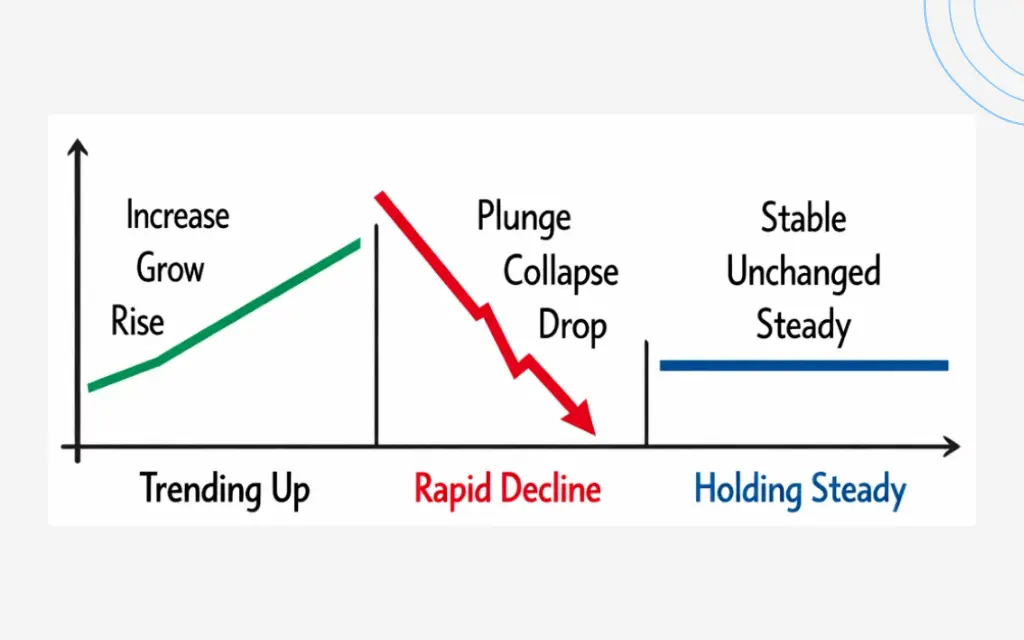
A helpful visual here would be a simple line graph showing three different patterns: a gentle rise, a sharp fall, and a stable period. Each pattern could be labelled with example vocabulary to show how word choice changes with the data.
Vocabulary for Upward Trends
When something goes up in Task 1, many candidates immediately write increase. This is acceptable, but it should not be your only option.
In examiner-friendly writing, upward trends are often described using a mix of verbs and nouns, depending on sentence structure. The key is that the word reflects both direction and intensity.
For example, if a figure rises slowly over time, a gentle verb feels more natural. If it rises quickly, a stronger verb is more accurate. Compare these two sentences in prose:
A weaker response might say that sales increased from 2000 to 2010.
A stronger response explains that sales rose gradually over the period.
Both are correct, but the second sentence gives the examiner more information without adding complexity.
Words commonly used for upward trends include rise, grow, and climb. These are neutral and safe. Stronger movement may be described with verbs such as surge or jump, but only when the data clearly supports this.
Vocabulary for Downward Trends
Downward trends are often handled less carefully, and this leads to subtle IELTS Task 1 errors.
Again, decrease is not wrong, but it is very general. Examiners expect candidates to show awareness of how sharp or steady the fall is.
If a value falls slowly, language that suggests a gentle movement is more accurate. If it drops suddenly, stronger wording is appropriate. Consider the contrast below:
A weaker description says that unemployment decreased during the period.
A stronger description explains that unemployment fell sharply at the beginning before levelling off.
The second version demonstrates clearer interpretation, even though the grammar remains simple.
Common downward trend words include fall, drop, and decline. Stronger changes may be described using plunge, but this should be used carefully and sparingly.
Vocabulary for Stability and No Change
One of the most overlooked areas of Task 1 vocabulary is language for stability. Many candidates focus heavily on movement and forget that periods of no change are also important.
Examiners reward accurate descriptions of flat trends because they show careful reading of the data. When a line remains mostly unchanged, saying it “increased slightly” or “fluctuated” is inaccurate and can lower Task Achievement.
Natural language for stable trends often includes expressions such as remain stable or stay constant. These phrases are simple, but very effective when used correctly.
For example, instead of forcing change language into the sentence, a strong response might calmly explain that production levels remained relatively stable throughout the period.
Vocabulary for Fluctuations
Fluctuations describe repeated rises and falls. This type of trend is common in line graphs and tables, yet many candidates misuse the vocabulary.
The word fluctuate should only be used when the data genuinely moves up and down more than once. Using it to describe a single rise followed by stability is inaccurate.
A weaker response might say that prices fluctuated slightly, even though the chart shows only one small change.
A stronger response would explain that prices showed minor variations before stabilising.
This kind of precise wording signals control to the examiner.
Adverbs and Modifiers: Adding Precision
Adverbs play a quiet but important role in IELTS Task 1 trend vocabulary. They allow you to adjust meaning without changing the main verb.
Words like gradually, steadily, slightly, and dramatically help the examiner visualise the movement more clearly. However, they must match the data.
Overusing dramatic adverbs with small changes is a common Band 6 habit. A small rise should not be described as dramatic. Precision always matters more than emphasis.
A useful visual here would show the same line graph labelled twice: once with mismatched adverbs and once with accurate ones, highlighting the difference in interpretation.
Common Vocabulary Mistakes That Lower Scores
Many Task 1 vocabulary list learners memorise long word banks but do not understand how examiners read them in context.
One common mistake is mixing trend vocabulary with comparison language incorrectly. Another is using nouns and verbs interchangeably without adjusting grammar.
For example, saying there was an increase requires a different sentence structure from saying the figure increased. Errors here are usually grammatical rather than lexical, but they affect both criteria.
Another frequent issue is repetition. Repeating the same trend word several times in one paragraph makes the writing sound limited, even if the word itself is correct.
How to Improve Trend Vocabulary Strategically
Improving your increase decrease vocabulary for IELTS does not require memorising dozens of new words. It requires learning a small, reliable set and using them flexibly.
A strong strategy is to practise describing the same chart in different ways, focusing on accuracy rather than variety alone. Reading examiner comments can also help you understand which word choices feel natural and which feel forced.
Above all, remember that examiners prefer clear, controlled language. A simple word used well will always outperform a complex word used badly.
Conclusion
Trend vocabulary is one of the clearest signals examiners use to judge Task 1 writing quality. When your word choice matches the data accurately and naturally, your writing becomes easier to read and easier to reward.
By learning how different trend words function, avoiding exaggeration, and using modifiers carefully, you can significantly strengthen your IELTS Task 1 trend vocabulary without making your writing more complicated.
To continue building this skill, explore Learn English Weekly’s Task 1 guides on specific chart types and examiner marking explanations, where these vocabulary choices are applied in context.
Related IELTS Task 1 Lessons
Glossary
Trend (noun) – The general direction in which data changes
Lexical resource (noun) – Range and accuracy of vocabulary used
Fluctuate (verb) – To rise and fall repeatedly
Stable (adjective) – Showing little or no change
Modifier (noun) – A word that adds detail to meaning, such as an adverb
Practise What You Learned
- Which is more important in Task 1: impressive vocabulary or accurate vocabulary?
- True or False: The word fluctuate can be used for a single rise in data.
- Choose the better description for a slow increase:
A) rose dramatically
B) increased gradually - Why is vocabulary for stability important in Task 1?
- Short answer: Name one adverb that can soften a trend description.
Answers
- Accurate vocabulary
- False
- B
- It shows accurate reading of data with no change
- Gradually / slightly / steadily
Join 1,300+ English learners
Get free English lessons, IELTS tips and useful vocabulary by email.
No spam. Just practical English you can use.