
Introduction to Using the Passive Voice in IELTS Task 1
IELTS candidates learn the passive voice early in their studies, but when it comes to Task 1, they often feel unsure about how (or whether) to use it. Some overuse it to sound “academic”, while others avoid it completely for fear of making mistakes.
Both approaches can limit your score.
The passive voice in IELTS Task 1 is not about showing off grammar. It is a tool. When used appropriately, it helps you describe data, processes, and results clearly and impersonally. This is exactly the style examiners expect in Task 1 writing.
This lesson will explain how examiners view the passive voice, when it genuinely improves a Task 1 response, and how to use passive structures accurately without sounding forced or unnatural.
Need to review the general grammar first? Study our complete passive voice guide for tense structures, active-to-passive transformations and practice exercises.
Practise English every weekday with me
Get short Mon–Fri English practice in LINE with LEW Daily, plus regular feedback to help you improve.
Explore LEW DailyNT$399/month • Cancel anytime

Why the Passive Voice Fits Task 1 Writing
IELTS Task 1 requires you to describe information objectively. You are not giving opinions or personal reactions. You are reporting what the data shows.
The passive voice supports this purpose because it:
- Removes unnecessary focus on people
- Emphasises processes, changes, or results
- Creates a neutral, academic tone
This is why examiners expect to see some passive structures in strong Task 1 responses, but only where they make sense.
What Examiners Expect — and What They Don’t
Examiners do not expect the passive voice everywhere.
They are not impressed by writing that sounds artificially formal or repetitive. Instead, they look for appropriate use.
In other words, the passive voice should appear when:
- The action is more important than the actor
- The actor is unknown, irrelevant, or obvious
- The sentence sounds clearer or more natural in passive form
If the passive makes a sentence harder to read, it works against you.
Passive Voice vs Active Voice in Task 1
Both active and passive forms are acceptable in Task 1.
The key difference is focus.
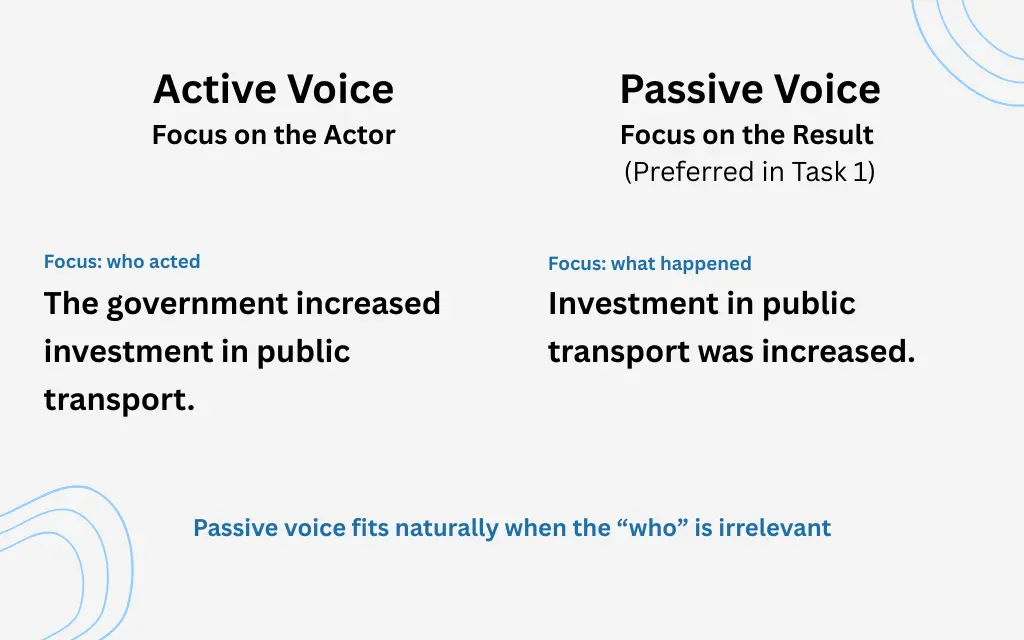
Active sentences highlight who or what does something. Passive sentences highlight what happens.
In Task 1, the “who” is often irrelevant. Charts, figures, or systems do not need actors. This is where passive structures fit naturally.
Where the Passive Voice Is Most Useful
The passive voice is particularly useful in specific Task 1 contexts.
One common area is process descriptions, where actions happen in a sequence and the actor is unimportant. Another is result-focused reporting, where the outcome matters more than the cause.
In these cases, passive structures help keep the writing concise and objective.
Passive Voice in Process Diagrams
Process diagrams are where passive structures appear most naturally.
In these tasks, the focus is on what happens at each stage, not on who performs the action. Passive sentences allow you to describe steps clearly without inventing unnecessary subjects.
For example, instead of introducing artificial actors like “workers” or “machines”, the passive keeps the description factual and clean.
This aligns closely with examiner expectations.
Passive grammar is especially useful in process tasks, but it works best when combined with accurate process diagram vocabulary such as “is filtered”, “is transported”, “is compressed”, and “is converted into”.
Passive Voice in Data Reporting
In charts and graphs, passive voice can be useful when describing how figures change or how results are shown.
This shifts attention away from the chart itself and onto the information it presents.
However, passive voice should be used selectively. Overusing it in simple trend descriptions can make the writing heavy.
Balance matters.
Grammar Control Matters More Than Range
Using the passive voice incorrectly harms your score more than not using it at all.
Examiners assess grammatical range and accuracy, not just variety. A few well-controlled passive sentences are far better than many unstable ones.
Common problems include:
- Incorrect verb forms
- Missing auxiliary verbs
- Confusion between past and present passive
Repeated errors here are very noticeable to examiners.
Keeping Passive Sentences Simple and Accurate
Strong Task 1 writing often uses simple passive structures.
There is no requirement to build long or complex passive sentences. In fact, shorter passive constructions are usually clearer and safer.
Examiners prefer clarity over ambition. If a passive sentence feels difficult to control, an active alternative is often better.
Passive Voice and Task Achievement
Passive structures support Task Achievement only when they help describe key features clearly.
They do not compensate for:
- Poor data selection
- Missing comparisons
- Lack of an overview
In other words, passive voice is supportive grammar, not a scoring shortcut.
Examiners reward it when it serves the task, not when it exists for its own sake.
Avoiding Overuse of the Passive Voice
One of the most common mistakes is using the passive voice in nearly every sentence.
This makes writing:
- Repetitive
- Heavy
- Less natural
A good Task 1 response usually mixes active and passive forms smoothly. The shift between them often feels invisible to the reader, which is exactly what examiners want.
Passive Voice and Academic Tone
Many candidates believe passive voice automatically equals “academic”.
This is only partly true.
Academic tone comes from:
- Objectivity
- Precision
- Logical structure
Passive voice supports this tone when used correctly, but tone is not created by grammar alone.
Examiners notice when grammar choices support meaning, not when they are added mechanically.
How Passive Voice Signals Control to Examiners
When passive structures are used naturally and accurately, they signal:
- Grammatical control
- Awareness of Task 1 conventions
- Comfort with formal reporting style
These signals help examiners feel confident in awarding higher bands, but only when consistency is maintained.
Common Passive Voice Mistakes in Task 1
Weak use of passive structures often includes:
- Forcing passive where active is clearer
- Mixing passive and active forms incorrectly
- Using the wrong tense in process descriptions
These errors tend to repeat, which makes them more damaging than one-off mistakes.
Practising Passive Voice for Task 1
Effective practice focuses on exam-relevant usage, not general grammar drills.
A useful exercise is to:
- Take a Task 1 process diagram
- Write one paragraph using mostly passive structures
- Rewrite the same paragraph mixing active and passive forms
Comparing the two helps you feel when the passive voice adds clarity — and when it doesn’t.
Passive Voice Across Different Task 1 Types
Although passive voice appears most often in process tasks, it also appears naturally in:
- Descriptions of how data is presented
- Summaries of results
- Statements about changes being observed
Understanding where it fits allows you to apply it flexibly across Task 1 visuals.
Why Examiners Care About “Appropriate” Use
Examiners are trained to reward appropriateness.
They do not expect candidates to use every grammar structure they know. They expect candidates to choose structures that fit the task.
This is why appropriate passive voice use often scores better than ambitious but unstable grammar.
Conclusion
Using the passive voice in IELTS Task 1 effectively is about judgement, not complexity.
When passive structures help you describe processes, results, or data objectively, they support clarity and examiner confidence. When they are forced or overused, they weaken the response.
Focus on accuracy, relevance, and balance. This approach aligns naturally with how examiners assess Task 1 writing.
To build on this skill, explore the related Learn English Weekly Task 1 and grammar guides linked below, especially those covering sentence structures and examiner marking.
Related IELTS Task 1 Lessons
Glossary
Passive voice (noun) — A sentence structure where the focus is on the action or result
Active voice (noun) — A sentence structure where the subject performs the action
Process diagram (noun) — A visual showing stages of a process
Task Achievement (noun) — How well the task is fulfilled
Grammatical control (noun) — Consistent and accurate use of grammar
Practice Questions
- True or False: Passive voice should be used in every Task 1 sentence.
- When is the passive voice most useful?
A) When the actor is important
B) When the action or result matters more - Why does overusing the passive voice lower scores?
- Short answer: Name one Task 1 situation where passive voice fits naturally.
- True or False: Inaccurate passive structures are better than no passive voice.
Answers
- False
- B
- It makes writing repetitive and unclear
- Process diagrams / result descriptions
- False
Join 1,300+ English learners
Get free English lessons, IELTS tips and useful vocabulary by email.
No spam. Just practical English you can use.