
Introduction to IELTS Listening Band Scores
IELTS candidates spend months practising listening tests, repeating recordings, and learning question types. Despite this, they are often surprised when results arrive.
“I thought I did better than that.”
“I only made a few mistakes.”
“I understood most of the recording.”
The issue is rarely effort. It is usually misunderstanding.
To improve your IELTS listening band score, you must clearly understand how the test is marked. Unlike Writing and Speaking, Listening is not judged subjectively. Examiners do not evaluate your language quality. They simply count correct answers.
This means improvement is measurable and predictable.
In this lesson, you will learn how IELTS Listening scoring works, how raw scores convert into band scores, what different bands represent in practical terms, and how to use this knowledge to improve strategically.
Practise English every weekday with me
Get short Mon–Fri English practice in LINE with LEW Daily, plus regular feedback to help you improve.
Explore LEW DailyNT$399/month • Cancel anytime

The Structure of the IELTS Listening Test
Before discussing scoring, it is important to understand the structure of the test itself.
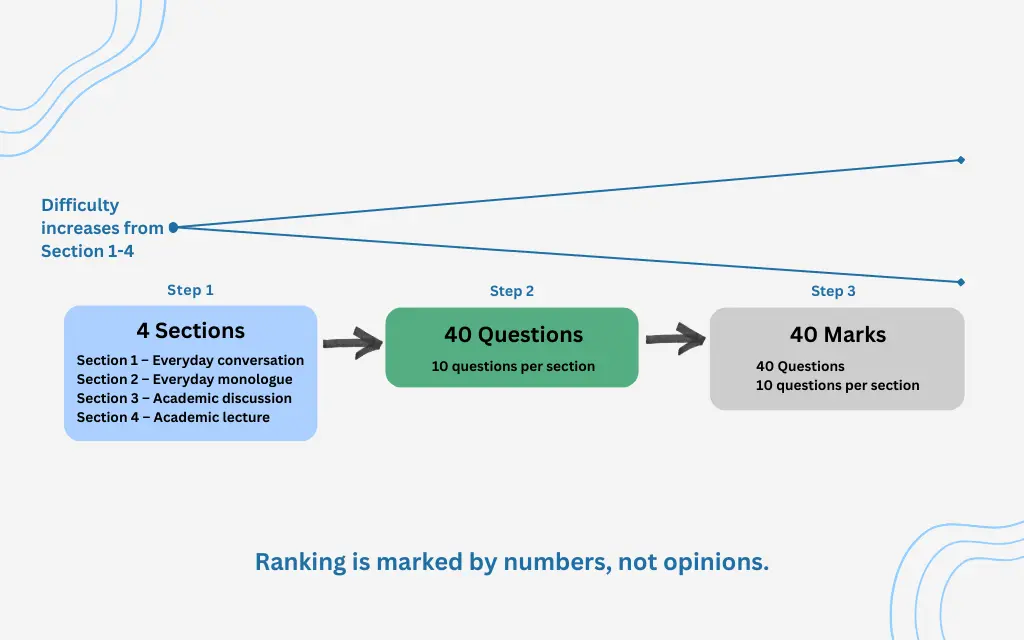
The IELTS Listening test contains four sections and forty questions in total. Each question carries one mark. There are no half marks and no negative marking.
The recordings increase in difficulty from Section 1 to Section 4. Early sections usually involve everyday situations, while later sections contain academic discussions and lecture-style speech.
Your final score depends entirely on how many answers are correct.
How IELTS Listening Scoring Works
Raw Score
Your raw score is simply the number of correct answers out of forty.
If you answer twenty-eight questions correctly, your raw score is twenty-eight. If you answer thirty-five correctly, your raw score is thirty-five.
There is no penalty for incorrect answers. However, accuracy is strict. Spelling errors, grammar mistakes, or exceeding the word limit result in a wrong answer.
There is no partial credit.
Converting Raw Scores to Band Scores
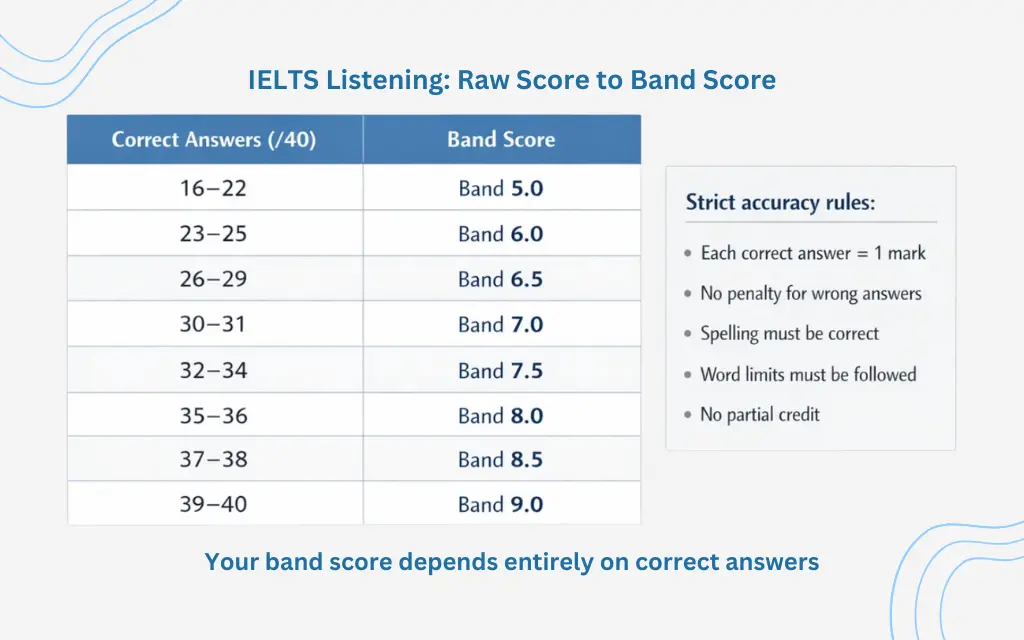
Your raw score is converted into an IELTS listening band score using an official conversion table. Although small variations can occur, the typical Academic and General conversion looks like this:
Sixteen to twenty-two correct answers corresponds approximately to Band 5.
Twenty-three to twenty-five corresponds to Band 6.
Twenty-six to twenty-nine corresponds to Band 6.5.
Thirty to thirty-one corresponds to Band 7.
Thirty-two to thirty-four corresponds to Band 7.5.
Thirty-five to thirty-six corresponds to Band 8.
Thirty-seven to thirty-eight corresponds to Band 8.5.
Thirty-nine to forty corresponds to Band 9.
Academic and General Training Listening
Unlike Reading, the Listening test is the same for both Academic and General Training candidates. There is only one Listening format, and the same band conversion applies to everyone.
This means all candidates worldwide are assessed using the same standard.
What Each Listening Band Represents in Practice
Understanding numbers is helpful, but connecting them to real listening ability is more important.
Band 5: Basic Understanding with Gaps
A Band 5 listener can follow general meaning in clear situations but struggles with detail.
Typically, this candidate misses specific numbers, dates, or spelling. Fast speech causes confusion, and distractors are often missed.
The overall idea is understood, but precision is weak.
Band 6: Functional but Inconsistent Listening
Band 6 is a common plateau.
A Band 6 listener understands main ideas and most factual information, especially in Sections 1 and 2. However, more complex academic discussions in Sections 3 and 4 reduce accuracy.
Mistakes often come from spelling, missed paraphrasing, or losing focus.
Understanding is generally good, but not fully reliable.
Band 7: Strong and Controlled Listening
Band 7 reflects confident academic listening ability.
A Band 7 candidate can follow detailed discussions, recognise paraphrasing, and maintain concentration across all four sections.
Errors still occur, but they are occasional rather than frequent.
This is the level most universities expect for academic study.
Band 8: Very High Accuracy
Band 8 represents excellent listening control.
At this level, candidates detect distractors quickly, handle fast academic speech, and rarely lose marks because of word limits or spelling.
Concentration remains steady throughout the entire test.
Band 9: Near-Perfect Performance
Band 9 indicates exceptional listening ability.
It means almost all answers are correct. The candidate understands accent variation, fast speech, and complex information with full control.
This level is rare and usually reflects extensive exposure to natural English in academic settings.
Why Candidates Lose Marks in Listening
Understanding how IELTS Listening is marked helps explain why marks are lost.
Spelling Errors
IELTS Listening requires accurate spelling.
If the correct answer is “accommodation” and it is spelled incorrectly, the answer is wrong. Many candidates lose two or three marks in this way.
Ignoring Word Limits
Instructions such as “NO MORE THAN TWO WORDS” are strict.
If you write three words, the answer is incorrect, even if the meaning is correct.
Falling for Distractors
In many recordings, speakers correct themselves.
For example:
“We’ll meet at 7 pm… actually, make that 8 pm.”
If you write 7 pm, you lose the mark. This is not a trick. It is testing careful listening.
Losing Concentration
The Listening test lasts around thirty minutes. Mental fatigue often reduces accuracy in Section 4.
Band 7+ candidates maintain concentration throughout.
Using Scoring Knowledge to Improve Strategically
Once you understand how IELTS listening band scores are calculated, preparation becomes more focused.
Track Raw Scores
Instead of saying “I am Band 6,” track exact raw scores across multiple practice tests.
For example:
Test 1: 26 out of 40
Test 2: 28 out of 40
Test 3: 31 out of 40
This shows measurable progress.
Analyse Error Types
After each test, identify why answers were wrong.
Was it spelling?
Was it a distractor?
Was it a word limit error?
Was concentration lost?
Improvement happens through diagnosis.
Strengthen Sections 3 and 4
Many candidates can score well in Sections 1 and 2. To reach Band 7 or higher, performance in academic discussion and lecture sections must improve.
These later sections often determine your final band.
Does Accent Affect Your Listening Score?
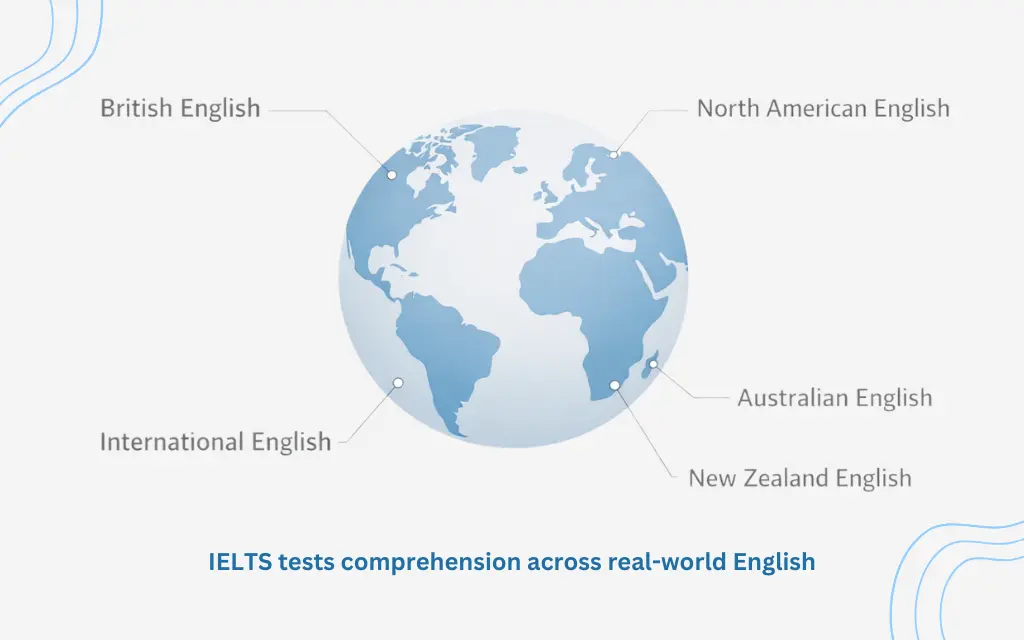
IELTS recordings include a range of accents, including British, Australian, and others.
Your score does not depend on accent preference. It depends on your ability to understand different speakers.
Regular exposure to varied accents improves confidence and reduces surprise during the test.
How Institutions Use Listening Scores
Listening scores represent more than test performance.
Universities interpret them as indicators of lecture comprehension and seminar participation. Employers see them as indicators of workplace communication and instruction understanding.
Your listening band score reflects your functional listening ability in real-life situations.
Predicting Your IELTS Listening Band Score
To estimate your band reliably:
Complete full practice tests under timed conditions.
Calculate your raw score.
Convert it using official tables.
Repeat across multiple tests.
One practice test is not enough. Patterns over time are meaningful.
Building Long-Term Listening Strength
High listening scores come from consistent habits rather than short-term tricks.
Develop regular exposure to natural English, practise active listening and note-taking, focus on spelling accuracy, and simulate full test conditions frequently.
Over time, this builds automatic accuracy and stronger concentration.
Conclusion: Why Understanding Scoring Matters
When you understand how IELTS Listening is marked, preparation becomes clearer.
You realise that accuracy determines everything. Spelling matters. Word limits matter. Concentration matters.
Instead of guessing how to improve, you can identify weaknesses precisely and work on them systematically.
To continue developing your Listening skills, explore related guides on section strategies, common listening traps, and paraphrasing in IELTS Listening.
Related IELTS Listening Lessons
Glossary
Band score (noun)
A score from 1 to 9 representing your performance level.
Raw score (noun)
The total number of correct answers.
Conversion table (noun)
A chart that changes raw scores into band scores.
Distractor (noun)
A misleading piece of information designed to confuse candidates.
Word limit (noun)
The maximum number of words allowed in an answer.
Practice Section
Questions
- (MCQ) How many questions are in the IELTS Listening test?
A. 30
B. 35
C. 40
D. 45 - (True/False) You lose marks for incorrect answers in IELTS Listening.
- (Short Answer) What mainly determines your IELTS listening band score?
- (MCQ) Which section often reduces scores for Band 6 candidates?
A. Section 1
B. Section 2
C. Section 3
D. Section 1 only - (True/False) Spelling mistakes can reduce your listening score.
Answers
- C
- False
- The number of correct answers (raw score).
- C
- True
Join 1,300+ English learners
Get free English lessons, IELTS tips and useful vocabulary by email.
No spam. Just practical English you can use.