
Introduction to Why IELTS Band Scores Don’t Improve
It is possible to practise regularly for IELTS, feel more confident, and still see no change in your band score. Writing may feel smoother, ideas clearer, and mistakes fewer, yet the result remains exactly the same.
This situation is especially common around Band 6 and 6.5. What makes it frustrating is that the effort is real, but the improvement does not appear in the score.
This lesson explains why IELTS band scores often stop improving even with consistent practice, what examiners actually see when marking writing that feels stuck, and why progress requires a change in focus rather than more effort.
Practise English every weekday with me
Get short Mon–Fri English practice in LINE with LEW Daily, plus regular feedback to help you improve.
Explore LEW DailyNT$399/month • Cancel anytime

What an IELTS plateau really looks like
An IELTS plateau does not mean nothing is improving. In many cases, candidates are improving in ways that do not affect the band score.
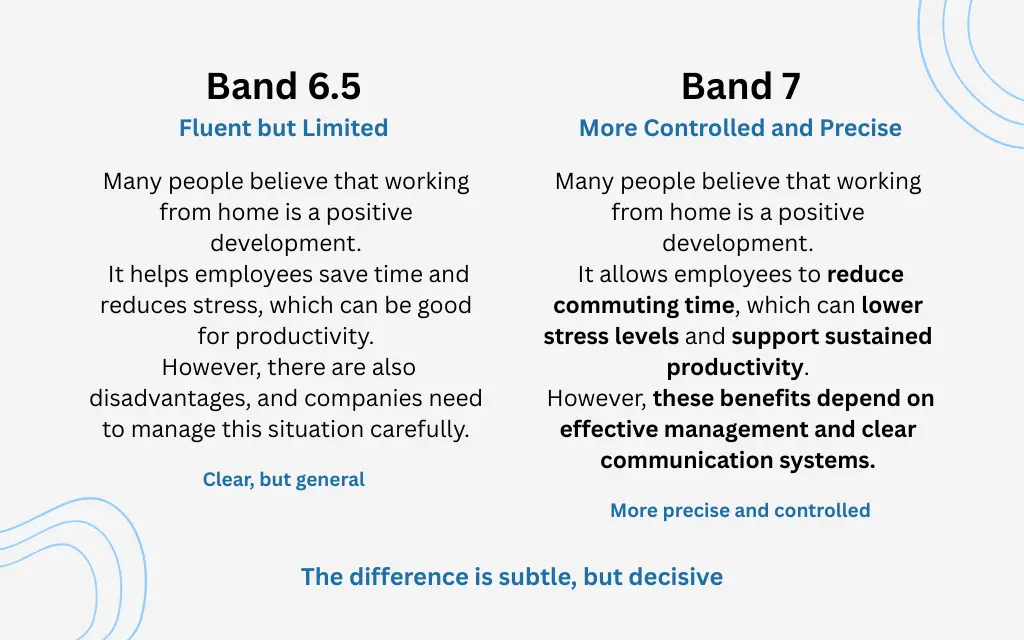
At this stage, writing often looks fluent. Sentences are mostly grammatical, ideas are relevant, and there are fewer obvious errors. However, the writing does not show the refinement needed for a higher band.
From an examiner’s perspective, this type of writing is stable but limited. It meets the requirements of a band, but it does not demonstrate the level of control needed to move beyond it.
Why more practice does not automatically lead to higher scores
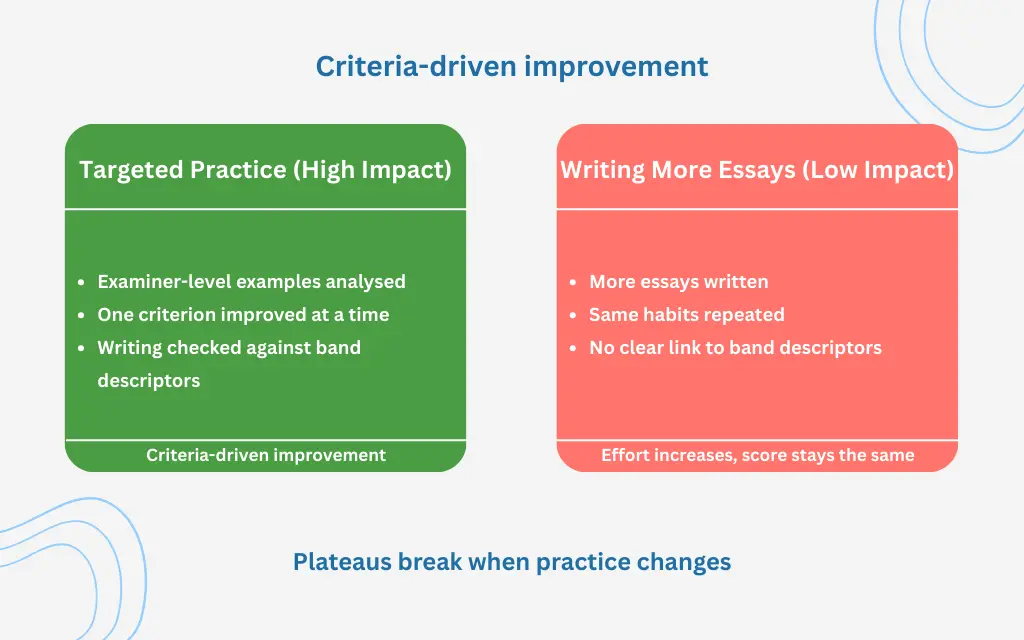
A common misunderstanding is the belief that writing more essays guarantees improvement. Practice is useful only when it is targeted.
Many candidates repeat the same habits. They plan essays in the same way, use familiar structures, and rely on the same vocabulary. This builds confidence, but it also reinforces existing limitations.
Examiners see this as consistency without development. The writing is predictable and safe, but it does not show progress.
The difference between improvement and score movement
Improvement and band score movement are not the same.
You can improve fluency, speed, and confidence without increasing your band score. Band score movement happens only when examiners see stronger performance in specific marking criteria.
This explains why candidates often feel confused or discouraged. The effort is genuine, but it is not aligned with how IELTS writing is assessed.
Understanding this difference is a key turning point.
Why Band 6 and 6.5 are the hardest to escape
Being stuck at Band 6 or 6.5 is extremely common.
At this level, writing is functional but inconsistent. Examiners typically notice that:
- ideas are relevant but not fully developed
- vocabulary is varied but not always accurate
- sentences are complex but sometimes unclear
These issues do not cause failure, but they prevent higher scores.
How examiner expectations change at higher bands
As band scores increase, examiner expectations change quietly.
At lower bands, examiners focus on whether meaning is clear. At higher bands, they expect precision and consistency. Language that was acceptable at Band 6 can feel careless at Band 7.
Many candidates continue using strategies that once worked, without realising the standard has shifted. This is a major reason IELTS band scores stop improving despite continued practice.
Common habits that keep scores stuck
Writing safely instead of clearly
Some candidates limit expression to avoid mistakes. They reuse familiar sentence structures and vocabulary to stay safe.
This reduces errors, but it also limits evidence of range and control. Examiners reward clarity and precision, not caution.
Memorising without adapting
Memorised phrases may sound impressive, but examiners quickly recognise when language does not fit the task.
Rather than helping, memorisation often freezes progress because it prevents genuine control.
Why feedback often fails to help
Many candidates receive feedback but see no improvement.
This usually happens when feedback is too general, focused on surface errors, or not linked to band descriptors. Comments such as “develop ideas more” are accurate, but unhelpful without examiner context.
Effective feedback must explain how examiners interpret the criteria, not just what looks wrong on the page.
The role of examiner perspective
Examiners do not read essays like teachers. They read quickly and look for patterns.
They ask whether the task is fully addressed, whether meaning is clear on first reading, and whether language is controlled or risky.
When the answers are mostly positive, the score stabilises. To move higher, those answers must be consistently strong.
Understanding this examiner mindset explains many IELTS plateaus.
Breaking through an IELTS plateau
Breaking a plateau requires changing how you practise, not practising more.
Stronger candidates focus on analysing examiner-level examples, improving one criterion at a time, and checking writing directly against band descriptors.
Conclusion
An IELTS band score not improving does not mean you lack ability. It usually means your practice is not aligned with examiner expectations.
Plateaus occur when writing becomes stable but not refined. The solution is not more effort, but more examiner-aware practice.
Related IELTS Examiner Insight Lessons
Glossary
Plateau (noun) — a stage where progress stops despite effort
Band score (noun) — the numerical result given in IELTS
Examiner (noun) — trained professional who marks IELTS writing
Control (noun) — consistent, accurate use of language
Descriptor (noun) — official description of band score criteria
Practice Questions
- True or False: Writing more essays always improves IELTS band scores.
- Multiple choice: What is the main issue at Band 6–6.5?
A) Lack of vocabulary
B) Lack of control
C) Poor handwriting - Short answer: Why do examiners value precision at higher bands?
- True or False: Memorised language usually helps break a plateau.
- Short answer: What kind of feedback is most useful for improvement?
Answers
- False
- B
- Because higher bands require consistent control
- False
- Examiner-aligned feedback
Join 1,300+ English learners
Get free English lessons, IELTS tips and useful vocabulary by email.
No spam. Just practical English you can use.